Unworkable Episode 1 – The Gig Economy — April 7, 2017

Unworkable Episode 1 – The Gig Economy

You can now listen to the new podcast from IWGB’s Emiliano Mellino!

The debut episode of “Unworkable” looks into the so-called “gig-economy”, with stories from Deliveroo riders fighting below minimum-wage pay in Brighton. There are also interviews with Leigh Day solicitor Annie Powell, who successfully challenged Uber at the employment tribunal, London School of Economics fellow Jamie Woodcock and University of Hertfordshire professor Ursula Huws.

Hosted and produced by Emiliano Mellino for the Independent Workers’ Union of Great Britain (IWGB).

More correspondence with UCLU — April 6, 2017

More correspondence with UCLU

Earlier this week, Danny wrote to UCLU to raise concerns about cuts affecting cleaners. He’s had an unsatisfactory response from Lynne Adam of UCLU, and responds below:

Dear Mr Millum,

I am responding to you myself as Ian Dancy is on leave at the moment.

UCLU strongly supports workers’ rights; we are proud to pay all of our staff the London Living Wage and we insist that our contractors match the generous terms and conditions we receive as staff of UCL. In this instance, we have worked hard with our contractor to ensure that there are no redundancies for the cleaning staff and only a reduction in the number of hours worked for some.

It is the very clear view of the Board of Trustees that it is appropriate to save our charitable money through not continuing to pay for cleaning that isn’t required. As a membership based organisation this decision is correct and puts our members at the heart of all of our decisions.

Some of the points in your email are not accurate, however many should be taken up with our contractor SecuraClean who directly deal with the cleaners affected by this decision.

I’m about to go away on holiday (from 6-20 April), so if you have any questions during my absence, don’t hesitate to contact Kris de Souza (copied in to this email).

Kind regards

Lynne

Danny responds:

Dear Lynne

Many thanks for getting back to me. However, in response I would note that:

  • It is disappointing that you are acting like any employer of an outsourcing company in passing the buck on SecuraClean when it is UCLU making the cuts.
  • You state that you are proud to pay the London Living Wage – given the unrefuted claims below that you are NOT doing so, will you cooperate with an independent investigation by the Living Wage Foundation?
  • It is not at all reassuring to be simply told that ‘some points in your email are inaccurate’; if this is the case, which points, and in what way?
  • It is also intriguing that unelected managers are able to put members at the heart of decisions while at the same time ignoring their democratic voice – members’ representative voted against these cuts, so you are essentially claiming that they are not to be trusted to make decisions in their own interest.
  • You have still provided no evidence that you are ‘over-paying’ – nor have you deigned to speak to any of the workers involved.

As a consequence our position remains the same. We fully support the UCLU cleaners in their campaign, and will back any actions they decide upon. We will also be circulating this to UCL staff.

Best wishes

Danny

El acceso a la justicia no es más un derecho laboral, sino un lujo —

El acceso a la justicia no es más un derecho laboral, sino un lujo

Below is a translation of Aditya Chakrabortty’s recent Guardian article on access to justice for workers.

El acceso a la justicia no es más un derecho laboral, sino un lujo
Chakrabortty.jpg

“Si no hubiera podido ir al tribunal, no creo que hubiera estado aquí hoy,” dice la limpiadora Liliana Almanza. “Si yo hubiera seguido así, no habría podido contar esta historia.”

Aditya Chakrabortty

La introducción de tarifas ha alejado los tribunales de empleo del alcance de muchas personas. El Supremo debe restaurar el equilibrio.

“Si no hubiera podido ir al tribunal, no creo que hubiera estado aquí hoy,” dice la limpiadora Liliana Almanza. “Si yo hubiera seguido así, no habría podido contar esta historia.”

Martes el 28 de marzo, 2017 06.00 BST

Las leyes que cuestan demasiado para ejecutar son leyes falsas. Un derecho civil que no está al alcance de la gente no es realmente ningún derecho. Y una sociedad que convierte la justicia en un artículo de lujo es una sociedad que no se ve más gobernada por la ley, sino por el dinero y el poder. Esta semana el tribual más alto del país va a decidir si Gran Bretaña se convertirá en tal sociedad. Hay abundantes signos que ya hemos ido demasiado lejos.

Escuchad al juez más destacado del país, Lord Thomas de Cwmgiedd, quien admite que “nuestro sistema de justicia ha pasado del alcance de la majoría.” Mirad nuestro sistema de asistencia jurídica, con su financiamiento cortado tan duramente por David Cameron y Theresa May que los pobres tienen que hacer de sus propios abogados litigantes, destinados a ser derribados por los abogados a sueldo de sus oponentes adinerados.

Siete jueces del Supremo oirán el caso más reciente, el cual enfrenta al gobierno contra el sindicato Unison. Será el colofón de una batalla legal cuatrienal centrado en uno de los derechos más fundamentales: el derecho de empleados a hacerles frente a sus jefes.

En 2013, Cameron despojó a trabajadores del derecho de acceso al sistema de tribunales de empleo. Sea una mujer embarazada que han expulsado de su trabajo, sea un hombre de origen bangladeshí que lucha contra el racismo en el trabajo, o un licenciado joven con discapacidades que sufre molestias por parte de su jefe, ahora todos tendrían que pagar £1.200 para tener la oportunidad de buscar reparaciones.

El número de casos que iban al tribunal cayó sin demora – en un 70% dentro de un año. El Citizens Advice Bureau (Atención al Ciudadano), unos abogados de empleo, y unos académicos prácticamente hicieron cola para advertir que la consecuencia sería que los trabajadores – y sobre todo los trabajadores pobres – encontrarían la justicia inasequible. Pero para los ministros conservadores, todo estaba bien. Unos portavoces leales tales como Matthew Hancock (el entonces Ministro de Empleo) sostenían que las personas disuadidas por las tarifas no eran nada más que oportunistas “inescrupulosos” que tenían el propósito de  “acosar a los jefes”. Siguiendo la lógica de Hancock, y habiendo escardado todas esas pérdidas de tiempo, uno esperaría ver aumentar el número de reclamaciones exitosas en los tribunales. De hecho, el número ha bajado.

En cada audiencia del caso de Unison, los jueces han terminado pidiendo ver a personas para quienes las tarifas han realmente representado una barrera para la justicia. Uno estaba seguro de que “si las estadísticas … se redujeran a unos casos individuales, unas situaciones se revelarían que mostrarían una incapacidad de ciertas personas de proceder ante un tribunal de empleo a causa de una falta de fondos.”

Si resultara que los jueces del Supremo quisieran la misma cosa, podrían conocer a Liliana Almanza. Encontrarían en ella un testigo convincente, aunque le resulte difícil estar sentada durante mucho tiempo debido a las tres hernias discales que tiene en la parte inferior de la espalda, las cuales le hacen sentir que esté arrastrando “una carga pesadísima”, provocándole dolores punzantes en las manos, en los hombros, y en el cuello. A veces ella sufre también de depresión severa y de ansiedad. El dolor físico y la enfermedad mental se alimentan el uno del otro.

Almanza ha trabajado de limpiadora en la Universidad de Londres desde el año 2011, y nunca ha escondido sus condiciones médicas de su empleador, una empresa de subcontratación que se llama Cofely. Entonces vino una supervisora nueva que, según Almanza, le tenía manía, amontonándole más trabajo encima de lo normal. Ella mandó a Almanza a la “planta de castigo” – realmente se trataba de tres plantas, las que normalmente limpiaban dos personas, pero ella tenía que hacer este trabajo a solas, y en poco tiempo. La aumentada carga de trabajo, sobre todo el manejar la aspiradora y la fregona, le causaba tanto dolor que a veces le mareaba. Sin embargo, dice Almanza que cuando se quejaba, la supervisora o se reía o le decía que cogiera una baja por enfermedad. Aunque esté requerido por ley, no hubo ningún ajuste por sus incapacidades.

Almanza, que es colombiana, recuerda como la supervisora le dijo que los latinoamericanos eran una banda de mendigos. En otras ocasiones, ella trataba de “perra” y “puta” a Almanza.

En sus peores días, Almanza andaba a la estación de Euston y se ponía en el mismísimo límite del andén. Esperaba a que viniera el metro. Luego ‘se encendía una luz’ y ella hacía un paso atrás.

Almanza hizo exactamente lo que querrían los ministros al hacer una queja formal vía los trámites internos de Cofely. Se la rechazó. Ella hizo una apelación y no oyó nada del tema durante meses. Por más desesperada que fuera su situación, no habría podido permitirse las tarifas de un tribunal. Algunas personas están exentas de las tarifas, pero Almanza y su marido – que son limpiadores los dos – aparentemente ganaban demasiado dinero para cumplir los requisitos de elegibilidad. La evaluación de medios económicos tampoco tiene en cuenta los costes de vida, a pesar de que, después de alquilar una habitación individual en una casa compartida en Londres (anteriormente una casa consistorial), y de pagar las facturas, no tienen casi ningún dinero a fin de mes.

Su sindicato, el minúsculo Independent Workers of Great Britain (IWGB), contribuyó algún dinero para ir al tribunal, y ayudó a financiar colectivamente el resto del dinero. Tan pronto como Almanza lo hizo, recuerda que su empleador hizo varios ajustes y alivió su carga de trabajo.

Yo me puse en contacto con Engie – así se ha renombrado Cofely – para obtener su respuesta a los cargos de Almanza. En una parte de su declaración dicen: “No toleramos la discriminación en el trabajo y cualquier reclamación … se investiga completamente. Después de una investigación extensa de los alegatos contra Cofely Workplace, se denegó todas las reclamaciones y el tribunal descargó oficialmente a Cofely de los procedimientos judiciales el 24 de mayo 2016.” Los documentos del tribunal demuestran que realmente Cofely fue descargada porque otra empresa se había quedado a cargo del contrato, la cual también llegó a un acuerdo con Almanza.

Sin donativos y los escasos recursos del IWGB, Almanza no habría podido presentar una reclamación. Si ella pudiera testificar en el Supremo, ¿qué diría? “Les diría a los jueces que si yo no hubiera podido ir al tribunal, creo que no estaría aquí hoy. Si yo hubiera seguido así, no habría podido contar esta historia. Quizás parezca una exageración, o una película. Pero es una cosa hablar de eso, y otra cosa vivirlo.”

Deliveroo are confusing themselves —

Deliveroo are confusing themselves

Deliveroo argue that they don’t have any employees or workers, just ‘independent suppliers’ – but their own contracts and instructions make it clear that they do. Here’s a quick roundup of news articles covering IWGB’s fight for Deliveroo workers’ rights:

http://www.itv.com/news/2017-04-05/revealed-the-lengths-deliveroo-goes-to-to-ensure-drivers-are-not-employees/

https://www.ft.com/content/9ad4f936-1a26-11e7-bcac-6d03d067f81f

https://www.theguardian.com/business/2017/apr/05/deliveroo-couriers-employees-managers

Support the IWGB Security Officers strike at the University of London —

Support the IWGB Security Officers strike at the University of London

We’ve just launched our Crowdpac campaign – you can find out more and donate here: https://www.crowdpac.co.uk/campaigns/1870/the-independent-workers-union-of-great-britain

qbm2tqbrcyvtjxlhe3kd.jpg

Why you should support the Independent Workers Union of Great Britain

Security officers at the University of London are fighting back against zero-hours contracts and pay cuts!

The University of London’s security officers will be striking for the first time ever in the next few weeks.

Security staff work long shifts, round the clock, and are here to help every day of the year: bank holidays, University closure days, even Christmas day.

They’re friendly, professional, and highly qualified. They support and protect staff and students alike in these uncertain times.

Why are they striking?

Their demands are simple:

1. No zero-hours contracts

2. Proper payslips for everyone

3. The University of London to honour its promises on pay

The University of London promised when it introduced the London Living Wage that it would maintain pay differentials.

It has completely failed to keep that promise, with the result that since 2011 security officers have seen their relative pay decline by a massive 25%

Security officers tried to resolve this by writing a petition letter to ask for the difference to be reinstated, then organised a group meeting with their managers.

The response? There will be no pay rise, and security officers’ holidays for the next two months, even ones that have been pre-booked, are being cancelled!

IWGB ran a ballot for strike among its members – the result was 100% in favour of taking strike action.

The strike will take place in the next few weeks – but every day of strike means money lost for these already low-paid workers.

Donating to the strike fund will help us compensate workers – and make it more likely that the strike will succeed!

https://www.crowdpac.co.uk/campaigns/1870/the-independent-workers-union-of-great-britain

SOS: Support Our Security! — April 5, 2017

SOS: Support Our Security!

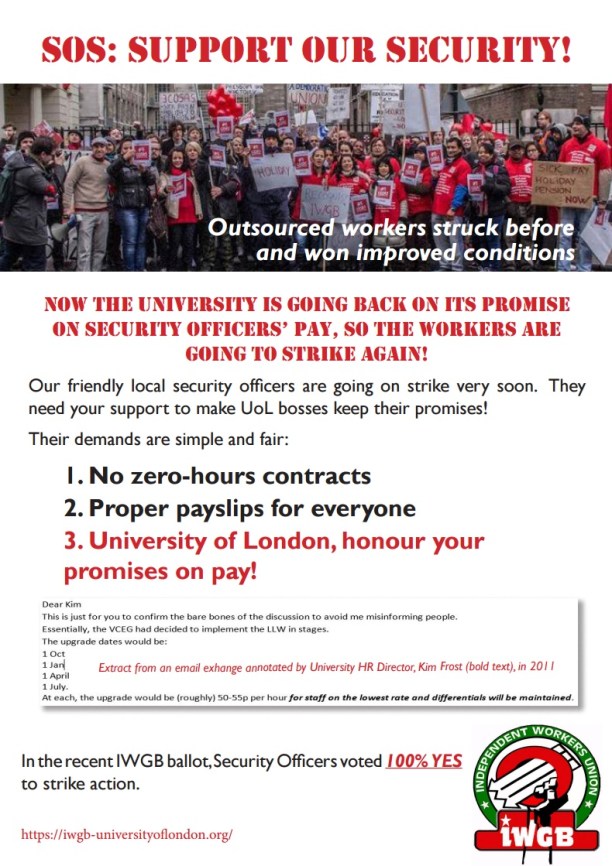
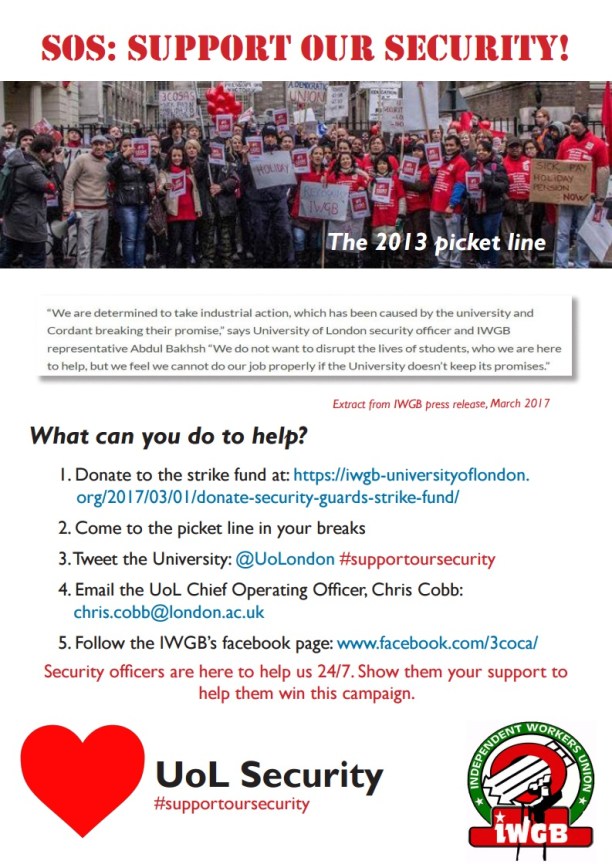
With a successful ballot under our belts, we’re planning strike action. Here’s a flyer explaining the reasons for the campaign and what you can do to help.

Please also see, share and donate to our new Crowdpac strike fundraiser – https://www.crowdpac.co.uk/campaigns/1870/the-independent-workers-union-of-great-britain

You can download the flyer as a PDF here: https://iwgb-universityoflondon.org/wp-content/uploads/2017/04/security-strike-flyer2.pdf

Flyer1.jpg

Flyer2.jpg

Unworkable – a podcast on the hidden side of work —
IWGB writes to UCL —

IWGB writes to UCL

IWGB’s Danny Millum has written to UCL to discuss the planned cuts affecting cleaners at UCLU:

Dear Mr Dancy

I am writing on behalf of the Independent Workers Union of Great Britain (IWGB) with regard to the planned cuts affecting cleaners at UCLU.

The IWGB completely supports the cleaners’ campaign against these cuts, which are both unjustified in themselves and have been implemented in a fashion contrary to UCLU’s constitution.

Despite previous commitments by UCLU in which it has stated its support for workers’ rights (specifically campaigning for better conditions and pay for cleaners) it appears that:

  • the main justification for these cuts are unsubstantiated lower quotes from competing cleaning companies
  • when it was discovered that management was planning these cuts the student council of representatives voted that they should not go ahead – but last week overruled by the board of trustees, a body containing unelected members
  • at no point has UCLU management cited talks with workers’ union representatives. Instead reference has been made to talks with the company and it seems likely no direct contact between UCLU and CAIWU (the workers’ union) has taken place
  • there has been no solid evidence presented to say that UCLU is overcharged by Secura Clean
  • no-one seems to have spoken to the workers – who can say for sure if the work they are doing could indeed be squeezed – even the management doesn’t seem to know for sure how these hours can be reduced, beyond anecdotal evidence
  • management is thus bringing UCLU into disrepute by breaking UCLU’s fundamental principles of democracy and ethical conduct (see UCLU’s Articles of Association which reads that “The Union is a democratic institution” and that it will “fulfil its objects in a socially and environmentally responsible manner”)
  • management in addition has failed to listen to its members (hundreds of whom have signed a petition calling on the cuts to stop)
  • furthermore it now appears that UCLU may be breaching its commitments as a London Living Wage employer

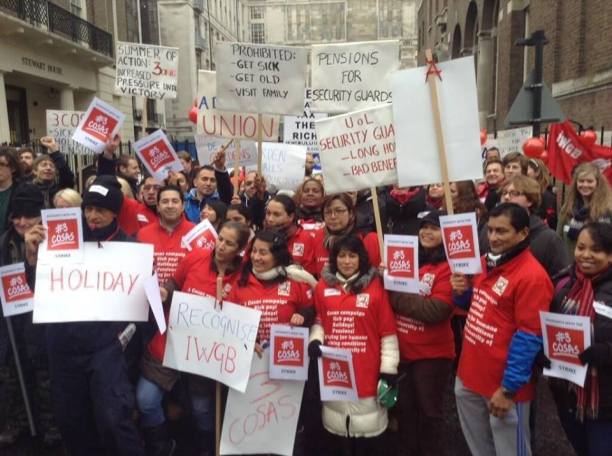
The IWGB would like to make it clear that it will be supporting wholeheartedly the cleaners’ campaign to correct these injustices. This may well manifest itself it strikes and demonstrations such as those seen as part of the 3 Cosas Campaign at Senate House – the video here should give you some indication of what is involved.

UCLU helped support and fund the IWGB when we found ourselves homeless shortly after this campaign – it is a sad irony indeed that it should now be on the side of those exploiting the most vulnerable in our society.

UCLU faces a straightforward choice – treat its workers with the dignity and respect that it pays lip service to, or see massive reputational damage and a prolonged and disruptive campaign which can only discredit the organisation itself.

Let’s hope they choose the former – if not, la lucha continua!

Best wishes

Danny

A potted history of 3 Cosas — March 31, 2017

A potted history of 3 Cosas

Verso Books have published a new collection of essays by Stefan Collini, on the neoliberalisation of the university, and to promote the book, they invited a number of people to write for their blog. I’ve written a short account of the 3 Cosas campaign, with a little bit about our recent activities – you can find it here alongside articles by Will Davies and Emma Dowling: http://www.versobooks.com/blogs/3149-the-future-of-our-universities-part-1