End Precarious Labour! Demonstrate against Uber / support UoL outsoruced workers, 27 September — August 14, 2017

End Precarious Labour! Demonstrate against Uber / support UoL outsoruced workers, 27 September

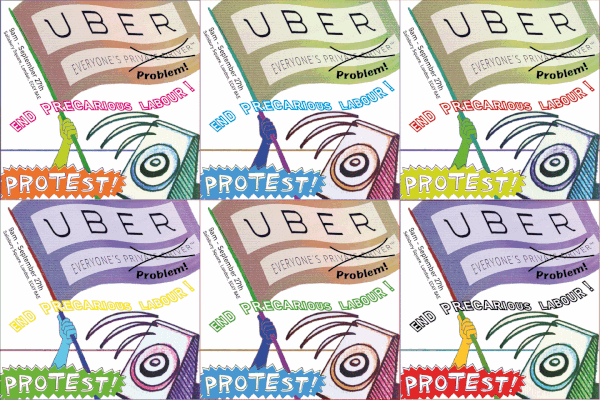
The IWGB is planning a big precarious labour bonanza march through central London in September!

On the 27th of September Uber will be appealing last year’s Employment Tribunal decision which awarded ‘worker’ status to Uber drivers. The lead claimants in this case are members of the IWGB. We are going to march through central London to the Employment Appeal Tribunal in support of our members and all Uber drivers, and to show ‘gig economy’ bosses, the courts and the British public that we will not lie down as our employment rights are taken away!

On the same day at the University of London security officers, porters and postroom staff will be staging their next strike action – and the march will culminate back on the picket line at the University!

Expect music, dancing, shouting, banners, workers and supporters.

All forms of precarious labour – Deliveroo drivers, outsourced cleaners, researchers, those on zero-hour contracts, foster carers – are invited to come out and unite for Precarious Labour Strikes Back!

A recent report estimated that up to 10 million Britons are in insecure work. The way that ‘gig economy’ companies like Uber and Deliveroo withold employment rights from their workers is only one part of this. More and more of us find ourselves with little to no employment protections and lower real wages: uniting behind Uber drivers is a way of strengthening the fight back!

Facebook event here

Download the flyer here [PDF]

A sponsored walk for the IWGB Legal Department —

A sponsored walk for the IWGB Legal Department

A group from the IWGB are going to be walking the Thames on the 28th of October to raise funds for the IWGB legal department. This event is part of the London Legal Support Trust’s (LLST) Thames Walk which takes place on the 28th of October 2017. Last year, organising at the last minute, an IWGB team of five walkers managed to raise £3,000 in sponsorship for our legal centre. This year we can raise more!

We want more members to sign up for the walk, and/or sponsor us. We’ve set up a Virgin Giving page (for which LLST handles all the administration and charges no fee) and all the money raised goes back to the IWGB legal centre.

http://uk.virginmoneygiving.com/fundraiser-web/fundraiser/showFundraiserProfilePage.action?userUrl=IWGBUnionWTT17&isTeam=true.

You can pledge money there, and there are also paper sponsorship forms available.

If you would like to take part in the walk, then write to Joe Trapido, (joetrapido@iwgb.org.uk). If you want paper sponsorship forms I can get them for you as well (though it is easier for you to use the Virgin Giving page as it will collect the money automatically after the walk). You can walk or cycle and you can do the full 26 miles or you can do half the distance, starting in the morning at London Bridge or in the afternoon at Putney.

Please get all your friends, family, workmates, rich people you happen to know, etc. to give money, and please share the link on Facebook, Snapchat, etc.

Why the legal department?

The IWGB has a very effective legal department, and we devote far more man hours to defending members’ rights than a normal trade union. But this costs money and we regularly fundraise to make sure it can keep going. The department has two main roles – to handle the day-to-day problems that members have, especially related to disciplinary and grievance procedures, and to bring cases to court where this is necessary. The IWGB has won a series of important victories in the courts for our members, and all of this was based on the work of the legal department.

This helps you as a member because the legal department will fight for you in the most determined and professional way possible, if you have a problem. But it also helps because management learns quickly that you don’t mess with our legal department, so in the workplaces where they have made their mark, the casual forms of employer abuse that were once common disappear.

We do this as cheaply as possible (ask to see our accounts if you are in any doubt) but it does cost money! The legal department has office costs, and salary costs, and we urgently need to fund the position of a translator. So sign up, give us money, and tell the world about the sponsored Thames walk…

Keeping the lifeline going: The ESOL classes need your help —

Keeping the lifeline going: The ESOL classes need your help

Since its beginnings the IWGB has been offering English classes to its members. The interest in these courses has shown how vital it is for immigrants to get this kind of support, as it helps them increase their confidence and gives them the tools to navigate their daily lives in London.

In July 2016 the IWGB received private funding which allowed the union to start the Sadiq Scholarship Fund, and with that support we started the organisation of fully funded English for Speakers of Other Languages (ESOL) classes. Since then, the course has been run by professional teachers and with no more than four students per class. The course has proved to be a big success, taking students from E1 level to E2 in less than a year.

As we move forward, IWGB is committed to the continuation and ongoing development of these classes. However, this past June was the last month the union received the private funding that allowed for the classes to be organised. Now we need your help to be able to keep providing these classes. We hope to raise funding not only to continue the current course at E2, but to also add an additional E1 course running in tandem, so that we can cater for a larger proportion of our members.

As Maya Refaat, one of the teachers and administrators of the programme has stated, “ESOL classes provide much more than a chance to learn English: they are a lifeline; a gateway to integrate into a new community, make new friends and combat loneliness, improve confidence and set sights on ambitions never before conceived to be possible.”

Please go to https://www.fundsurfer.com/crowdfund/english-for-speakers-of-other-languages-esol-classes-at-iwgb and donate whatever you can, so that we can keep the lifeline going.

UCU votes to accept low pay offer of 1.7% — August 2, 2017

UCU votes to accept low pay offer of 1.7%

In a very disappointing development, UCU members have voted to accept UCEA’s pay offer of 1.7%. This offer is substantially below inflation, and represents a real-terms pay cut, for yet another year. In June, inflation stood at 2.9%.

Turnout was 48.6%. 64.6% of members voted to accept the offer, and 51.4% of members voted that they would not be prepared to take industrial action.

You can view the full report on the vote on the UCU’s site.

The IWGB has consistently argued for negotiating position based on a starting offer of at least 5% – which is still considerably below what staff would be receiving had pay risen in line with inflation. If you’ve got any questions about the UCEA negotiations or next steps, please get in touch.

Supreme Court finds employment tribunal fees discriminatory —

Supreme Court finds employment tribunal fees discriminatory

Last week, the Supreme Court found that employment tribunal fees were discriminatory and unlawful. As a result of this ruling, the IWGB will be seeking back the thousands of pounds in fees that it has paid on behalf of its members. Our press release is below:

The Independent Workers’ Union of Great Britain (IWGB), the leading trade union for workers in the so-called “gig economy”, welcomes the Supreme Court’s unanimous decision stating that employment tribunal fees are in breach of British and EU laws.

The case was brought by public sector trade union Unison, with the IWGB and the Equality and Human Rights Commission (EHRC) intervening.

The seven-judge panel found that the fees were discriminatory against women and other groups protected by the equality act.

The IWGB welcomes today’s momentous decision. We have forked out a fortune on employment tribunal fees for our low-paid members who otherwise would not have been able to argue their cases,” said IWGB General Secretary Dr Jason Moyer-Lee. “Given the near total absence of government enforcement of employment law and the government’s refusal to get serious about addressing insecure work, today’s decision is a game changer. This is what justice looks like.”

The IWGB believed that it was vital that it intervene in this case in order to support the interests of its mostly low-paid members – including “gig economy” workers and cleaners – which are some of the groups that are most in need of the protection of the courts.

The elimination of employment tribunal fees is one of three policy proposals that the IWGB has been lobbying for to address the issues surrounding precarity in the so-called “gig economy”. The other two are government enforcement of employment law and an enhanced “worker” status, that would give self-employed workers the same rights as employees.

There are currently three employment statuses in the UK: Independent contractors, workers and employees.

The government previously said that it would pay back all fees paid since they were introduced in 2013, if the Supreme Court deemed them to be illegal. The IWGB will be seeking back the thousands of pounds in fees that it has paid on behalf of its members.

The IWGB has won a number of test cases before employment tribunals, including Dewhurst v CitySprint and Boxer v Excel. Other companies including The Doctors Laboratory and eCourier, voluntarily admitted that they were unlawfully classifying their workers as independent contractors, following legal action brought by the IWGB.

The IWGB is awaiting decisions on other landmark cases against Deliveroo and Addison Lee.

Over the years the union has also brought a number of discrimination, unfair dismissal and unlawful deduction of wages claims on behalf of its many migrant worker members.

IWGB wins against Addison Lee —

IWGB wins against Addison Lee

In a week of victories, the Independent Workers’ Union of Great Britain (IWGB) has won an employment status case against Addison Lee at the London Central Employment tribunal, which ruled that the company was unlawfully classifying a courier as an independent contractor.

The tribunal ruled that Christopher Gascoigne was in fact a worker and consequently entitled to holiday pay and the national minimum wage. The amount of holiday pay owed by the company to Gascoigne will be determined in a later hearing.

Workers, as opposed to independent contractors, are entitled to holiday pay, guaranteed minimum wage and protection against discrimination. Employees have further rights to sick pay and protection against unfair dismissal.

This decision is the last one relating to a slew of employment status cases brought simultaneously last year by the IWGB against four courier companies – CitySprint, Excel, eCourier and Addison Lee. In all four cases the judge ruled or the company admitted that the couriers were in fact workers and not independent contractors.

You can read more here:

https://iwgb.org.uk/2017/08/02/iwgb-wins-employment-status-case-against-addison-lee/

UoL branch appoints part-time organiser! —

UoL branch appoints part-time organiser!

We’re delighted to announce that we’ve appointed Emiliano Mellino as a part-time organiser for the UoL branch. Emiliano started off volunteering with the IWGB as a translator, and for the last few months has been press officer for the union as a whole. You’ve probably heard his work in the form of the Unworkable podcasts (Episodes one and two are online now). He’s brought considerable skills from the world of financial journalism to work in the service of good!

IMG_20170425_084439

Emiliano is fluent in both English and Spanish, and he’ll be working on security officers’campaign as well as organising cleaners’ meetings and support, three days a week. Having the ability to fund a post is a big step forward for the branch, and we’re looking forward to pushing on with campaigns!

IWGB contacts HSE regarding asbestos issues —

IWGB contacts HSE regarding asbestos issues

The IWGB has notified the Health and Safety Executive of a number of breaches in the Control of Asbestos Regulations at the University of London. We will keep you informed of any further developments – if you’ve got any concerns about asbestos, please contact Danny.

In November 2016 maintenance staff were informed that asbestos had been discovered in various locations across the University of London estate which had previously been declared asbestos-free.

Over the last eight months the following breaches have become clear:

  1. No asbestos management plan

Under regulation 4 of CAR 2012 the dutyholder is required to: 

  • prepare a plan that sets out in detail how the risks from these materials will be managed
  • take the necessary steps to put the plan into action
  • periodically review and monitor the plan and the arrangements to act on it so that the plan remains relevant and up-to-date

A copy of the plan was repeatedly requested by staff and unions. Eventually in an email dated 2 June 2017 University Secretary Kim Frost stated:

The University’s Asbestos Management Plan is currently in the process of being updated.  Once updated, this version will be available on the intranet and shared with Bouygues. 

No such plan can be found on the intranet. There appears to have been no asbestos management plan since the departure of the previous asbestos manager in 2010.

  1. No records of non-licenced work

CAR 2012 states that: written records should be kept of non-licensed work, which has to be notified eg copy of the notification with a list of workers on the job, plus the level of likely exposure of those workers to asbestos.

No records of this sort exist, despite work of this sort being performed on a regular basis both up to November 2016 and subsequently.

There are examples too numerous to recount, but for instance, at Nutford House, a student hall of residence, a 2016 refurbishment discovered:

asbestos in the boiler room and various wall and roof voids.  This contamination was the result of discarded asbestos fibre pipe lagging & debris found on the floor of attic from years ago. This roof space houses all the cold water storage tanks, old heating pipes, hot & cold water pipes and before the refurbishment, the expansion tank from the old boiler system.

Over the course of the year the handymen and engineers, are required to make numerous inspections and repairs to storage tanks, pipes and valves etc.in the roof spaces.

Prior to these last works, according to the asbestos register, the last time inspection & removal had taken place in Nutford House was in 2002.

Thus non-licensed and notifiable non-licenced work had been going on here between 2002 and 2016 without records being kept, training being provided, asbestos plans being followed or staff even being aware of any risk.

  1. No surveillance by doctor

CAR 2012 states that: all workers/self employed doing notifiable non-licensed work with asbestos must be under health surveillance by a Doctor.

Notifiable non-licensed work has been performed on numerous occasions (eg involving asbestos insulation, drilling holes etc). No member of staff is under surveillance by a doctor.

  1. No mandatory training

CAR 2012 states that: Training is mandatory for anyone liable to be exposed to asbestos fibres at work

While post-November 2016 some cursory training was provided for maintenance staff, prior to this these staff had been working without training whilst exposed to asbestos fibres. IN addition non-maintenance staff have received no training at all.

  1. Information on location and condition of the materials not provided

Under regulation 4 of CAR 2012 the dutyholder is required to:

provide information on the location and condition of the materials to anyone who is liable to work on or disturb them

Prior to November 2016 this had not been done at all. Subsequent to this a series of reports have been produced, but these (despite numerous complaints) have been incomplete and have failed to cover areas which clearly contain asbestos.

One example is the Student Central building, whose most recent report in May 2017 omits a series of areas containing asbestos for which staff have provided photographic evidence (there are many other such examples).

  1. Continued use of previous failed contractor

Previous asbestos surveys by the RPS Group at the University of London had declared the site to be safe. In November 2016 it turned out that that these surveys were inaccurate.

Rather than take legal action, the University of London has re-employed RPS to carry out the current works.

IWGB in huge victory for foster care workers! —

IWGB in huge victory for foster care workers!

The Independent Workers Union of Great Britain (IWGB) has won a landmark employee status case and the first case the union is aware of of foster care workers being recognised as employees by a UK tribunal.

Following a preliminary hearing in June, the Glasgow Employment tribunal ruled today that the level of control and mutuality of obligations meant that James and Christine Johnstone were clearly employees. It also found that the council was enforcing contractual obligations by their “no work, no pay” policy.

This marks a massive step forward for the rights of this group of workers that look after some of the most vulnerable children in our society.

You can read our full report on the main IWGB site:

https://iwgb.org.uk/2017/08/02/first-case-of-uk-employment-tribunal-recognising-foster-care-workers-as-employees/