Opportunity – new post of University of London IWGB ‘women’s officer’ — July 27, 2018

Opportunity – new post of University of London IWGB ‘women’s officer’

womenAt next week’s branch meeting we’ll be voting on an exciting proposal – to create a new post of ‘women’s officer’ for our local branch.

As women’s officer you would:

  • Support and encourage women members to take an active role in the branch
  • Work closely with the national women’s officer on campaigns affecting branch members
  • Form connections with other women’s groups to promote solidarity
  • Be point of contact for campaigns and issues affecting women members in particular

As well as anything else you want to bring to the role!

Contact Catherine Morrissey (catherinemorrissey@iwgb.co.uk) for details.

We’re looking to build on the success of the fantastic 10 July IWGB Leading Women event, which highlighted the discrimination that outsourced women at the University of London face, and featured a fantastic line-up of speakers:

Mildred – LSE cleaners/UVW

Catherine Mayer – women’s equality party

Ayesha Hazarika – comedian/former labour adviser

Liliana Almanza – UoL cleaner/IWGB

Councillor Bélgica Guanía – 1st Ecuadorean councillor in U.K. – lab (newham))

Nilufer – activist in TGI Fridays campaign

Marta Luna Marroquín – retired cleaner & veteran of 3 cosas campaign at uol / IWGB

Lucia Zapata – general secretary of Socialist Youth, Uruguay

Meg Brown – Chair, Couriers & Logistics branch IWGB

lw2

Details on the SOAS in-house transfer — July 20, 2018

Details on the SOAS in-house transfer

At a recent FM Services meeting at Senate House, Chris Cobb, the University of London’s chief operating officer, attempted to play down SOAS’s plans to bring their outsourced workers back in-house by 1 September. Below Danny Millum, the IWGB’s branch secretary, responded to his claims that the SOAS situation does not compare to that of the University of London.

Dear Chris

Following last week’s FM Services meeting, I just wanted to clarify a couple of issues that were raised relating to the SOAS in-house process.

Firstly, I can confirm that this is proceeding as planned, and will be completed on the planned date of 1 September 2018. The relevant documents are attached, and I think it’s very clear from these what a straightforward process this is. Secondly, you stated in the meeting that the University of London was 4 times bigger than SOAS. However, I have had it confirmed that the SOAS transfer will involve 160-170 employees, and at the University we are probably talking about around 300, so I think it’s important to be clear that the difference between the two cases is much less than was claimed.

Thirdly, it is worth noting that prior to their in-house announcement SOAS was occupied for weeks and had been subject to endless protests and bad publicity. Since Baroness Amos made her clear announcement they have had a year without problems and controversy.

I hope this clearly shows that SOAS provides a straightforward model that the UoL could and should adopt tomorrow, which would be benefit workers and University alike.

Best wishes

Danny

Danny Millum
Branch Secretary
University of London IWGB


University of London’s outsourcing manager under fire for racist Facebook posts — July 10, 2018

University of London’s outsourcing manager under fire for racist Facebook posts

IWGB’s general secretary demand immediate action over racist and far-right posts by Cordant manager who oversees two of the University of London’s five outsourcing contracts

Dear Chris Cobb,

I am writing to you, in my capacity of General Secretary of the Independent Workers’ Union of Great Britain (IWGB), to express my grave dismay at the fact that the person you have chosen to oversee your outsourced contracts is openly xenophobic and racist.

The person in question is a Cordant manager who oversees two of your five outsourcing contracts, in particular with respect to cleaners, porters, security guards, receptionists, and postroom staff. As you are well aware, the overwhelming majority of these workers are migrants.

The matter has come to my attention as his Facebook page, which is accessible to the public and has been seen by various of the outsourced workers he oversees, is replete with anti-immigrant, xenophobic, racist, and race-baiting posts.

I suggest you give it a look yourself, but to see just a small taste on what is on offer, the below suffices: an homage to Enoch Powell, a joke about how immigrants in the UK are benefits scroungers, and a joke about how Polish people are cleaners. For good measure he also wants fascists to have free reign to propagate their hate (see post about Tommy Robinson).

Now for some time we have been making the case that outsourcing, at least the way you do it, is inherently discriminatory. You have a predominantly BAME and migrant workforce which work on far inferior pay, terms and conditions, and treatment compared to their predominantly white British directly employed colleagues. And our members certainly feel as though they are bearing the brunt of the discriminatory policy.  But these recent revelations take the matter to a whole new level.

For now, in addition to working under inferior terms and conditions, the workers are being supervised by someone who thinks they shouldn’t even be here in the first place. Given some of the hostile interactions some of the workers have had with Lee Smith, including on one occasion Lee Smith aggressively pushing and shoving one of our members, needless to say, some of our members are deeply unsettled.

Of course, there are also serious legal issues which you need to consider, such as the University’s Public Sector Equality Duty pursuant to the Equality Act 2010.

Now your usual tactic is to place the blame for all things outsourcing on the contractors themselves. Not this time. You and only you chose Cordant for your contracts. No one else made that decision except the University of London. This is your responsibility. I want to know what you’re going to do about it, and I want to know now.

Kind regards,

Dr Jason Moyer-Lee
General Secretary
IWGB


Birkbeck Justice for Workers Campaign Update #2 —

Birkbeck Justice for Workers Campaign Update #2

Below, is an extract from a letter from Birkbeck Justice for Workers, which provides an update on its campaign to bring Birkbeck, University of London’s cleaning, catering and security staff back in house. They also share a letter in solidarity received from the South Africa’s Outsourcing Must Fall movement.

Dear all,

Our campaign is gathering pace. We have over 450 signatures on our petition – we’d love to get that to 500, so please keep sharing with your friends and colleagues. Birkbeck UNISON are having positive negotiations with management and we know the weight of support for our campaign is strengthening our hand. We have also received a heart-warming message of solidarity from the Outsourcing Must Fall movement in South Africa – you can read that below.

The message of solidarity mentions fighting unions. We’d like to thank the University of London IWGB for joining us at our demonstration last month.

Best wishes

Birkbeck Justice for Workers


Solidarity from #OutsourcingMustFall Campaign, South Africa

We write to you in solidarity with your struggle for the insourcing of workers at Birkbeck College. Our struggle against outsourcing received national prominence during the student protest against fee increases in 2015 when insourcing of workers was included as part of #FeesMustFall movement’s demands. The solidarity from students raised the profile of our struggle against poor working conditions and wages we had endured since our universities introduced outsourcing of what it called, ‘non-core functions’ in the late 1990s.

Although outsourcing is commended as ‘cost effective’, ‘efficient’, ‘productive and strategic’, it has been shown through a cost accounting analysis based on the experience of the University of the Witwatersrand in South Africa, that it results in increased ‘transaction costs’. These include cost creep from an increase in complaints and worker unrest, the loss of coordination efficiencies and of tacit skills and organisational memory (Adler et al., 2000, in Dumba, 2014).  The combination of these elements have shown the opposite of organisational efficiencies claimed to justify outsourcing.

Notwithstanding the victories scored to be insourced at some of the institutions in South Africa, there is still a long road ahead against outsourcing in our country. Not only are many higher education institutions still using workers from outsourced companies, the #OMF  has had to extend its campaign to include the whole of the public sector where cleaning, security, catering and landscaping services have been outsourced at local, provincial and national government level including parastatals.

We have combined different tactics of protests such as pickets, occupations and strikes to make our voices heard. We have also approached political parties to pass motions against outsourcing in the Legislature but we have yet to see results from this approach.

While we have worked with a union, and many members of #OMF have subsequently joined this union, we have had to fight on two fronts, of the union and #OMF campaign. The latter has proven to be much more flexible to respond to the immediate concerns of workers. We are also of the view that our campaign has the potential to revive and rebuild fighting unions in the process of struggling to ensure outsourcing does fall.

We wish you all the success with your struggle against outsourcing at Birkbeck College.

Yours in solidarity

#OMF Co-ordinating Committee Convenor

Executive Mukhwevho


IWGB training and workshops – Talleres de capacitacion y entrenamiento — July 8, 2018

IWGB training and workshops – Talleres de capacitacion y entrenamiento

The IWGB is organising two training and workshop events on Saturday 21 July (10.30am–4.30pm) for English speakers, and the second on Saturday 28 July (10.30am–4.30pm) for Spanish speakers.

This will take place at the Institute of Advance and Legal and Studies (IALS), room; Council Chamber at 17 Russell Square, London WC1B 5DR.

This training and workshop will be an opportunity for you to learn essential organising skills and get informed about latest important policies such as data protection and employment rights, so it is important that you attend the whole session in order to make the most of your learning.

The workshop will feature the following topics:

  • Campaigning and recruitment
  • Union structures
  • Media training
  • Data protection
  • Employment Law:  main speaker, Nicola Countouris (UCL professor of labour law and European law).

The event is open for union officials, representatives, volunteers and case workers who will need to confirm attendance by the 10 July 2018 in order to book a place by sending me an email to henrychangolopez@iwgb.co.uk or a text to: 07922810798.

 Please confirm your attendance as soon as possible as lunch will be provided!

Finally, please note that the Employment law session which will run from 3–4.30pm  is open to all members and non-members so it would be great if you could advertise this widely .

Many thanks

ESPANOL

El sindicato IWGB esta organizando dos eventos de talleres de entrenamiento y capacitacion, el primero el sábado 21 de julio de (10.30am–4.30pm) para los que hablan Ingles y el Segundo el dia sábado 28 de Julio para hispano hablantes. 

Este tendrá lugar en el Institute of Advance and Legal and Studies (IALS), salon; Council Chamber en 17 Russell Square, Londres WC1B 5DR.

Esta capacitación y taller será una oportunidad para que aprenda habilidades organizativas esenciales y se informe sobre las últimas políticas importantes, como la protección de datos y los derechos laborales, por lo que es importante que asista a toda la sesión para aprovechar al máximo su aprendizaje.

El taller presentará los siguientes temas:

  • Campaña y reclutamiento
    • Estructuras del sindicato
    • Entrenamiento de cómo hablar con medios comunicación
    • Protección de Datos
    • Leyes laborales:

El evento está abierto para oficiales del sindicato, representantes, voluntarios y asistentes de casos quienes deberán confirmar su asistencia antes del 10 de julio de 2018 para reservar un puesto enviando un correo electrónico a:henrychangolopez@iwgb.co.uk o un mensaje al: 07922810798

Por favor, confirme su asistencia tan pronto sea posible ya que se proporcionará el almuerzo!

Finalmente, la secion de Leyes Laborales la cual es de 3-4:30pm esta abierta para todos los miembros y no miembros asi que seria importante que lo publiciten con todo el publico.

Muchas gracias

Henry Chango Lopez
President
IWGB

http://iwgb.org.uk/


Protest! Support women fighting to end outsourcing at the University of London — July 4, 2018

Protest! Support women fighting to end outsourcing at the University of London

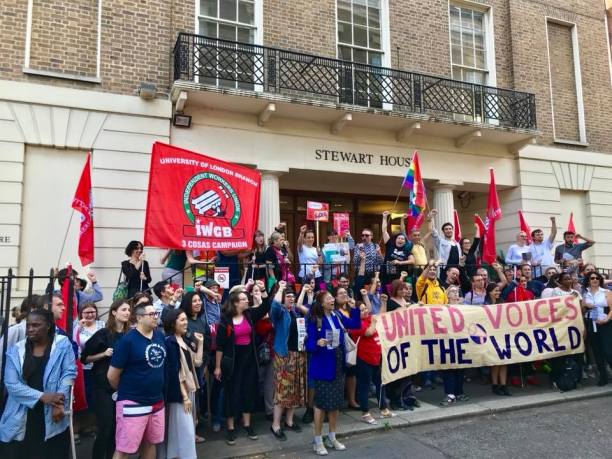
Outsourced women workers and their colleagues at the University of London (UoL) will be protesting for equal rights with direct employees.

The protest on 10 July outside Senate House will highlight UoL’s hypocrisy as it holds events nominally in favour of women’s rights, while denying decent terms and conditions to migrant and black, Asian and minority ethnic (BAME) women.

It will coincide with the university’s ‘Breaking the Silence: Women, Leadership, and #MeToo’, event with speakers including Catherine Mayer, founder of the Women’s Equality Party, and is part of its #LeadingWomen season, which aims ‘to break down the barriers women still face in education and the workplace today’.

IWGB supports call to repeal anti-union laws, establish strong right to strike — July 2, 2018

IWGB supports call to repeal anti-union laws, establish strong right to strike

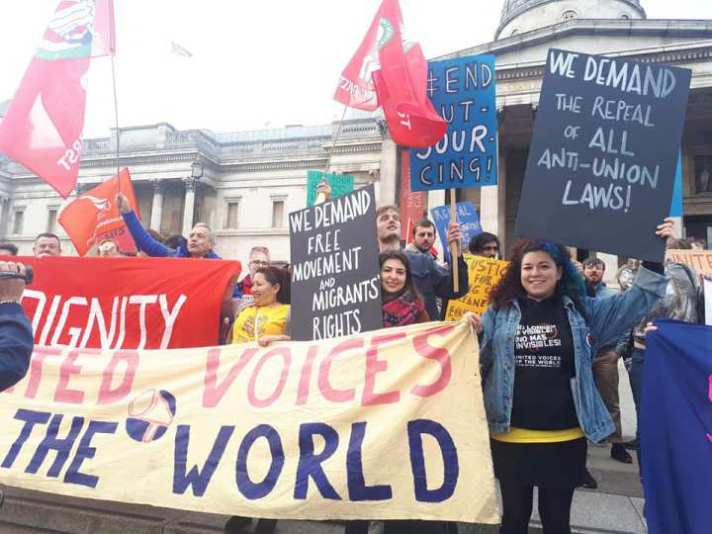
The Independent Workers’ Union of Great Britain (IWGB) is backing the call supported by a growing number of trade union branches and organisations for repeal of all anti-trade union laws and their replacement with positive legal rights for workers and unions to organise and take industrial action.

In a recent statement, initiated by the Lambeth local government branch of Unison, welcomes the policies to this effect passed at last September’s Labour Party conference and seeks to ensure they are carried out.

As Labour’s policy says, “for unions to be effective workers needs an effective right to strike”. This requires the anti-union laws, from the 2016 Trade Union Act back to Margaret Thatcher’s first Employment Act in 1980, to be scrapped. In their place we need strong legal rights to organise, strike, win reinstatement, and establish recognition and collective bargaining. As far as possible the law should aid workers’ self-organisation, not hinder it.

We call on other labour movement organisations, from branches up to national unions, to also add their names to the statement, and look forward to taking part in coordinated campaigning on this.

***

WE NEED THE RIGHT TO ORGANISE AND STRIKE – FREE OUR UNIONS

We need abolition of the anti-trade union laws, which hamstring workers organising and taking action, and their replacement with strong legal workers’ rights. Otherwise we are fighting the challenges of low pay, insecurity and lack of rights with our hands tied behind our backs.

We applaud the 2017 Labour Party conference’s unanimous call for repeal of not just the 2016 Trade Union Act, but also the “anti-union laws introduced in the 1980s and 90s” by the Tories and maintained after 1997; and for a “strong legal charter of workers’ rights”“For unions to be effective workers need an effective right to strike”. This builds on the unanimous 2015 decision that the next Labour government should “legislate for strong rights to unionise, win recognition and collective bargaining, strike, picket and take solidarity action”.

We will campaign for:

  • Complete and speedy repeal of all anti-union laws.
  • Strong legal rights for workers to join, recruit to and be represented by a union; strike/take industrial action by a process, at a time and for demands of their own choosing, including in solidarity with any other workers and for broader social and political goals; and picket freely.
  • The right to reinstatement for workers found to have been sacked unfairly. A complete ban on dismissal for industrial action, however long it lasts. Full rights from day one of a job.
  • Strong rights for unions to access workplaces, win recognition, and establish collective bargaining, including sector-wide bargaining.
  • Unions’ right to decide their own policies and activities, determine their own structures and rules, and spend their funds as they choose, free from state and employer interference, in line with ILO Conventions and the European Convention on Human Rights.


IWGB applauded for standing up to the ‘gig economy giants’ — July 1, 2018

IWGB applauded for standing up to the ‘gig economy giants’

IWGB’s fight against organisations such as the University of London, which continues to trample over the employment rights of its outsourced workers, features on the politics page of the Guardian.

The article, “The tiny union beating the gig economy giants”, describes IWGB’s grassroots fightback that is helping to win basic rights for couriers, cleaners and other workers on zero-hours contracts.

It highlights a range of the union’s successful actions including last month’s Deliveroo case in which 50 couriers won a six-figure payout because they had been denied rights including the legal minimum wage and paid holiday. More important, the article pays particular attention to IWGB’s ongoing ‘back in house campaign’ at the University of London.

Written by Yvonne Roberts, it quotes from Glen Jacques’ letter in which the receptionist warns: “Every pyramid is only as strong as its foundation, and if the foundation is not maintained to a high standard, the pyramid will, in time, collapse.” And it includes profiles of three of the workers who run the union – Mags Dewhurst, part-time bicycle courier and IWGB vice-president; Sarah Anderson, chair of the union’s first foster care workers’ branch; and our president, Henry Chango Lopez.

Read the full Guardian article here.

IWGB questions proposed closure of Lunchbox café and subsequent redundancies — June 26, 2018

IWGB questions proposed closure of Lunchbox café and subsequent redundancies

Less than two years after staff working at the Lunchbox café in Student Central were TUPE’s to Aramark from University of London employment, plans are afoot to close the outlet. This would mean the loss of a vital shared space for students in Bloomsbury and potential redundancies.

There is no doubt that with proper investment this could be a profitable concern.  IWGB is appealing to the university to reverse this decision and recognise its wider responsibility for Bloomsbury’s student and academic community, and has today contacted Vivienne Shinner, Aramark’s director of operations (see below), to call for clarification and question the hasty nature of the formal consultation process, which is taking place without adherence to due process.

Dear Viv,

I have been informed by affected staff that there are plans to close the Lunchbox café at Student Central with a number of potential redundancies.

This information was communicated to staff at a meeting on Wednesday 20 June, at which they were also informed that the formal consultation process had begun.

As with previous Aramark restructures, it is clear that due process is not being followed here.

  1. Aramark has immediately entered into formal consultation over redundancy with no attempt being made over preceding months to improve the situation or involve staff.
  2. Insufficient information has been provided for this to constitute a meaningful consultation – all that staff have been told is that the outlet has been suffering ‘difficult trading conditions’ and has made a loss of £12.6k over the last 10 months. Without more detail as to the financial situation (previous profit levels, turnover, investment or lack thereof) it is impossible for staff to participate properly in this process.
  3. No consideration whatsoever has been given to the role that the café plays as part of the wider University community, and the impact the loss of this facility and this space will have on the student experience more widely, as well as the other outlets based in the building.
  4. This comes only 2 years after the restructure which saw staff TUPE from the University of London to Aramark. It is a damning indictment of the lack of resource that has been put into the café that Aramark are now looking to close a previously thriving café.
  5. You state in your letter that this is merely a consequence of ‘difficult trading circumstances’. However, in the meeting you said that the decision had in fact been made by the University of London – which of these is in fact the case?
  6. Coincidentally, this comes at a time when Aramark and the University have been forced by the IWGB campaign to end zero-hour contracts at the UoL – it would appear extremely convenient that Aramark have chosen this moment to try and save money by making staff redundant.

Could you please provide full detail of the financial position of the café and the decision-making process / alternatives considered prior to this point?

Could you also confirm who on the University of London side is responsible for this decision?

Can you confirm that in ANY redundancy package staff will receive the enhanced redundancy terms accorded to University of London staff?

Best wishes,

Danny