UCU congress votes overwhelming to support Senate House boycott — May 31, 2019

UCU congress votes overwhelming to support Senate House boycott

The IWGB’s boycott of Senate House, the University of London’s (UoL) central administrative headquarters in Bloomsbury, has been given a boost.

Last week (25–29 May), the University and College Union (UCU) Congress overwhelmingly passed a boycott motion. This means that it is now official UCU policy to NOT attend nor organise any events in UoL’s central administrative buildings until all its outsourced workers have been brought in-house.

The UCU’s support has empowered the mainly BAME cleaners to release a short video asking higher education staff and academics to help their case by supporting the boycott – please check it out here. They have been fighting for some two years for equality of employment.

This level of national solidarity is unprecedented. At the Congress speaker after speaker pledged their support for our workers and Jo Grady, UCU’s new general secretary, also confirmed her commitment to the campaign.

The boycott motion was brought to the UCU Congress because, while the in-house campaign has forced the university to commit to the principle of in-housing, there are still many outstanding issues:

  • only 10% of workers have been brought in-house
  • current plans are so vague that the 90% of workers who are not in-house have only been promised ‘reviews’, some of which will not take place until 2021
  • there are no guarantees that any of these 90%, which includes all the cleaners, catering staff and the majority of security staff will ever be brought in
  • these workers are still being massively discriminated against in terms of sick pay, holidays, pensions and more

In addition, as outlined below, UoL has launched a crackdown on the workers and their union, the IWGB.

University of London crackdown

The university and the outsourced companies have not only refused all offers of talks with the workers and their union – the IWGB – its management has responded by attacking trade union rights. Moreover, it has increased discrimination against the outsourced workers.

First the IWGB’s branch secretary was threatened with disciplinary action for accepting an invitation to attend a seminar to talk about the boycott.

Second, cleaning company Cordant Services introduced a draconian new sickness phone-in policy solely for the cleaners. Rather than reporting to managers or supervisors they must now call a centralised number to report all absences. Failure to do so will result in instant disciplinary action. 

There was just one catch. Many of the cleaners speak little or no English while no-one in the call centre speaks anything but. Listen here as an Ecuadorian cleaner tries to call in sick.

Third, Cordant Security has refused to allow trade union representation for migrant security staff at the university. The company has gone so far as to hire EXTRA security to physically block the IWGB representative from attending a meeting to which he was invited by the worker.

This is all happening at OUR university and is in response to pleas by the lowest-paid and most vulnerable workers in the building to be treated equally.

‘Convenors against outsourcing’ members asked to sign up for the Senate House boycott for the 2019-20 academic year —

‘Convenors against outsourcing’ members asked to sign up for the Senate House boycott for the 2019-20 academic year

Dear all,

We are writing following the UCU Congress last weekend to bring you an update on the Senate House Boycott and to ask for your (continuing) support.

Congress overwhelmingly passed the boycott motion, which means that it is now official UCU policy NOT to attend or organise any events at the central University of London administration buildings (essentially Senate House, Stewart House, Student Central, the Warburg Institute and the Institute of Advanced Legal Studies (Charles Clore House)) until all outsourced workers have been brought in-house.

In addition, University of London cleaners have just released a short video asking for support for the boycott – please check it out here.

The reason the boycott motion was brought to Congress is that while the in-house campaign has forced the University to commit to the principle of in-housing:

  1. only 10% of workers have been brought in-house.
  2. current plans are so vague that all the rest are promised are ‘reviews’, some of which will not even occur until 2021.
  3. there are no guarantees that any of these 90%, including all the cleaners, catering staff and majority of security will ever be brought in.
  4. furthermore, as we outline in more detail below, the University has launched an unprecedented crackdown on the workers and their union.

We are therefore writing to you as signatories of our original letter in support of insourcing and the outsourced workers to sign up to the Senate House boycott for the 2019-20 academic year.

It is important to remember that this is a boycott of the University of London, not the IHR – events of all sorts are being moved from the University, and we are determined to maintain our relationship with the Institute to allow the seminar programme to return once everyone working in the building the IHR is housed in is treated equally. As part of this we have set up a Convenors Against Outsourcing group to provide a conduit between the IWGB union and convenors and are also able to offer help in finding rooms for any seminars which need to relocate.

University crackdown

The University and the outsourced companies have not just REFUSED all offers of talks with the workers and their union, the IWGB – they have responded by attacking trade union rights at the University of London and increasing discrimination against outsourced workers.

First they threatened the branch secretary of the IWGB with disciplinary action for attending a seminar to talk about the boycott.

Second, cleaning company Cordant Services introduced a draconian new sickness phone-in policy JUST for cleaners – rather than reporting to managers / supervisors they were now expected to call a centralised number for ALL absences or face disciplinary action.

There was just one catch – most of the cleaners speak little or no English – but no-one in the call centre speaks anything but. Listen here as an Ecuadorian cleaner tries to call in sick.

Third, Cordant Security refused trade union representation to migrant worker security staff at the University – hiring EXTRA security to physically block entry to a meeting to the IWGB representative.

This is all happening at OUR University – and all in response to the lowest-paid and most vulnerable workers in the building asking to be treated equally.

It is vital that we show that we will not tolerate this – and therefore we are asking ALL seminars to sign up to the Senate House boycott for the 2019-20 academic year. This will force the University to see sense, end its policies of repression and discrimination and return to being an institution that we can all be proud of.

We are asking that you speak to your fellow convenors, confirm that you will be supporting the boycott and if possible volunteer one person from each seminar to join our Convenors Against Outsourcing committee.

Please do let us know if you have any questions at all.

Kind regards,

Dr Dion Georgiou
Convenors Against Outsourcing Group

Background to the boycott
At the central University of London a huge in-house campaign has been raging since September 2017. Security and cleaning staff have held no fewer than 17 strikes, as well as innumerable protests, with students also occupying Senate House in support of their campaign.

The demands of the campaign are simple – for equality of terms and conditions. Currently outsourced workers have much worse holidays, pensions, sick pay, maternity and paternity pay than their directly employed colleagues. They also suffer from vastly higher levels of bullying and harassment from the outsourced companies they work for.

Eighty per cent of these workers are from BME backgrounds. Ninety per cent 90% of the cleaners are women.

The University’s response has been draconian – they have threatened TU activists, allowed their hired goon security to beat students, spent £1.3m in just 6 months on additional security and turned Senate House into a fortress.

The campaign has forced them to commit to the principle of in-housing, but this far only 10% of workers have been brought in-house, and their current plans are so vague that there are no guarantees that any of the others, including all the cleaners will ever be brought in.

To win this campaign the workers need external help, and in December 2018 they called for a boycott of events at the University of London central administration in support of the campaign.

The response has been fantastic – More than 35 Senate House seminars  and 180 events have relocated in support of the boycott and more than 440 academics have individually pledged solidarity. In addition, more than 25 UCU branches have passed a motion of support.

The boycott is working, in that the University is now looking to speed up its in-housing. We are on the verge of winning this campaign and achieving equality and dignity for these workers but without your help many of these gains could evaporate.  

Breakfast with the IWGB! —

Breakfast with the IWGB!

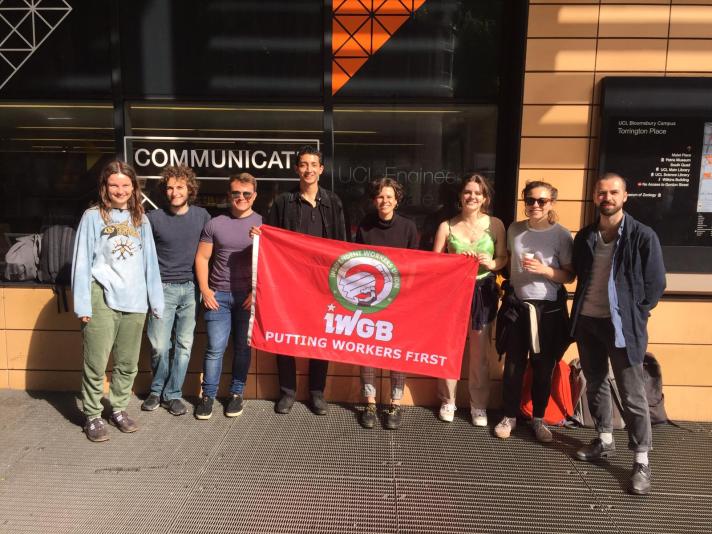
Another week, another breakfast stall! Students, ex-students and IWGB organisers have been greeting outsourced workers at UCL with tea, coffee and pastries one or two mornings each week since last summer. We’d like to express our gratitude to the activists who have shaken off sleep to make these stalls happen, but most of all to the cleaners who have stuck around after work to talk to us about how we can work together to improve their terms and conditions at UCL.

Workers at the breakfast stall in May.

The stalls function as a community hub where strong relationships have developed between workers who might not see each other on shift and between workers and the union. As a result, union membership and solidarity more generally has blossomed among cleaners at UCL. We have been able to solve numerous complaints and grievances brought to us by cleaners at the stalls. At the Institute of Education, for example, cleaners told us about the imminent introduction of clock-in-clock-out fingerprint technology. After a mini-campaign by the IWGB, this was delayed indefinitely.

If you’d like to get involved with the stalls, message UCL Justice for Workers. If you’re in the area, you can find the stalls at the Malet Place entrance to UCL on Thursdays (and at different locations across UCL on Fridays).

Issues relating to the current TUPE transfer – letter from our branch secretary to the University — May 28, 2019

Issues relating to the current TUPE transfer – letter from our branch secretary to the University

Dear Professor Kopelman

I hope this email finds you well.

I am writing to you in order to raise a number of issues related to the recent TUPE transfer of front of house staff from Cordant Security to the University of London. I believe the issues raised below expose the incompetence of outsourced companies but also the lack of willingness of the University of London to commit to a genuine and honest in-house process.

It needs to be clarified to begin with that 90% of the outsourced workers remain employed by external contractors. Despite the fact that the university has maintained that it is ‘committed to the principle of in-sourcing’, it still refuses to make a clear statement committing to transferring the remaining staff into its employment. Understandably, this gives no reassurance to those left out of scope of the transfer.

With regard to the TUPE transfer itself, both Cordant and the University of London have failed to provide the workers affected by the TUPE with clear information on the methodology and criteria applied to define the scope. Instead, the whole process has been characterised by misinformation, incompetence and opacity.

Serious doubts over the information provided by Cordant relating to the transfer were initially triggered by the fact that our President Henry Chango Lopez received a letter informing him of his transfer into the university. This despite the fact that his employment with Cordant had terminated more than a year ago!

Another of our members, a receptionist at IALS, was originally excluded from the process and deemed out of scope by Cordant. She was only reinstated when the IWGB raised a grievance on her behalf.

Another IALS member, who has worked as a receptionist for more than seven years, and who was informed a month ago that her employment was going to be transferred into the University was told the day she went to collect her University of London uniform  that she was considered out of scope and that she would remain outsourced. This case has now been taken to ACAS by the IWGB.

Two further Senate House night receptionists were originally given letters telling them they would be transferred to the University – only to be told casually in person a month later that they were being excluded. They too have now lodged grievances via the IWGB.

I would also like to highlight that despite the University affirming that all ‘front of house’ services would be brought in house, many officers whose EXCLUSIVE duty is to cover reception in the academic buildings remain outsourced and employed by Cordant.

This has led to the ludicrous position that reception positions (for instance in Senate House and Stewart House) which have not been filled by an outsourced member of staff TUPE-ing, and which cannot now be filled by Cordant Security (as they are no longer responsible for reception duties) are instead being advertised via CoSector, as are positions for a porter and a postroom operative.

In addition, these are being advertised as zero-hours posts with sub-London Living Wage pay – in total breach of the University’s commitments on both these issues.

Cordant Security have also failed in their statutory responsibilities in relation to the TUPE re the scheduling of appeals and hearing of grievances. More than 15 affected Cordant Security employees, who have been excluded from the TUPE, have submitted individual appeals more than a month ago and a half ago against their unfair and unjustified exclusion from the transfer. All of them are still awaiting a response from your contractor. Furthermore a number of requests sent to your institution asking for the methodology used to define the scope of the TUPE  have received no answer.

The statutory rights of our members to choose their own trade union representation have also been repeatedly breached.  Despite the fact that both Cordant and the University of London are well aware that a vast majority of outsourced workers belong to the IWGB they have still decided to nominate Unison as employee representatives instead of allowing workers to choose or elect their own.

In addition, during the 121 consultation meetings which have been taking place as part of the TUPE, we would highlight that it has been customary practice at the University of London for outsourced staff attending such meetings to bring a representative of their choice. The UoL IWGB branch secretary has attended those meetings before during previous TUPE transfers. Despite this, our trade union representatives have been informed in writing that they would not be allowed to attend our meetings and were physically prevented from doing so by an agency security officer hired by your institution specifically for that purpose. This occurred even though the letters received by our members informed them of their right to bring a colleague or trade union representative.

Several of our members who have been considered to be in scope and have been brought in house have also informed me that the University of London has provided all of them with a template contract that did not reflect the individual terms and conditions. This is consequence not only of the absence of a genuine consultation process but also to the exclusion of their trade union representatives,  who should have been there to ensure that the information provided by the contractor was correct .

Due to all this more than 40 security officers have raised a grievance in relation to the lack of definition of the scope, the violation of the right to trade union representation and the unfair exclusion of the vast majority of the workforce from the transfer.

In conclusion, it seems clear that the root cause of these issues is the decision to split the Cordant Security contract and exclude the majority of workers from the in-house process. The result of this is:

1.       Cordant have been left to make the decision on who was or was not in scope, when it was in their interest to exclude as many employees as possible. The more employees who remain with Cordant, the larger their profit on the contract.

2.       Services have been split in a way that is not operationally viable – receptionists, the bench team, relief officers and Halls reception staff all provide cover for each other and work across different sites and shifts. By only bringing in-house 13 receptionists the University now does not have enough resource to cover this service, and cannot now rely on the larger pool of staff.

3.       Staff who were previously colleagues have now been divided – with those arbitrarily left out of scope understandably extremely upset and now preparing legal challenges.

4.       Staff and their chosen representatives have not been properly consulted, with the result that the process has been far more stressful and problematic than necessary.

The resolution to all of these issues is straightforward – to act immediately to bring in house the remainder of the Cordant Security contract. We would be happy to work with you and the PFM team to ensure that this happens as smoothly as possibly, for the benefit of both staff and the University.

Best wishes

Danny

Danny Millum

Branch Secretary, University of London IWGB

Academic explains why he is proud to back the IWGB’s University of London boycott — May 24, 2019

Academic explains why he is proud to back the IWGB’s University of London boycott

Dr Dion Georgiou, a senior lecturer at the University of Chichester, calls on academics to “stand in solidarity with cleaners and security staff, and fight precarious employment.”

Writing in the Guardian, Dr Georgiou who has been organising seminars and events at Senate House for more than a decade, said outsourcing has to end and he is proud to back the University of London boycott.

In his article he also points out that universities routinely invest huge amounts in real estate while neglecting to invest in their staff. And commenting on the difficulties the outsourced workers at the University of London have been facing since their campaign began in 2017, he said “… they face an intransigent university management with skewed priorities, whose response has all too frequently blended short-termism with heavy-handedness.

“Refusing to negotiate directly with the workers’ chosen union representatives, it has instead expended heavily on policing the workers’ industrial action and student protests taken in support of them, spending over £400,000 on additional security over a two-month period last year alone.”

Remembering the IWGB members who supported academics who themselves had to take industrial action against their employers, Dr Georgiou said “Last year, while I was stood on the picket line outside King’s College London (where I myself was then precariously employed) during our strike over pensions, IWGB members supported our action, with some refusing to cross UCU picket lines. Now we must stand with them. We are all in this fight together.”

Read the full article here.

Campaigners against outsourcing take their battle to the Palace of Westminster —

Campaigners against outsourcing take their battle to the Palace of Westminster

The battle for the outsourced workers at the University of London (UoL) has entered the lofty corridors of the House of Parliament. 

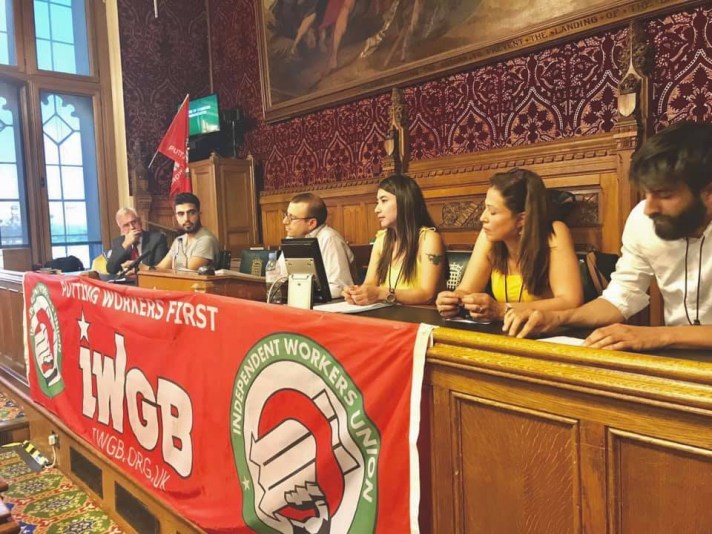
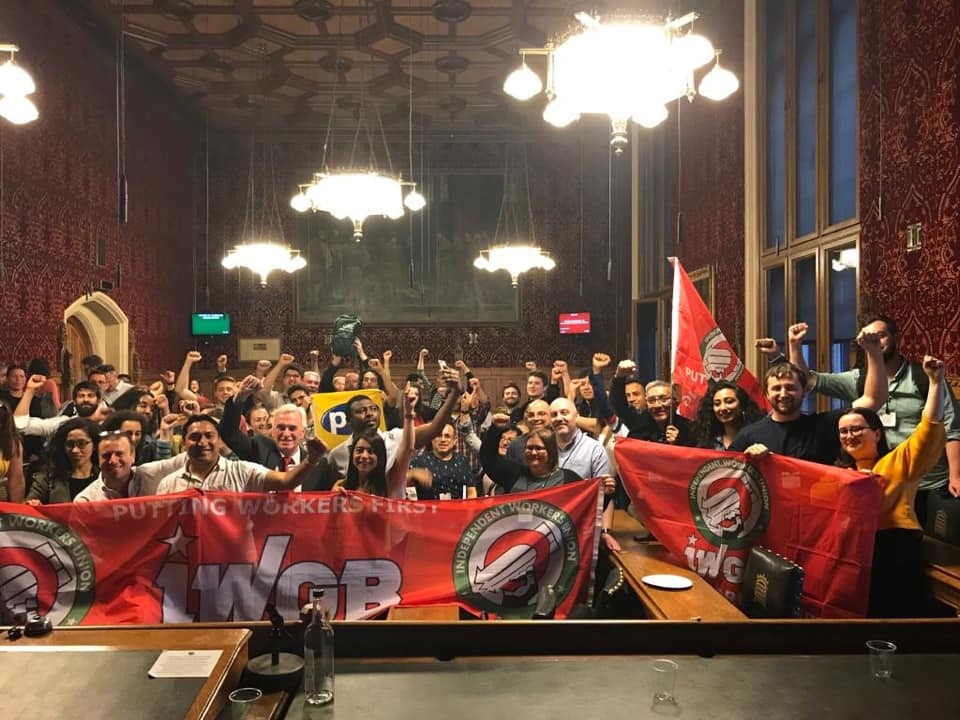
This week (22 May), members of the IWGB union joined a panel led by Shadow Chancellor John McDonnell MP to discuss how outsourcing is used to drive down working conditions and what can be done to fight back.

As well as John McDonnell, speakers included Maritza Castillo Calle, IWGB’s UoL’s branch chair, Liliana Almanza, union representative and cleaner. They were joined by Katie Leslie, London south branch secretary of the Public and Commercial Services Union (PCS) representing staff at Business Energy and Industrial Strategy, and representatives from the National Union of Rail, Maritime and Transport Workers (RMT).

Since 2017, IWGB has been campaigning for UoL, one of the UK’s largest university in terms of student numbers, to end outsourcing and directly employ the workers who provide cleaning, catering, security and other services.

Outsourcing is one of the underhanded methods used by employers for decades to drive down our employment conditions. By using middlemen in the form of outsourcing companies such as Cordant, employers are able to offer some workers far worse pay, holiday entitlements, sick pay and pension contributions. 

But the abuse doesn’t stop there. The unaccountable nature of outsourcing companies means the workers (who are often from minority ethnic and migrant backgrounds), employed by them are much more likely to suffer from bullying and discrimination. 

But recent years have seen outsourced cleaners, security officers, receptionists and catering staff, win a number of important victories that have pushed back against some of the worst abuses of the outsourcing industry. 

At the event in Westminster, Maritza Castillo Calle and cleaners’ representative, Liliana Almanza, spoke movingly about their experiences as outsourced migrant workers, and how they had been empowered by joining a union. John McDonnell pledged his support to end outsourcing in general AND for the Boycott Senate House campaign in particular.

Workers from other outsourced campaigns also spoke, including the representatives from the PCS and RMT unions. All committed to building closer links between unions to strengthen the fightback.


Couriers working for The Doctors Laboratory strike over pay and conditions — May 17, 2019

Couriers working for The Doctors Laboratory strike over pay and conditions

On Thursday and Friday next week (23 and 24 May) medical couriers at The Doctors Laboratory (TDL) will be going on strike, and IWGB members are encouraged to show solidarity for our cycle couriers who provide blood delivery services to more than 50 NHS and private hospitals on behalf of this private company.

The focus of the action will take place at TDL’s Euston Road headquarters (95 Euston Rd, Kings Cross, London NW1 2RA) from 7.30am–1.30pm on both days. However, the main event that as many people as possible are being encouraged to attend will be from 12 noon–1.30pm on the Thursday. A range of speakers have accepted invitations to take part. 

All sorts of activities are lined up for the two days and a Facebook event “SAVE LIVES NOT PENNIES” has been launched. IWGB members are urged to show their support at this Facebook page, which will reassure and empower the workers taking part in the strike – a decision that was not taken lightly.

After years of mistreatment TDL couriers unionised in 2018 in the hope of achieving better working conditions and an increase in pay that had stagnated for years. The IWGB has been engaged in talks with TDL for the last year, but the company has done everything it can to delay negotiations and has continued to treat the couriers with contempt. 

Indeed, TDL decided to cease negotiations and instead pursue forced employment on its self-employed couriers which would mean huge pay cuts. This was the final straw. The couriers decided there was no other option than to ballot for a strike with 84.6 per cent voting to take industrial action.

A large part of TDL’s ridiculous wealth is founded on the dismantling of the NHS through privatisation. As the NHS is slowly broken down TDL hoovers up services and transform them into huge profit for the senior management and shareholders.  

TDL’s refusal to meet the workers’ demands for modest increases in pay is in sharp contrast to the generous pay rises it has given its top two executives. They earned a combined £2.6 million in 2017with the highest paid director doubling his pay since 2013 to £1.6m,far more than any NHS manager. The company’s Australian owner, Sonic Healthcare, has received £60 million from the business over the last 5 years. While this company is turning over such astronomical profits, it is looking for ways to squeeze the long-serving, hardworking couriers.

As Alex Marshall, a TDL courier and IWGB member, said: “While TDL investors and managers get fat off NHS contracts, the couriers that risk their lives every day to deliver emergency blood and pathology samples are being left to suffer under a regime of pay cuts and neglect.”

Huge victory at University of London as first workers come back in house! —

Huge victory at University of London as first workers come back in house!

Next week marks a watershed moment in IWGB’s ‘back in house’ campaign as the first outsourced workers will formally be transferred to University of London employment.

Selected members of staff from reception, portering, postroom and audio-visual support will be the first in 20 years to reverse the trend of outsourcing at UoL.

This is a huge victory for the workers’ campaign as just two years ago the University refused to discuss the issue of in-housing, claiming that issues with the workers’ employment conditions were not a matter for the University to consider.

In recent communications to directly employed staff, the University has changed its line and sought to claim credit for the decision to bring the workers in house and for the beneficial effects of doing so. But it won’t be forgotten that the decision to bring these workers back in house comes after a huge campaign and massive pressure applied to the University by the workers and their union, IWGB!

IWGB has now been able to scrutinize the terms and conditions of incoming workers’ contracts and confirm that existing working patterns will be respected while everyone will be entitled to the University’s pensions, sick pay, annual leave and other benefits such as closure days – all of which mark a significant improvement on terms and conditions available to outsourced staff.

“This is an incredible day for us,” said Abdul Bakhsh, one of the affected workers and UoL IWGB Vice Chair. “We are finally getting what we have been asking for – to be treated equally with our colleagues at the University.”

But workers are determined to carry on the campaign until all their outsourced colleagues are brought in-house: the number transferring on 20 May is a tiny proportion of affected staff. The University maintains in communications that it is ‘committed to the principle of in-sourcing’ but still refuses to make a clear statement committing to transferring the remaining 200+ staff into its employment. Understandably, this gives no reassurance to those left out of scope. The workers will fight on until the campaign is won!

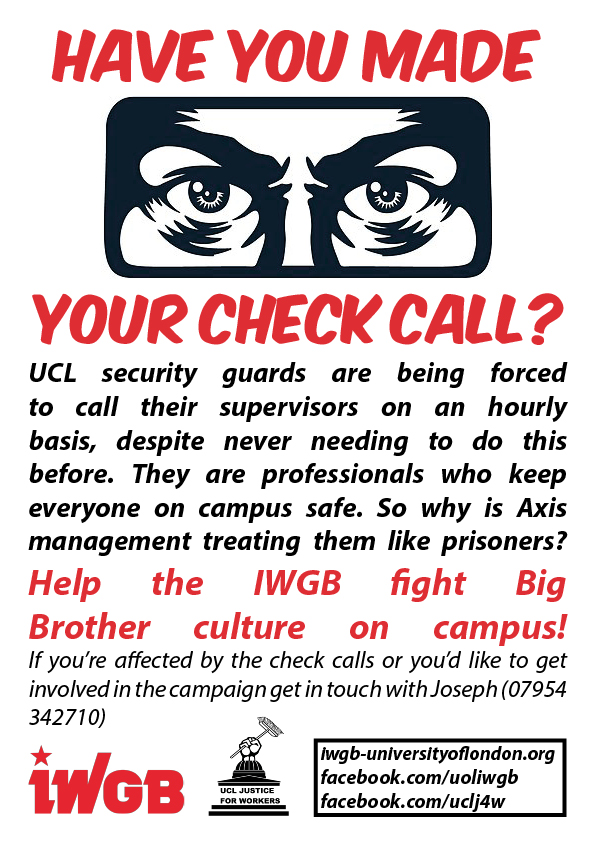
Have you made your check call??? — May 16, 2019