‘In-house’ fundraiser gives £2,000 boost to IWGB strike fund — September 18, 2018

‘In-house’ fundraiser gives £2,000 boost to IWGB strike fund

Thanks so much to everyone who came to the University of London ‘back in-house’ fundraiser party on 15 September, and to those who helped raise the money in a range of creative ways. These included raffle prizes donations and the organising of a well-run bingo session.

Some 200 people descended on SOAS for the event. We had an amazing time and managed to raise more than £2,000 which will help us continue the fight for justice and equality and support the next strike by outsourced workers at Senate House.

Translation

¡Muchísimas gracias a todos los que vinieron a la fiesta de recaudación de fondos para la campaña de la rama Universidad de Londres anoche, y tambien a todos quienes nos apoyaron y ayudaron a recaudar el dinero de diferentes maneras!

Definitivamente la pasamos genial y logramos recaudar más de £2000 para la próxima huelga y para seguir luchando por justicia y igualdad!

 HASTA LA VICTORIA SIEMPRE!

IWGB joins forces with UCL out-sourced cleaners —

IWGB joins forces with UCL out-sourced cleaners

The Independent Workers Union of Great Britain (IWGB) has been busily organising and recruiting cleaners at UCL who are currently undergoing TUPE transfer from their current contractor Tenon FM, to a new company, Sodexo. Although TUPE is designed to protect employees in this situation, history tells us they are right to be concerned.

The union recently met with this group of outsourced cleaners and their representatives, who have decided to organise en masse with the IWGB. They are tired of being exploited, badly treated, undermined and forced to work under worse employment conditions than their directly employed colleagues. Sounds familiar?

Like other IWGB members, the workers are hungry for justice and workplace equality. They will keep organising and building up towards their big campaign to have workers brought in-house at UCL.

Stay tuned for what is coming!!

Translation

 Muy buena reunion con los limpiadores y representantes subcontratados de UCL quienes han decidido organizarse en un gran numero con el sindicato IWGB después de estar cansados de ser explotados, irrespetados y con peores condiciones de empleo que sus colegas quienes trabajan directamente para la Universidad.

Ellos estan hambrientos de justicia e igualdad en su lugar de trabajo y seguirán organizandose y trabajando para su gran campaña!

¡Estén atentos para lo que se viene!

Finding another way: an open letter to the University of London’s new vice-chancellor — September 13, 2018

Finding another way: an open letter to the University of London’s new vice-chancellor

Dear Professor Kopelman,

I am writing you in my capacity as General Secretary of the Independent Workers’ Union of Great Britain (IWGB).  Firstly, I’d like to congratulate you on your appointment as interim Vice-Chancellor and to welcome you to the University of London community.  I can assure you that many of your outsourced workers are looking to you with hope that your appointment will signify a departure from past practice and instead represent a more rational and humane approach to dealing with the industrial disputes at your doorstep.

As you will no doubt be aware, the IWGB is the largest trade union at the Central University.  We also represent the overwhelming majority of the outsourced workers.  When it comes to the outsourced workers the IWGB is the sole legitimate voice with whom the University could in good faith engage.  Unison, whilst undoubtedly able to boast high membership densities and a decent track record at other locations, for example, SOAS, cannot say the same at the Central University.

In fact they did such a terrible job that the outsourced workers left en masse  to join the IWGB.  To negotiate with Unison, on behalf of the outsourced workers, is therefore not only misguided, but is genuinely insulting to many in that workforce.  UCU on the other hand represents direct employees on grades 7 and above and as such does not even claim to represent the outsourced workers.

With this background one can assess the University of London’s strategic approach to dealing with the IWGB, which over the past few years has been as consistent as it has been ill-judged.  The University’s approach has been to respond to pressure from the IWGB in every instance (e.g. the 3 Cosas Campaign for sick pay, holidays, and pensions, the Back in House campaign against outsourcing, the triggering of the Information and Consultation procedures, etc.) by ignoring IWGB and instead engaging with the “recognised unions”.

In trying to look at the situation from an objective, analytical, and dispassionate- rather than partisan- perspective, I do understand the rationale.  The University sees the IWGB as radical, unwavering, and generally as people with whom they cannot do business.  The University views the recognised unions on the other hand as easy to work with, reasonable, and malleable.  By doing a deal with the recognised unions, the University can drape any decision they make in the shroud of legitimacy and industrial relations best practice.

The problem with this approach is that ultimately it makes the University’s problems worse, not better.  For the reasons explained above, the recognised unions have absolutely no mandate to do anything on behalf of the outsourced workers.  So negotiating with them achieves nothing.  They do not have the power to decide whether or not the campaign will continue nor do they have the power to make counteroffers that will calm the industrial strife.

Similarly, with the ICE example, trying to do a stitch up with the recognised unions instead of engaging with the IWGB in good faith resulted in two tribunal decisions against the University and uncounted wasted thousands in legal expenses.  Further, every time the University does something which feels like a slight to the outsourced workers, it only serves to pour fuel on the fire of the campaign.

I trust that the people who surround you will be pushing a certain narrative and approach when it comes to dealing with the outsourced workers, their campaign, and their union.  An approach that has been tried and failed time and time again.  I am writing to encourage you to take a step back and think for yourself on this one.

The IWGB is not some group of radical crazies with whom good faith dialogue and negotiation cannot be undertaken.  Our policies, approach, and actions are dictated democratically by the membership.  To dismiss us as radical unreasonable ideologues is to dismiss the cleaners, security guards, postroom staff, porters, and other outsourced workers who keep the University functioning as radical unreasonable ideologues.

What I would say better defines our approach is a ruthless pragmatism focused on deploying those tactics which will most effectively and quickly achieve our aims.  In the present case, our aim is to bring all workers back in house, asap, as our members believe it is unjustifiable to continuously subject the predominantly low paid, BME workforce to inferior treatment, terms and conditions.  Unfortunately, experience has taught us that high profile pressure campaigns tend to get the quickest results in winning these sorts of things.  If dialogue and negotiations were capable of achieving the same result they would absolutely be our preference.

I am therefore writing to make the same offer to you as I made to your predecessors: meet with us, negotiate with us, and we might be able to find a way out of the industrial strife.  Alternatively, the campaign will continue- we are about to begin balloting for another round of industrial action- the negative press coverage will continue, the legal cases will continue, further pressure tactics will be deployed, and the end result will be the same because we won’t stop until the workers are brought back in house on equal terms and conditions as their directly employed colleagues.

Many thanks in advance for your attention on this matter.

Kind regards,

Dr. Jason Moyer-Lee
General Secretary
IWGB

Correction: Implementation of 2018-19 pay award will be in October — September 3, 2018

Correction: Implementation of 2018-19 pay award will be in October

We would like to apologise to members who attended last Wednesday’s IWGB meeting at Senate House where they were told that the two per cent pay award had been implemented. This was an unintentional error.

Plans are to implement the award in the October payroll. However, unions have rejected this nationally and, currently ballots for strike action are taking place.

We will keep you up-to-date with developments.


One university should mean one workforce: it is time to end discrimination at UoL — August 15, 2018

One university should mean one workforce: it is time to end discrimination at UoL

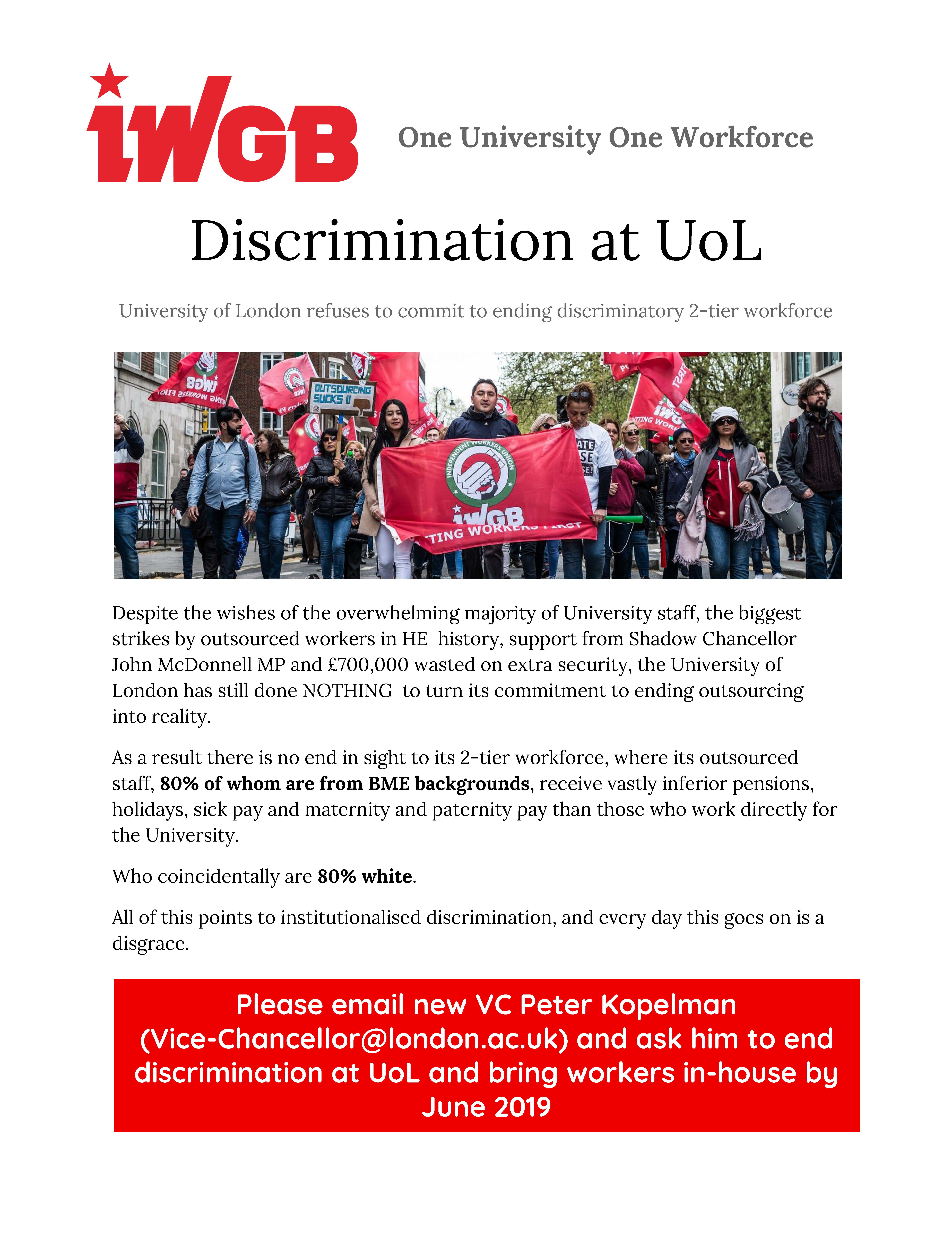
Despite the wishes of the majority of its staff, the biggest strikes by outsourced workers in higher education history, support from high-profile politicians, and £700,000 wasted on extra security, the University of London (UoL) refuses to commit to ending its discriminatory two-tier workforce.

Not even the acres of negative press nor the heartfelt pleas from outsourced staff, the majority of who are from BME backgrounds, have managed to make a chink in the armour of the university’s senior management team.

Incidentally, 80 per cent of the institution’s directly employed staff are white. And guess what? Unlike their outsourced BME colleagues, they have enviable pension arrangements and holiday entitlements, are entitled to sick pay and good maternity and paternity pay. Moreover, the university’s ‘dignity at work’ policy ensures they are treated with respect.

All of this point to institutionalised discrimination, and it is a disgrace.

Please email the university’s new vice-chancellor, Peter Kopelman (vice-chancellor@london.ac.uk) and ask him to end discrimination at UoL and bring workers in-house by June 2019.


First aid allowance — August 8, 2018

First aid allowance

One of the issues raised by IWGB representatives at the Information and Consultation of Employees (ICE) forum at the end of July related to payments to first-aiders by the University of London (UoL).

It was pointed out that the allowance, which is currently £8.50 per month, has not increased for 15 years and is not in line with other organisations. Moreover, at the time of the meeting, it transpired that some first-aiders are not even being paid at all.

The university was asked to review this, and IWGB can now report that the human resources and organisational and staff development departments are looking into the issue. This includes a review of what other higher education institutions pay for such a role.

In the meantime, any first-aiders who are not getting paid for their duties or have any questions regarding back pay should email Elizabeth.Morcom@london.ac.uk.

Help us end discrimination against workers and #CleanUpOutsourcing — August 7, 2018

Help us end discrimination against workers and #CleanUpOutsourcing

The Independent Workers Union of Great Britain (IWGB) has launched a legal challenge that could help end discrimination against the ‘invisible’ outsourced workforce that ensures that our offices, schools and universities run smoothly day after day. They include those who work in cleaning, security, receptions, catering and maintenance.

Last year the IWGB started a legal challenge over the rights of 75 outsourced workers at the University of London (UoL) who are employed through Cordant, the facilities management company. The union believes the university is the de-factor employer with ultimate decision-making power over the workers’ terms and conditions. Therefore, they should be able to collectively bargain directly with UoL, but this has been denied putting the university, says the union, in breach of article 11 of the European Convention on Human Rights, which guarantees trade union rights.

If successful, the case, which has been given permission to be heard in the High Court, would change the lives of the 75 workers at the University of London and some 3.3 million other outsourced employees.

But the establishment is closing ranks to try and stop it. The Tory government has decided to join the University of London in resisting our challenge and will be arguing that the European Convention of Human Rights cannot be interpreted in a way that extends these workers’ rights.

Outsourced workers, the majority of whom are migrants and BAME, tend to suffer from far worse terms and conditions because they are not employed directly by the place where they work, but by third party facilities management companies.

As the Guardian columnist and economics commentator, Aditya Chakrabortty, points out “Outsourcing breeds economic apartheid, in which workers who are nearly all from ethnic minorities, including cleaners who are almost without exception women, are exploited in a way that would never happen to the mostly white academics and managers whose employment contracts are with the university.”

Despite the establishment’s attempt to stop us from taking on the anachronistic and exploitative practice of outsourcing we are determined to fight until the end. Our fantastic legal team of solicitors from Harrison Grant, and renowned barristers John Hendy QC and Sarah Fraser Butlin, will robustly challenge the university and the government.

Unfortunately, the court has denied the IWGB cost protection. This means that if the union loses it could be forced to pay the legal costs of the university, Cordant and the government. The final bill could be in the hundreds of thousands of pounds, but we are setting up an initial target for the crowdfund of £10,000.

Thankfully, we are not alone. The Good Law Project, aware of the importance of this case, has decided to back it with an initial donation of £5,000. Please Join them and help us #CleanUpOutsourcing by pledging whatever amount you can afford. See details here and here.

Any money that isn’t spent will go into the IWGB’s fighting fund, to take on other exploitative companies and practices.


Information and Consultation of Employees (ICE) forum update — August 1, 2018

Information and Consultation of Employees (ICE) forum update

Last Wednesday was the third meeting of the Information and Consultation of Employees (ICE) forum.

HR’s official minutes will be posted on the intranet soon (with old ones kept here) but in the meantime, detailed notes taken by one of your IWGB staff reps is available here. It was a long meeting with lots of discussion, so edited highlights are below.

As always, please feel free to contact ICE representatives with any questions, comments or matters to raise next time.

With the exception of information about policies they’re updating, everything we’ve discussed so far has been originally raised by staff so it really does work. In particular, please do let us know your views on the issue of the London weighting debate being reopened as this has the potential to positively impact staff in all areas.

IN BRIEF – matters discussed 25.7.18

London weighting

IWGB reps raised that the final amount from the previous agreement will be paid in August but the issue can be re-opened because the London Living Wage rose by more than 6 per cent (it rose by 11.5 per cent).

There will be a JNCC meeting on 6 August about it but all staff cannot attend. We will push for another meeting on this – we want your views. We will continue to raise this and keep you posted.

Business World (BW)

It was noted that staff are not happy with the delivery of the system, although Ghazwa Alwani-Starr (GA-S), present in a managerial capacity, said her impression is that everyone in her department thinks it’s great.

Reasons cited for issues with BW were that UoL (University of London) had to move quickly from Northgate (old system) to Business World in a short period of time to deliver the basic requirements needed. Market was tested and apparently Agresso is the only thing that can deliver ‘what we need’.

A lot of work was done, especially on background functions, but did not have enough time. Also issues with ‘holes in the data’ inherited from Northgate.

Problems were particularly raised re Saturday working in the Library: system was unprepared for this. The manager responsible undertook to meet library employees to discuss.

Facilities Management services review

A robust discussion took place.

G Alwani-Starr reported that a revised customer services/security model will be put to the Board of Trustees (BoT) in November.

ICE reps noted this is irrelevant. What the workers want to know is when they will be treated equally. There is a deadline for that. If that is not met, their campaign continues. Every worker who was shown the Uni’s statement on this was uncomprehending or angry. Noted that UoL is taking completely the wrong approach to this.

GA-S responded that the BoT has stated they are concerned about charitable objects and return on investment.

IWGB ICE reps noted that workers in these fields weren’t always outsourced in the past so there is no contradiction with the university’s charity or business aims, just a return to the state of 15 years ago. Reps invited Board of Trustees to come to the ICE forum and discuss it if this is confusing.

Asbestos

A standing item after the re-discovery of asbestos that had supposedly been removed.

The asbestos management plan is being finalised and will go to Chair of Health and Safety committee for comments/approval soon.

Referrals should be made to Occupational Health for anyone concerned.

DM: Kim Frost promised for 6 months that he would provide us with history of how asbestos issue has been handled, and left before doing so. Asked for this to be supplied.

USS pensions reform

The ‘deficit’ has been revised already – from £17bn quoted before, now saying £8bn.

Nonetheless, a proposal will be put to staff to increase contributions from 8 per cent:18 per cent to 8.8 per cent members’ contributions, 19.5 per cent employers, followed by further increases.

Information will be on intranet and Q&A sessions for staff will be held in autumn.

Dignity at work policy

… has been finalised. Much discussion about whether or not it also applies to outsourced staff. To be confirmed by next meeting.

Family friendly policies

… are being reviewed, including redundancy policy. A full list of policies under review will be communicated and circulated for comment once finalised.

University to confirm whether these policies will apply to HEE staff on UoL contracts.

First aid policy

IWGB Reps raised that payments to first-aiders have not increased for 15 years and appear not to be in line with other organisations. Some first aiders are not even being paid at all. The university was asked to review this and report back.

SAS website costs

Quote is £0.25 million. EW confident we will not pay that amount.

Lower ground floor access

CW noted staff had enjoyed use of staircase briefly. GA-S said Deller Hall staircase will reopen soon.

 

UCU pensions update — July 31, 2018

UCU pensions update

Below is copy of a letter from Tim Hall, UCU’s Senate House Branch Chair, updating its members on the issues around pensions and the latest information from the Universities Superannuation Scheme.


Dear Members,

I understand that this is a bit of a long one but I wanted for you all to be as informed as possible so please do take the time to read it.

By now, most of you will have received an email from HR sent on behalf of USS. The email explained what their plan for cost sharing will look like:

Under the 2017 valuation that USS approved in November 2017, contributions will eventually rise by 10.6 per cent from 26 per cent of salary (18 per cent employer, 8 per cent member) to 36.6 per cent (24.9 per cent employer, 11.7 per cent member) in order to retain the status quo.

Why is the cost-sharing rule being implemented in USS?
Members will already know that under its current valuation, USS is in deficit. USS has been claiming for months that it is legally obliged to have a plan in place for dealing with that deficit. But the Joint Expert Panel (JEP) will not make any decisions about the current valuation until September 2018, and the previous plan to recover the deficit by removing the Defined Benefit element of the scheme was left in tatters after strike action by our members: you!

As a result, USS has chosen to trigger a process known as ‘cost-sharing’, although it is better described by the phrase ‘shared contribution increases’. Under Rules 76.4–8 of the scheme, the trustee can require employers and members to increase their contributions to the rate which they deem sufficient. This decision has been made without the pension regulator’s enforcement – they are still happy for UUK, USS, and UCU to resolve this without their intervention.

We must stay vigilant because there are few signs that UUK has abandoned its long-standing goal of transferring as much of the cost and the risk of pension provision onto employees as possible. Prior to the USS dispute, UUK used a manufactured deficit in USS to represent Defined Benefit pensions as unaffordable. The JEP arose out of USS members’ growing appreciation that the deficit was, in fact, illusory, and the reforms which it had been used to justify were not needed. More information on the JEP can be found on the UCU website at this address: https://www.ucu.org.uk/strikeforuss

Pension Contribution Calculator
Here’s a tool that lets you get an idea of how much more you can expect to pay in contributions under this new plan: https://beta.observablehq.com/@scjoss/uss-cost-sharing.

It’s important to note that UniversitiesUK had the option of taking up the extra member increases themselves should they have wished to do so, but turned it down. That would have been possible by a resolution of the JNC. UCU negotiator Sam Marsh pushed for UniversitiesUK to cover the full burden of interim cost sharing, given strike was entirely UUK’s fault and we’ve already lost a lot of money via strike deductions. This seemed a fair compromise. Again, UUK said no – hence it falls to us all.

Now it looks like USS are prepared to listen to a rethink from UUK on their ‘risk-appetite’ (which if you remember, most said they were willing to stay will current level, with some saying they’d be happy with increase – UUK decided to go with the minority of employers and push through a low-risk appetite strategy). This is an area the JEP are likely to comment on. The hope will be that a change to the Test 1 parameter will lead to a resolution to this dispute but it’s important to keep informed.

Pay Dispute
If you haven’t been following UCU’s national email communications: following the e-ballot on pay and equality members completed in late spring 2018, UCU members will now be asked to vote formally in a statutory ballot opening towards the end of August and closing in mid-October. The current employer offer is 2%. When taking inflation into account as well, it’s clear that our take-home pay will go down by more than 2% in the next year.

Bill Galvin, Chief Executive of USS, has seen a 31% pay rise over last 2 years. On top of drastic increases to the cost of living and a decade of pay-rises below inflation, we’re getting hit again with increased pension contributions. All this adding up to a hefty pay-cut. The latest imposed pension arrangements amount to a 3.7% pay cut, plus 6.9% loss of potential pay. All of this so university leaders can remove USS (i.e. our future pay) from their financial liabilities. Please bear this in mind when the UCU ballots on their 2% pay offer.

Excellent information can be found on https://ussbriefs.com – A website built and populated with content by UCU members volunteering their time and expertise to keep the rest of us informed.

If you have any questions please email ucu@london.ac.uk.

All my best,

Tim Hall
UCU Senate House Branch Chair