
Hunter gatherers, Candy Crush Saga and excess workload at the University of London — March 24, 2019

Hunter gatherers, Candy Crush Saga and excess workload at the University of London

Many of us working at the University of London feel pressure at the moment to work extra hours beyond their contracts to meet increasingly burdensome demands and expectations, and it is sometimes difficult to take a step back and realise that this is a) not necessary and b) not something you need to put up with in silence!

If in the basement of Senate House you should come across the skeleton of a woman that’s about 10,000 years old you might idly wonder if she belonged to a hunter-gatherer group or a farming community that grew grain. Simply examine the skeleton’s back, knees and toes: if they’re deformed it’s because the woman spent many hours rocking back and forth grinding grain, to give her severe RSI.[1]

It’s widely accepted that the gradual move from a mixed lifestyle of hunting and harvesting to the backbreaking raising of a monocrop was a terrible deal for humans. Hunter-gatherers were healthier, bigger and less prone to disease than their counterparts. Their lifestyle was more varied and, arguably, more skilled. Long hours doing the same thing are bad for us physically, mentally and emotionally.

In modern times we can congratulate ourselves on many achievements: The Daily Mail, Candy Crush Saga, BaeWatch. How do our working lives compare with the hunter-gatherer? The University of London is obviously not the worst place in Britain to work: just ask fruit pickers, workers in massage parlours who rely on tips, or many others. But owners of massage parlours do not generally crow about work-life balance so perhaps we can and should hold UoL to a higher standard.

The University has, for several years, operated a “recruitment chill”. This normally means that if someone leaves they are not replaced for a minimum of six months. Who does their work? Who do you think? Were these colleagues previously sitting around looking to fill their time? Scarcely. Were they already in fact overworked? You betcha. The recruitment chill should more honestly be called the Exploit Existing Workers Doctrine.

A number of people in my department regularly work more than 70 hours a week. Because they love the job? Not so much. Chronic under-resourcing means they have to do it or everything would break down (and they would be blamed for it). What’s being selected for here is goodwill and self-sacrifice. Those who won’t do it will leave or push work onto others. A cash- and resource-rich institution is making its most dedicated workers ill through excessive hours in the name of “bearing down on costs” or similar self-serving nonsense.

Leaving aside the morality of this, it’s nonsensical on a practical level. It is well known that the quality of work falls as people become more and more tired. That’s kind of obvious but Quartz recently reported on a study that shows how quickly this happens.[2] If the eight-hour work day produces low-quality work what effect is the recruitment chill having, on top of all the other extra loads being rammed onto our shoulders?

If you want a quick way to know if an institution actually cares about the quality of work being done there look no further than open-plan offices. These are such a bad idea that kids today probably learn “don’t work in an open-plan office” from their parents at about the same time they learn “don’t drink bleach”. Open-plan offices reduce work and reduce communication between colleagues; the only thing they increase is sickness rates. [3]

Despite this the University has put a lot of effort into creating a giant open-plan office in Senate House’s basement. In a gesture of solidarity the managerial elite of the University have moved down there too. But open-plan is especially harmful for deep, thoughtful work, so the output of our senior managements remains unaffected.

If anyone complains about this situation the managerial response varies between sympathetic head-nodding, which does very little to reduce anyone’s workload, and injunctions to think creatively about that workload, to ensure that you are working smarter not harder. To be fair the mantra work smarter not harder is pretty useful: it tells you that the person saying it is an imbecile whose views can be conveniently ignored.

If there are any humans left in 10,000 years’ time they can examine our skeletons. If they’re deformed in the hands, wrists and shoulders it’s because of RSI, produced by long hours at a computer or tablet. I don’t think they’ll be able to tell if we were working smarter not harder.

Are you forced to work beyond your contractual hours because of workload? You’re not alone. Contact uol@iwgb.org.uk if you want to discuss this issue in confidence.

1. James C. Scott, Against the Grain, p.83.

2https://qz.com/work/1561830/why-the-eight-hour-workday-doesnt-work/

3. See, for example, https://m.signalvnoise.com/the-open-plan-office-is-a-terrible–horrible–no-good–very-bad-idea/, or just ask your parents if going open-plan/drinking bleach is a smart move.
University of London’s victimisation of IWGB member causes ‘grave concern’  — March 22, 2019

University of London’s victimisation of IWGB member causes ‘grave concern’ 

Danny Millum, secretary of the University of London’s (UoL) branch of the Independent Workers Union of Great Britain (IWGB), has been reprimanded, in writing, by his employers for accepting an invitation from seminar convenors to discuss the union’s ‘Boycott Senate House’ campaign. 

Below, Rebecca Dooley, an IWGB activist and member of UoL’s Information and Consultation of Employees forum, calls out Professor Rick Rylance for singling out and victimising Danny for his trade union activity. In his 5 February letter the dean of the School of Advanced Study where Danny has been a loyal employee for more than 13 years, made it clear he would not hesitate to instigate disciplinary action in the future.

Dear Professor Rylance, 

I am writing in my capacity as the assistant secretary of the University of London IWGB. I am assistant to our branch secretary, Danny Millum, and I am writing with regard to the letter that he received from you regarding his attendance at an IHR seminar. 

I write with grave concern, as both an employee of the University and as a committed trade union member and activist, that Danny is being singled out and victimised for his trade union activity, despite being an exemplary employee of the university for many years. I am a member of the ICE forum and have publicly stated on more than one occasion at those meetings that the university has recently been showing a degree of disdain towards the IWGB and its members as a result of our in-house campaign, and I fear that this attitude towards our union is now manifesting itself in very real ways in potential disciplinary action against a valued employee.

I would ask you at this time why it was deemed necessary to take such action against Danny for his attendance at this seminar? Whilst I do note that your letter states that no action is being taken, the very fact of it being a formal letter, from yourself, copied to senior management, seems to say the complete opposite. 

For something that I think many would consider to be a very minor matter, this seems to be a wholly excessive response, designed to intimidate Danny into reigning in his trade union activity. The work of union representatives is vital for maintenance of a safe and secure workforce and those who choose to undertake this work (often giving up vast amounts of their free time, unpaid) should be able to do so without the fear of reprisal from their employer.

Kind regards,

Rebecca Dooley

University cleaners unhappy about the use of biometric clock-in — March 19, 2019

University cleaners unhappy about the use of biometric clock-in

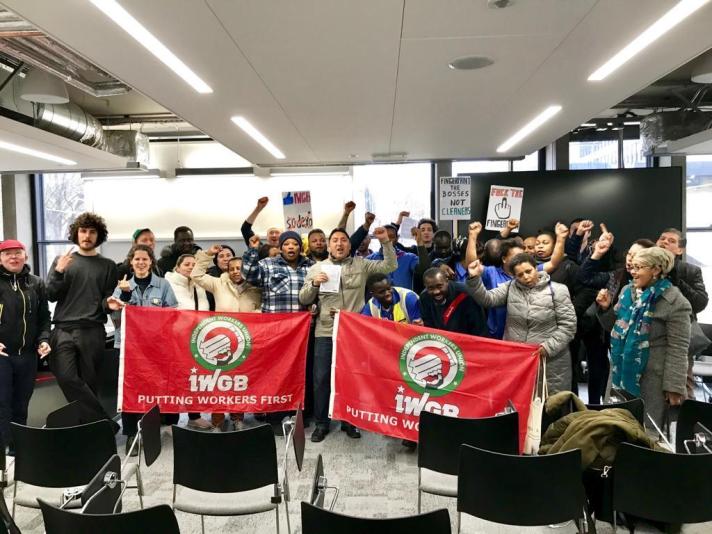
University College London (UCL) cleaners are protesting against the introduction of a biometric time management system that is being forced on them. 

The cleaners, who are employed by Sodexo, say the technology will infringe their rights and have written to Sodexo and UCL to express their unanimous opposition. They also confirm that 100% of those who attended a meeting to discuss the plans to introduce this technology voted in favour of strike action.

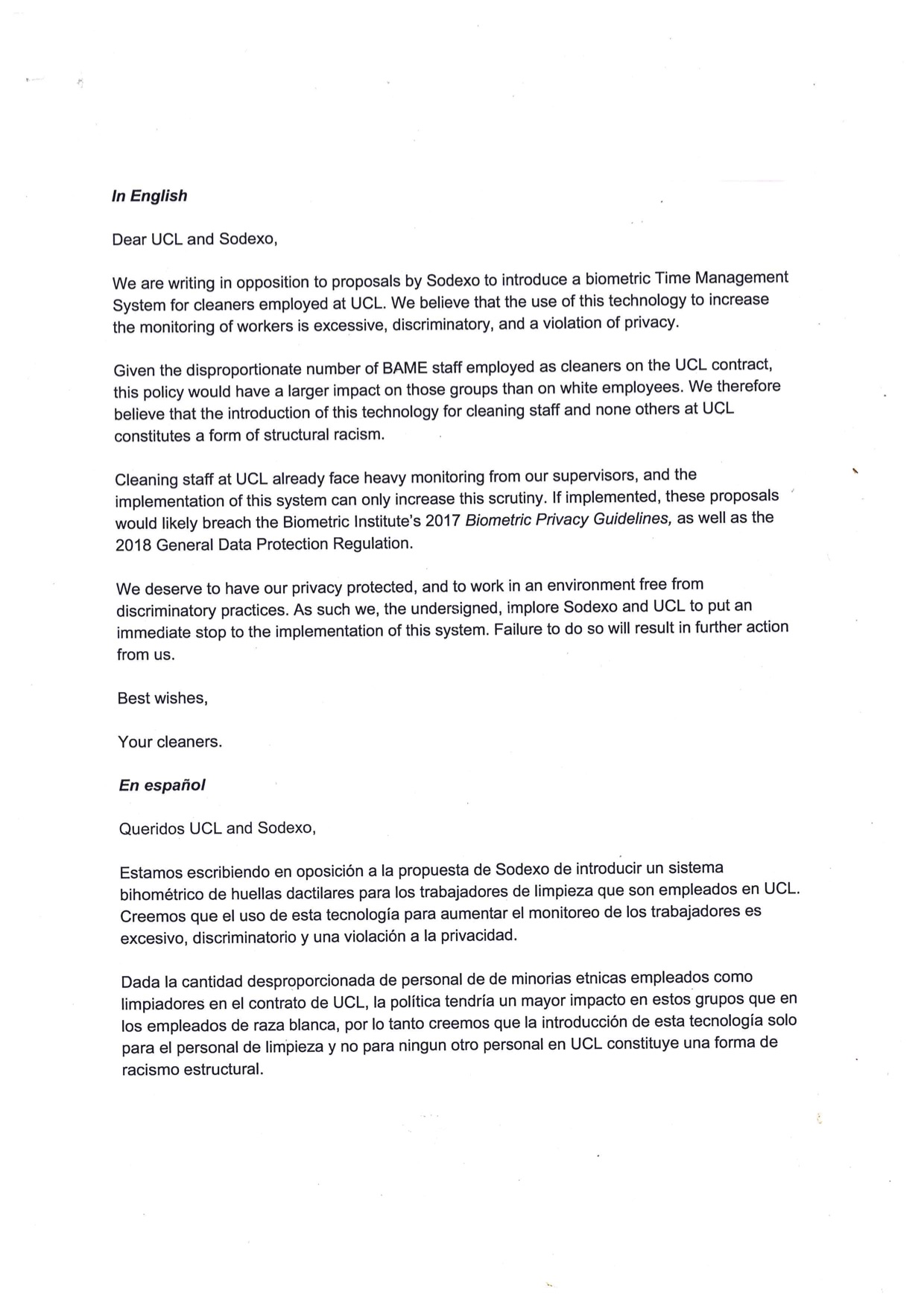
IWGB and UCU, the unions supporting the cleaners, said that to date neither UCL nor Sodexo have responded to their letter (see copy below) or made any attempt to answer any of the queries raised.

They said it is “extremely disappointing that Sodexo and UCL seem to have such a lack of concern for the opinion of their cleaning staff and these potential breaches of GDPR and the Biometric Privacy Guidelines.”

The matter has now been raised with the University Council and passed to the IWGB’s legal department.

page4image24016704
page6image24115008
UCL security officers detail “serious issues” relating to outsourcing contractor — March 11, 2019

UCL security officers detail “serious issues” relating to outsourcing contractor

Nearly 100 security officers working at University College London have signed an open letter to the University Council drawing its attention to extremely serious issues relating to Axis, the university’s outsourcing contractor.

Dear Professor Arthur,

We are writing as security officers currently employed by Axis on the University College London contract to bring to your attention and that of the wider UCL community the conditions, which those staff who keep your buildings and people safe currently endure.

The security contract was taken over by Axis on 1 November 2018, more than four months ago. We consider this to have been a probationary period, and one which they have unfortunately failed, as a result of their inability to resolve the following issues:

1. Loss of personal data

As part of the TUPE process when an employee moves over to a new company they are asked to supply a comprehensive schedule of data. This includes bank details, copy of passport, national insurance number, full name, addresses in the last 5 years and other biographical details.

Guards provided this information to Axis (in hard copy), only to be later contacted and asked to supply data that had already been provided. We estimate around 70% of the guards were asked to resupply data, including passports and bank details.

We believed that Axis had lost a quantity of the hard copy data we had given them, and this was confirmed in an email by an Axis manager in response to union enquiries. Despite this, Axis have subsequently denied losing the data and claimed that it had just not been sent in the first place by the guards.

Not only the loss of this data extremely serious, but the fact that Axis have chosen to blame officers and cover up the truth makes them unfit to hold this contract. The matter has now been referred to the Information Commissioner’s Office (ICO).

2. Loss of all holiday information

Despite Axis having had 3 months prior to the 1 November 2018 transfer to shadow the outgoing contractor (CIS), they made the astonishing revelation after the handover that they had not obtained any of the holiday records for the 200 or so officers who had TUPE’d from CIS.

Quite simply, this meant that they had no record of the holiday that had already been taken that year, and no way of knowing what their officers were entitled to. When this came to light, rather than take responsibility for the situation, they blamed CIS.

We believe that it is one of the basic requirements of an employer to be able to handle holiday issues, and would add that the failure to flag this up prior to handover casts grave doubts on the capability of the UCL facilities team tasked with overseeing the transfer.

3. Failure to pay holidays correctly, as well as other pay problems

As a consequence of the above, the payment of holidays to Axis staff has been utterly chaotic for the last 4 months. Issues regarding holidays and pay break down into a number of categories:

  • Paying guards at a rate lower than their usual hourly rate.
  • Holiday pay missing completely from pay.
  • Paying holiday at less than the 12 hours that they work in a shift.
  • Not recognizing the correct number of holidays a guard had remaining for the pay year.
  • Not recognizing when guards had been given permission to carry over holiday from the previous year by the previous security company.
  • Guards unable to book holiday on the company’s holiday system (Timegate).
  • Guards being placed for months on the wrong tax code, in some cases depriving them of thousands of pounds.

For December alone, the IWGB union reported more than 30 cases where errors had been made, and there were doubtless many more errors, which were not brought to their attention. That this should occur for one month is shameful. That four months after the contract was taken over by a company that boasted of their record of low payroll issues guards should continue to be underpaid on a regular basis is unacceptable.

Indeed, given the frequency of these payroll errors for a predominantly BAME outsourced workforce versus the virtually zero rate of error for mostly white in-house staff, this constitutes indirect discrimination.

It should be re-iterated that we (with cleaners and caterers) are the lowest paid staff in the University – one missed or reduced wage packet can lead to direct debits bouncing, mortgage payments failing and overdraft charges being incurred. It is a scandal that this has been allowed to occur with nothing more than a shrug of the shoulders from UCL.

4. Failure to communicate

Since taking over the contract, the communication from Axis has been extremely poor. Some key examples of this are:

  • Failure to remedy mistakes. Despite the fact that they must have realised that they did not have the correct holiday information for any of their guards (see above) Axis made no effort to contact them. When the IWGB flagged this up, they then promised to send a letter to all staff to elicit the relevant missing information. No such letter was sent – and when challenged on this Axis first lied and claimed it had been, and then when confronted with the truth said they had email ‘some’ of their staff.
  • Lack of response. Axis managers often do not reply to or even acknowledge emails. Staff were constantly being told another manager is dealing with a problem, or that they need to talk to head office, who then passes them back to a site manager. Now they have one manager to deal with problems, but it took too long to appoint and communicate this to the guards.
  • Passing the blame. First of all they blamed CIS, the previous security company, saying that they had not supplied the information they were required to supply, or that it was just inaccurate. They seemed to suggest that the very guards who they were failing to pay properly were LYING about having supplied information to them and about the details of the holiday entitlement. They hinted that individual CIS managers, some of whom themselves were TUPE’d over to Axis, were taking actions designed to sabotage the handover. This is very subjective, but they seemed, at times, to suggest that UCL had not told them everything they should have been told before tendering for the contract.
  • Failure to honour promises. At and IWGB meeting on 9 January with Mark West and Lesley May we asked Mark and Lesley to request Axis send a written apology to each guard’s home address, as a first step in winning back the guard’s confidence in Axis. They promised this would happen. We assume Mark and Lesley relayed our request. A letter was sent, but it did not contain anything we believe could pass as an apology. Finally an email containing an apology was sent – on the 5 February, nearly a month later.

5. Failure to provide uniform

Despite the contract having been in place for more than 4 months, many security guards at UCL are still without proper uniforms. Some guards are still wearing CIS uniforms, while others have had to purchase their own garments have been issued with inappropriate items for their gender. This has been flagged up by guards on many occasions but without resolution.

6. Worst terms and conditions of security staff in the whole of Bloomsbury

The terms and conditions under which security at UCL work are a disgrace to the institution. Security are the lowest paid staff (along with cleaners and caterers) and work extremely long hours. We do not have work related pensions (only have the Statutory Enrolment Pensions).

Unlike outsourced security in other Bloomsbury universities, UCL guards receive only the statutory minimum 28 holidays (in-house staff get 41), and just 4 weeks company sick pay (in-house staff get 6 months full and 6 months half-pay). In addition many security guards (working 3 on 3 off etc) are only receiving 22 days holiday, not 28.

There are no additional payments for overtime, whether that be at weekends or nights.In addition, staff are forced to stand outside without relief for huge stretches of the day, and breaks are frequently missed or delayed.

While Axis have failed to resolve these issues, it is at least fair to say that many of them pre-date them. The issue here lies with the very nature of outsourcing itself, which is a cruel, inhuman and discriminatory way for a supposedly progressive institution like UCL to avoid its responsibilities to its most vital workers.

As a consequence, we would contend that although Axis are demonstrably unfit to run this contract, these problems would exist to a greater or lesser extent under any outsourcing company (under CIS payroll problems were rife, as was the rapid turnover of managerial staff which continues to hamper efforts to run a competent service).

UCL therefore does not just need to cancel this particular contract (re which, if the above evidence is not enough, the IWGB can provide copious detail on Axis’ failings and incompetence) but to end the process of contracting out entirely, and restore security to their rightful place as UCL employees, with the humane treatment and decent terms and conditions this implies.

We are calling on you too make this decision as soon as possible – before UCL’s reputation is permanently tarnished before the wider world and its security staff lose their patience entirely.

Best wishes,

Your security guards

University of London contractor delays paying staff the London living wage —

University of London contractor delays paying staff the London living wage

In December 2018, a group of city investors wrote to listed firms urging them to pay all employees a living wage, which in London is £10.55 and hour.

Coordinated by the Share Action campaign group, the letter pointed out that “paying the living wage to all staff and contractors is the hallmark of a responsible business.”

What pity that Nurture, the gardening outsourced company contracted to look after the University of London’s (UoL) grounds at Senate House, doesn’t buy into that “responsible business” sentiment.

The living wage is a powerful weapon against poverty. Yet, nearly four months after the London Mayor announced a new London Living Wage of £10.55 per hour (an increase of 35p per hour) some of the staff employed by Nurture are still being paid at the old rate.

Hopefully that will change now that the secretary of the UoL branch of the Independent Workers Union of Great Britain (IWGB) has sent the company a gentle reminder (see below).

Dear Greg

It has been brought to my attention that some staff employed by Nurture on the University of London contract are being paid below the London Living Wage (LLW) rate of £10.55 an hour.

As you are aware, Nurture is obliged under the terms of its contract to pay the LLW as a minimum.

Can you confirm that this will be corrected with immediate effect, and back-dated to November?

Best wishes,

Damning report into outsourcing at University of London released today — March 8, 2019

Damning report into outsourcing at University of London released today

World renowned research NGO Corporate Watch has today released a damning report into the University of London’s outsourcing plans.

Outsourced workers at the University of London have been campaigning for an end to outsourcing since September 2017. Despite countless strikes, protests and a boycott of the university which was launched last year, the university has only agreed to bring in-house around 35 of a total of more than 250 outsourced workers that work at its premises.

The Corporate Watch report found that: 

  • the university has substantial cash reserves, with £45 million in the bank. 
  • financial problems used by management to argue against in-housing have been a direct result of their own expansion strategy. 
  • many of the staff at the consultancy chosen to review the costs of in-housing used to work for outsourcing companies.
  • The University of London has refused our Freedom of Information request for a copy of that review. Similar reviews by other universities found in-housing would not be significantly more expensive.

The report can be found here

For more information:

Emiliano Mellino, press officer
press@iwgb.co.uk


GUARDE LA FECHA – AGM, SÁBADO 27 DE ABRIL — March 7, 2019

GUARDE LA FECHA – AGM, SÁBADO 27 DE ABRIL

La reunión general anual de la Rama Universidad de Londres de este año tendrá lugar el sábado 27 de abril, ¡y todos los miembros están invitados!

Esta es una oportunidad de escuchar todo lo que la sucursal ha hecho en el último año (¡cuando hemos crecido a más de 600 miembros!), Elegir a los oficiales para el próximo año y comer algunas empañadas …

Todos los detalles para seguir, ¡pero por favor póngalos en el diario ahora!

Cualquier pregunta a uol@iwgb.org.uk.

SAVE THE DATE – AGM, SATURDAY 27 APRIL — March 6, 2019

SAVE THE DATE – AGM, SATURDAY 27 APRIL

This year’s University of London Annual General Meeting will take place on Saturday 27 April, and all members are invited!

This is your chance to hear about everything the branch has done in the last year (when we have grown to over 600 members!), elect officers for the next year and eat some empañadas…

Full details to follow – but please put in the diary now!

Any questions to uol@iwgb.org.uk.

No to the fingerprint! Joint letter of protest from UCU and IWGB —

No to the fingerprint! Joint letter of protest from UCU and IWGB

The IWGB and UCL UCU have written jointly to Sodexo and UCL in protest at their plans to introduce biometric testing for cleaners at UCL – full letter below!

We are writing in response to the announcement by Sodexo that the company plans to introduce a Time Management System using biometric technology for cleaners employed on the UCL contract.

Both we and the affected workers (many of whom are members of the IWGB union) believe that this proposal is ill-considered, discriminatory and likely to be in breach of the Biometrics Institute’s2017 Biometric Privacy Guidelines, as well as the UK’s 2018 General Data Protection Regulation (GDPR) with regard to the principle of proportionality.

These workers are already the most heavily scrutinised in the University. They have passes in order to clock in and out, as well as a signing in book, and their supervisors control their entry to and exit from work. The introduction of additional monitoring systems is out of step with contemporary practice in relation to cleaning jobs in buildings of this type, and therefore excessive.

We are therefore calling on Sodexo and UCL to halt the implementation process immediately, and to provide answers to the following questions:

1)      Why is this system being introduced for cleaners, but not for any other group of staff working at UCL?

2)      Why is it being introduced at UCL and not at other comparable institutions (indeed, plans for a similar system at Birkbeck were recently abandoned)?

3)      Given the disproportionate number of BAME staff working on the cleaning contract, has an Equality Impact Assessment been conducted to ensure that these plans are not in breach of the Equalities Act 2010?

4)      Can Sodexo please provide references to their own policies to show that they have addressed the following guidelines as laid out in the 2017 Biometric Privacy Guidelines?

i)        Principle 1 Respect for Individuals/Data Subject Privacy

ii)       Principle 2 Proportionality

iii)     Principle 3 Informed Consent

iv)     Principle 4 Truth and Accuracy in Business Operations

v)      Principle 5 Protection of Biometric Data Collected

vi)     Principle 6 Complaints and Enquiries

vii)   Principle 7 Purpose

viii)  Principle 8 Non Discrimination

ix)     Principle 9 Accountability

x)      Principle 10 Sharing of Biometric Data

xi)     Principle 11 Provision of Advance Warnings of Surveillance

xii)   Principle 12 Transmission of Biometric Data Beyond National Boundaries

xiii)  Principle 13 Employee Biometric Data Must be Protected

xiv) Principle 14 Limit the Extent of Personal Data Exchanged and Retained

xv)   Principle 15 Maintain a Strong Privacy Environment

xvi) Principle 16 Maintain Privacy Logs

5)      If the Biometrics Institute Privacy Guidelines have not been incorporated into the policy, could  Sodexo please send a copy of the relevant Privacy Impact Assessment that has been carried out in relation to the proposed implementation?

The IWGB and UCU are extremely concerned both at these plans and at the way they are being implemented with little consultation or consideration for the privacy rights of our colleagues. If this is not halted then we will be passing the matter to our respective legal departments and considering a representation to the Information Commissioner., especially in relation to any areas of GDPR-related non-compliance.

A failure on the part of Sodexo to address our concerns within 10 working days will leave us no option but to alert all UCL staff and students to this inconsiderate and disproportionate approach to the privacy rights of the most vulnerable and low-paid of our colleagues on campus.

Yours sincerely

Maritza Castillo Calle (President UoL IWGB)
Danny Millum (Branch Secretary UoL IWGB)
Sean Wallis (President UCL UCU)
Saladin Meckled-Garcia (Vice President UCL UCU)
Tony Brown (Branch Secretary UCL UCU)