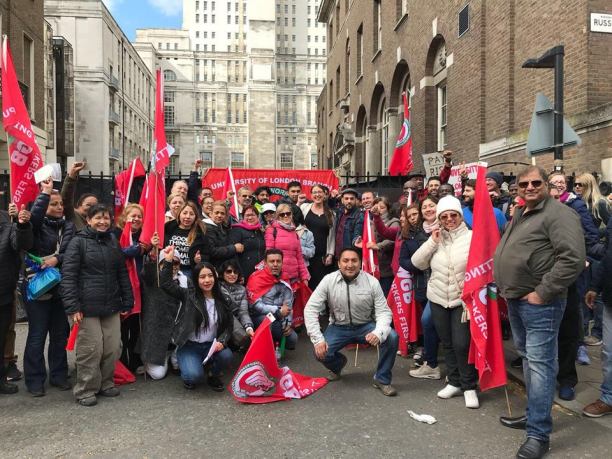
IWGB general secretary invites UoL vice-chancellor to join boycott — December 10, 2018

IWGB general secretary invites UoL vice-chancellor to join boycott

Dear vice-chancellor Kopelman,

I’m writing to inform you, in case you’ve missed it on Twitter, of our boycott of the University of London (UoL). The boycott, which has already garnered an incredible amount of public support, ranging from the National Union of Students to the co-leader of the Green Party, the Shadow Chancellor, and Ken Loach, will continue until such time as all outsourced workers are brought in house on equal terms and conditions to their directly employed colleagues.

Given that we are signing up academics and institutions, I’d also like to invite you to join up. You can do so here. This is a great opportunity for you to get on the right side of history.

I appreciate that this may create a logistical conundrum for you as you work at Senate House, but being the progressive and modern institution that UoL intends to be, surely it could make some working from home arrangements for you?  Further, when the dust settles on this whole thing, at least you’ll have something to fall back on lest you be accused of presiding over the worst reputational damage in the history of the institution during your very short tenure.

Going from awarding Nelson Mandela his distance degree to being boycotted by trade unions, student unions, academics, and leading figures on the British left over unfair treatment of predominantly BME workers is quite a steep fall.

Either way, there is and always has been a very easy way out of this mess: bring the workers in house now!

Kindest of regards,

Dr. Jason Moyer-Lee
General Secretary
IWGB

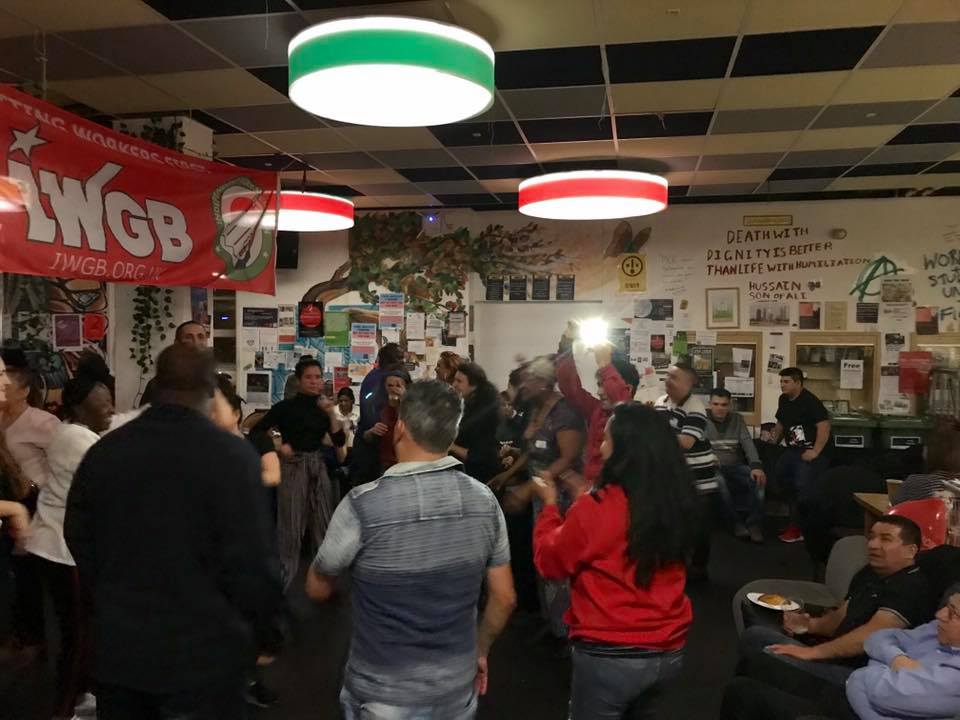
Party on with IWGB —

Party on with IWGB

It’s that time of year again when employees up and down the country are getting into gear for the office Christmas party. Some people love the opportunity to kick loose, while others view the annual bash as an ordeal to suffer rather than celebrate.

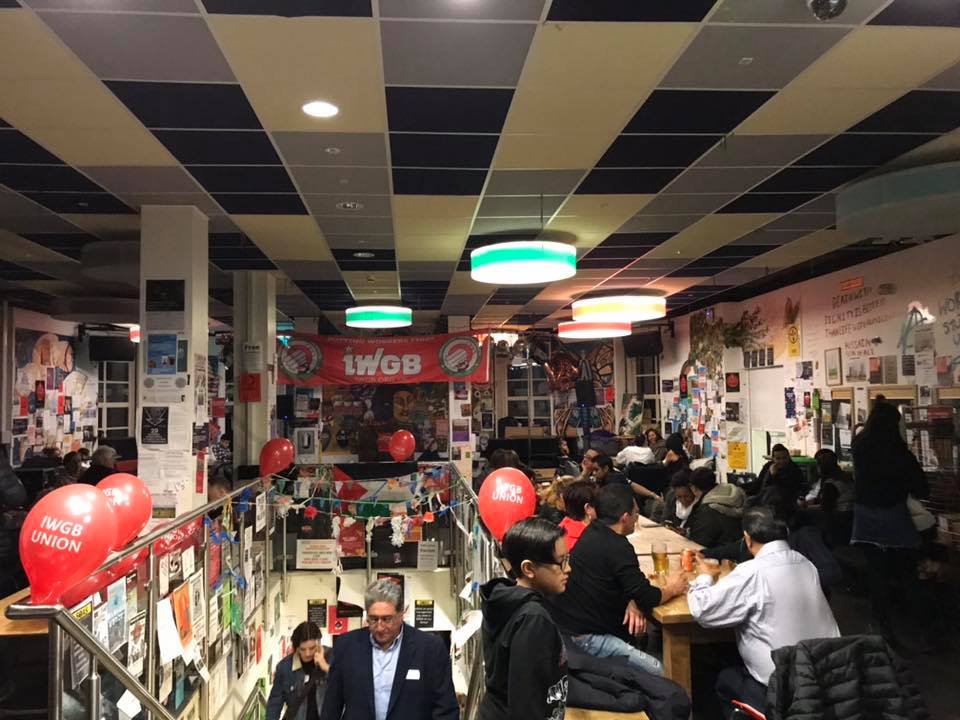
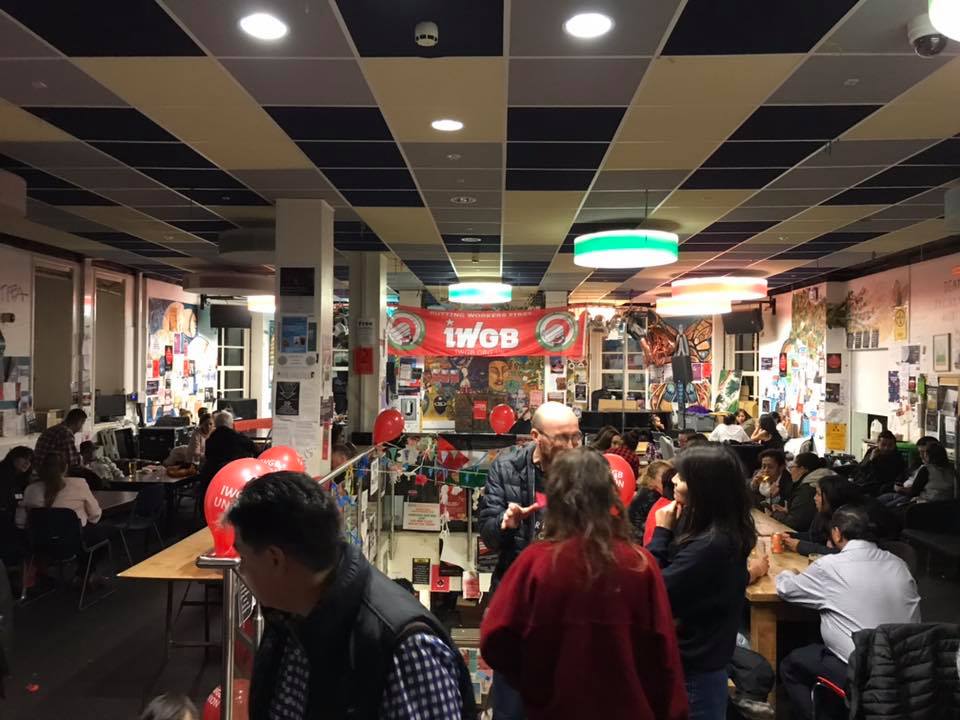
For members of the Independent Workers Union of Great Britain (IWGB) the festive ‘works do’ it an eagerly anticipated event – a time to glam up, let your hair down and brush off the stresses of the year at least for a few hours.

And, if every picture really does tell a story, that is exactly what happened at this year’s Christmas party. Happy holidays!

Academics, students and politicians to boycott University of London —

Academics, students and politicians to boycott University of London

More than 100 academics, politicians and others are backing a boycott of the University of London, including the iconic Senate House building, over the institution’s continued use of outsourced workers to provide essential services.

The supporters of the boycott, which include shadow chancellor John McDonnell MP, the National Union of Students and several high-profile professors, are demanding that the university end outsourcing and directly employ the outsourced workers that provide cleaning, catering, security and other services.

A full list of current signatories to the boycott will be found on the page http://www.boycottsenatehouse.com and https://iwgb.org.uk/boycottsenatehouse from Monday 10 December.

Outsourced workers at the University of London have been campaigning to be made direct employees with equal terms and conditions as other staff for over a year. These workers – who have worse sick pay, holiday pay, maternity pay and pension contributions than directly employed staff – have taken up to 15 days of strike action.

Instead of agreeing to negotiate with the workers, the majority of which are migrant and BME, the university has spent hundreds of thousands of pounds on heightened security in an attempt to stave off industrial action and protests. More information here, here and here.

After initially stating that it would bring services in-house last May, the university has now gone back on its commitment, only guaranteeing that a small portion of the workforce will be made direct employees by this summer.

The bulk of outsourced workers – maintenance, cleaners and catering – will remain outsourced at least until their contracts are up for tender in 2019, 2020 and 2021. At that point an in-house bid will be presented alongside other commercial bids, leaving the door open for the workers to remain outsourced indefinitely.

In the meantime, outsourced workers continue to suffer under a regime of bullying and discrimination. In 2018, the Independent Workers Union of Great Britain handled over 50 complaints on behalf of outsourced workers a the University of London. Notably the IWGB raised a complaint in July when it discovered that a senior manager of outsourcing company Cordant was supporter of the far right.

In October, the IWGB raised a separate complaint when the university failed to act after three separate women brought complaints of sexism and homophobia against a separate Cordant manager.

London School of Economics Anthropology Professor Dr David Graeber said: “It is completely reprehensible that people that provide such an essential service continue to be treated as second class workers by the University of London. As academics who benefit from the work of the cleaners, catering staff and other outsourced workers, we have a moral duty to stand in solidarity with them and boycott the university until it ensures that they are given the same terms and conditions as other staff.”

University of London cleaner Margarita Cunalata said: “For over a year, we have been asking the university to respect us as equal members of staff, yet it has made clear that it sees us as less than human. We have sent letters, we have been on protests and we have gone on strike, but the university doesn’t even have the basic decency to sit down with us and negotiate. We are tremendously grateful that academics are willing to support our fight by boycotting the university until it makes us direct employees.”

Kings College London Lecturer Nick Srnick said: “At a time when university Vice Chancellor pay is surging across the country, it is an outrage that the least well-off workers of the university continue to face a situation of hyper-exploitation and abuse. Yet there’s an easy solution to immediately improve the lives of the workers that keep the university running: join numerous other universities in bringing them back in-house and paying them a decent wage.”

The boycott asks supporters to not attend or organise events at the University of London central administration, which besides Senate House includes Stewart House, The School of Advanced Studies, the Institute of Advanced Legal Studies and Student Central (formerly ULU).

Events make up a significant proportion of the university’s income. According to its latest financial report, the University of London made GBP 43m from residences, catering and conferences in the year ending July 2018.

IWGB announces Brexit position — November 27, 2018

IWGB announces Brexit position

Following our discussion at the September branch meeting on Brexit, the motion was passed by the IWGB Executive Committee – see below for a letter from our general secretary:

Dear Members,
 
I’m writing to inform you of our position on Brexit, which we will be announcing publicly.  Before the referendum the IWGB had a policy to support Remain, mainly due to concern over our large contingent of membership working in the UK on EU passports and due to concerns over the impact of Brexit on EU-derived employment law.  There are four key areas where Brexit, in particular a hard Brexit, is likely to have detrimental impacts on the IWGB and our members:
 
1. Immigration. Nearly all of the Cleaners and Facilities Branch members are here on EU passports.  A huge proportion of the University of London Branch members are as well.  Some members in all of the other branches, including Couriers and UPHD, will be too.  And 50% of our staff are here on EU passports.  Restrictions on free movement could make it harder for them to bring family members over, or depending on the type of Brexit, hard for them even to stay in this country.  Further, the environment and discourse around immigration has become increasingly toxic, with Brexit greatly contributing to this toxicity.
 
2. Employment law. A large number of employment rights are derived from EU law.  The importance of EU law is that: (i) in some cases it introduces rights which didn’t previously exist in the UK (e.g. paid holidays), (ii) the law is ultimately interpreted by an EU court which on the whole is more progressive and pro-worker than UK courts, and (iii) EU law in effect supersedes domestic law, so the Tories are unable to shred employment rights that come from the EU, even with a supermajority.  The IWGB relies on EU law rights to defend members on a daily basis, e.g. paid holidays, protection from discrimination, TUPE, etc.  EU law also forms a central plank to various branches’ legal strategies, e.g. the ICE regulations which are used in UoL branch.  Further, the foster care branches’ current legal strategy is largely dependent on EU law superseding UK law.
 
3. Economy.  There is a virtual consensus among economists that a hard Brexit will result in an economic shock and a big decrease in government revenues.  We know from past experience that those who bear the biggest brunt of any economic shock and cuts in government spending are low-paid workers, e.g. our members, who have already had to struggle against the austerity agenda.  This will inevitably be the same with any negative economic impact from Brexit.  
 
4. Inability of Government to get anything done.  Brexit is all consuming and Parliament is hard pressed to focus on anything that isn’t Brexit-related.  This is particularly the case when Parliament and the current government are focusing on creating a new arrangement rather than choosing an off-the-shelf option such as remaining in the single market and adopting EU law into UK law, which would require much less change.  The IWGB needs Parliament to be able to engage with non-Brexit issues, e.g. a central plank of the foster care strategy is to get Parliament to pass legislation regulating the industry.  Similarly, we are calling on legislation on behalf of UPHD branch to give more powers to licensing bodies in particular to cap private hire driver license numbers.
 
The trade union movement is becoming increasingly vocal on these issues.  The TUC has called for a soft Brexit and a referendum on the final deal if it looks like the deal won’t be in the interests of workers, GMB has called for a referendum on the final deal, UNITE has left open the option of another referendum, etc.  Although the IWGB is not a big player, we are of the size and profile to have an influence on certain sections of the public.  Therefore, our taking a position could contribute, in albeit a small way, to a concrete result which (as outlined above) would directly benefit our members.  
 
For these reasons the IWGB Executive Committee voted overwhelmingly to adopt the following position:
 

1.       The people should be given a vote on the final Brexit deal.

2.       Failing the above, Brexit should take the softest possible form, in particular by remaining in the single market with the institution’s protections for free movement and by incorporation of EU-derived employment law.

To help make our case we have made this video: https://www.youtube.com/watch?v=JKf_b0QeWwE&feature=youtu.be, which we will be pushing on social media tomorrow.  I have also written an article for the Guardian on the employment law aspects of the proposed deal.
 
Kind regards,
Dr. Jason Moyer-Lee
General Secretary
IWGB

http://iwgb.org.uk/
T: 02034907530; 02035383720
M: 07771783094

Plans to TUPE staff from University of London to Health Education England — November 22, 2018

Plans to TUPE staff from University of London to Health Education England

Dear all,

We are writing in our capacity as IWGB ICE representatives, as the ICE Forum has been sent documentation relating to the proposed TUPE transfer of all UoL staff to HEE, and we will be discussing this at the next Forum meeting, which will be taking place next Wednesday 28 November 2018.

The University has refused to allow us to release the actual documentation to affected staff, despite our objections, but it deals in essence with the email below that you have all received.

It is worth bearing in mind that on 28 September 2018 HR Director Simon Cain wrote to me that – ‘there is currently no discussion underway to transfer UoL staff to HEE’ – and yet now the University is moving with such haste that it intends to complete this transfer by 1 April 2019.

We have submitted the attached questions (HEETUPEtransferquestions) to the University / HEE for a response – but please do let us know if you have further queries you would like raising.

The key element of this move will be that staff will be forced to move from their current UoL pensions (SAUL or USS) into the less favourable NHS pension scheme.

The IWGB’s position is that that staff who have already been through a massive and traumatic restructure are now being made to pay again (this time via their pensions) for an accountancy error made at the highest levels.

Furthermore, there is no need for this to happen – UoL and HEE should be querying the VAT interpretation, especially since it in essence it represents the government taking money from itself.

The IWGB will be challenging this development in the ICE Forum – to escalate the fight then we need staff to get in touch and let us know what action they are prepared to take. If you want to fight this we will back you up all the way.

Best wishes

Danny

(on behalf of your IWGB ICE reps)


From: London and South East Communications 
Sent: 21 November 2018 15:00
To: All (London) <all.london@hee.nhs.uk>
Subject: Important update message for staff on the business relationship between HEE and University of London (UoL)

Dear colleagues,

Following my communication on 7 September 2018, I am writing to provide an update on the ongoing discussions regarding the current business relationship between HEE and the University of London (UoL). As you will be aware, UoL staff currently work alongside HEE staff as part of our operations in London.

I advised you previously that, following a HMRC review, it has been established that HEE will incur a £2.1 million VAT liability as a result of the current contractual arrangement between UoL and HEE. This change of taxation creates a cost pressure which is not sustainable going forward.

HEE’s Executive Team and the London Regional Management Group have considered all options available to HEE in reducing this cost pressure and we have determined that a full transfer of the service provision is now required.

This transfer of service provision will also require a transfer of employment for staff employed by UoL under this service provision. The transfer would be performed under the protection afforded by the legislative regulations set out under Transfer of Undertakings (Protection of Employment) Regulations 2006 amended 2014 (known as TUPE). Those regulations include the requirement for full consultation with affected staff.

HEE have notified colleagues at UoL of our intention to transfer the service provision and we have requested a transfer date of 1 April 2019. UoL will now undertake their governance and consultation procedures in response to our request.

HEE have also notified our recognised trade unions of the transfer and we will be continuing our discussions with trade union representatives on 28 November 2018 at the London Staff Partnership Group and the wider HEE Social Partnership Forum on 10 December 2018.

I will continue to keep you updated on this matter and I fully expect that UoL will also be communicating with their trade union partners and employees in due course.

A set of FAQ’s relating to the effects and practicalities of TUPE will also be provided.

In the meantime, please do not hesitate to contact your line manager, trade union representative, or HR team should you have any questions at this stage.

Best wishes,

Lisa.

Lisa Bayliss-Pratt
Chief Nurse and Interim Regional Director for London

Health Education England
Stewart House | 32 Russell Square London | WC1B 5DN


UoL’s outsourced workers to benefit from UK living wage rise — November 17, 2018

UoL’s outsourced workers to benefit from UK living wage rise

At last some good news. The lowest paid staff at the University of London (UoL) are set for a pay increase as both Cordant Security and Cordant Cleaning, the university’s outsourcing companies, confirm they will adopt the uplift in the rate of pay set by the Living Wage Foundation on 5 November.

It means the outsourced workers struggling with the rising cost of living in London will see their pay rise to £10.55 an hour, an increase of 3.5%. For workers in the rest of the country the rate will rise 2.9% to £9 an hour.

The salary boost for Cordant’s UoL staff, which is effective from 5 November, was confirmed in an email from Guy Pakenham, Cordant Cleaning Limited’s managing director.

In his response to repeated requests for information from Danny Millum, the University of London IWGB branch secretary, Pakenham said, “I can confirm that both Cordant Security and Cordant Cleaning [will] introduce the new LLW rate from the date of announcement and it is paid on the next applicable pay rate, which in this case, falls within November for all our affected staff.”

The UK living wage pay rate is a voluntary measure adopted by more than 4,700 employers and is calculated by assessing how much workers need to meet the basic cost of living in Britain. It is £1.17 higher an hour than the statutory national minimum wage imposed by the government for those over the age of 25.

Currently £7.83 an hour for workers who are over 25, the government’s national living wage, will itself rise to £8.21 an hour from next April. For 21–24-year-olds, the current rate of £7.38 will become £7.70; and the rate for 18-20-year-olds rises from £5.90 to £6.15.


Senior research fellows urge UoL to treat all workers the same — November 16, 2018

Senior research fellows urge UoL to treat all workers the same

While the University of London’s (UoL) senior management team continue to delay providing full details of how it will bring all staff in-house and confirm that they will do so by June 2019, academics continue to show their support for its precarious workers. Below is and open letter from fellows at the Institute of Advanced Legal Studies confirming their concern for the workers in view of recent revelations about managers at Cordant Services.

Jules Winterton
Director
Institute of Advanced Legal Studies
University of London
Charles Clore House
17, Russell Square
London                                                                                                                                                                                       16 November 2018

Dear Jules,

We are fellows of the Institute of Advanced Legal Studies (IALS) who have signed this letter in support of outsourced workers at the Institute as we believe that all staff at the Institute should be treated equally.

We support the bringing of all outsourced staff in-house as a priority.

We kindly request on behalf of these workers that the Institute provides full details of how it will seek to bring all staff in-house and confirm that it will seek to do so by June 2019.

We are especially concerned about the outsourced workers’ position in view of the recent revelations about managers in Cordant Services, the company that employs these workers. Three women workers have brought the exact same accusations of sexism and homophobia against one Cordant manager. Another manager in charge of these staff had to be moved from this role after he was found to have shared xenophobic and far-right posts on social media. Given that the many of the outsourced staff are women, migrant and BAME, we share their concerns that they cannot be assured that they will be treated in a fair and non-discriminatory way until the University of London takes direct responsibility for their employment and working conditions.

We value our association with the Institute, and wish this association to continue, and we hope to have your support in ensuring that we can continue our association with an institution where all workers are treated the same regardless of their role.

We, the undersigned,

  1. Dr Sinéad Agnew, Senior Associate Research Fellow, IALS (Faculty of Laws, University College London)

  2. Professor Diamond Ashiagbor, Senior Associate Research Fellow, IALS (Kent Law School, University of Kent)

  3. Professor Rosemary Auchmuty, Senior Associate Research Fellow, IALS (School of Law, University of Reading)

  4. Professor Ilias Bantekas, Senior Associate Research Fellow, IALS (College of Law & Public Policy, HBKU)

  5. Dr Francis Boorman, Associate Research Fellow, History of Arbitration Project, IALS

  6. Lydia Clapinska, Associate Research Fellow, IALS (Office of the Parliamentary Counsel)

  7. Clare Cowling, Associate Research Fellow and Project Director, Legal Records at Risk project, IALS

  8. Dr Richard Danbury, Associate Research Fellow, IALS

  9. Dermot Feenan, Associate Research Fellow, IALS (Law and Compassion Research Network)

  10. Professor Rosemary Hunter, Senior Associate Research Fellow, IALS (Kent Law School, University of Kent)

  11. Professor Harry McVea, Senior Associate Research Fellow, IALS (Law School, University of Bristol)

  12. Professor Sa’id Mosteshar, Senior Associate Research Fellow, IALS (London Institute of Space Law and Policy)

  13. Professor Derek Roebuck, Senior Associate Research Fellow, IALS

Protest: University of London Foundation Day (Tuesday 20 November) — November 14, 2018

Protest: University of London Foundation Day (Tuesday 20 November)

protestTuesday 20 November is the University of London’s Foundation Day, when honorary degrees approved by the Collegiate Council are presented by University Chancellor Princess Anne.

As has become an annual tradition, IWGB outsourced workers will be demonstrating outside Senate House to demand the University of London end discrimination, take direct responsibility for the employment and working conditions of outsourced workers and bring them in-house now!

Pleaase could all members and supporters try and make it down for 5.30pm next Tuesday and support our outsourced colleagues!

https://www.facebook.com/events/749668095389529/


Academics appeal to University of London to provide details on employment status of its outsourced staff — November 8, 2018

Academics appeal to University of London to provide details on employment status of its outsourced staff

More than 100 academics have signed an open letter to the director of the Institute of Historical Research (IHR) regarding the employment status of its staff

Dear Professor Fox

We are over 100 IHR seminar convenors who have jointly signed this letter in support of outsourced workers at the Institute, as we believe that all staff at the IHR – and indeed, across the wider University of London – should be treated equally.

While we welcome the IHR’s commitment to make bringing all outsourced workers in-house a priority, we would request on behalf of these workers that the IHR provide a full details of how this process will work, and a commitment (which the workers themselves have been very clear on) that they will all be in house by June 2019.

We are particularly concerned about the workers’ position in light of the recent revelation that a senior manager in charge of these staff on behalf of Cordant Services, through whom they are subcontracted, had to be moved from this role after he was found to have shared xenophobic and pro-far right posts on social media.

Given that the majority of the outsourced staff are migrant and BAME, we feel that we cannot be assured that they will be treated in a fair and non-discriminatory way until the University of London takes direct responsibility for their employment and working conditions.

We obviously treasure our seminar groups’ long association with the IHR, and would want this to continue, and we hope to have your support in ensuring that these seminars take place in an institution where all workers are treated the same regardless of their role.

We, the undersigned,

Dr Larne Abse Gogarty (University College London; Marxism in Culture Seminar)

Dr James Baker (University of Sussex; Digital History Seminar)

Dr Catriona Beaumont (London South Bank University; Contemporary British History Seminar, and Voluntary Action History Seminar)

Professor Matthew Beaumont (University College London; Marxism in Culture Seminar)

Dr Chiara Beccalossi (University of Lincoln; History of Sexuality Seminar)

Guy Beckett (Birkbeck, University of London; History Acts Seminar)

Professor Jonathan Bell (University College London; North American History Seminar)

Dr Justin Bengry (Goldsmiths, University of London; History of Sexuality Seminar)

Professor Michael Berkowitz (University College London; Jewish History Seminar)

Professor Virginia Berridge (London School of Hygiene and Tropical Medicine; History and Public Health Seminar)

Dr Steffan Blayney (University of Sheffield; History Acts Seminar)

Dr. Jeff Bowersox (University College London; Modern German History Seminar)

Professor Alan Bradshaw (Royal Holloway, University of London; Marxism in Culture Seminar)

Dr Sean Brady (Birkbeck, University of London; History of Sexuality Seminar)

Dr Georgina Brewis (University College London; History of Education Seminar)

Dr Ludvine Broch (University of Westminster; Modern French History Seminar)

Dr Warren Carter (The Open University; Marxism in Culture Seminar)

Dr Lily Chang (University College London; Comparative Histories of Asia Seminar)

Professor Gregory Claeys (Royal Holloway, University of London; History of Political Ideas Seminar)

Dr Nicola Clark (University of Chichester; Society for Court Studies Seminar)

Dr Liesbeth Corens (Queen Mary, University of London; Low Countries History Seminar, and European History 1500 – 1800 Seminar)

Professor Penelope J. Corfield (Royal Holloway, University of London; British History in the 18th Century Seminar)

Dr Joseph Cozens (University of Essex; British History in the 18th Century Seminar)

Dr Ruth Craggs (King’s College London; London Group of Historical Geographers Seminar)

Dr Gail Day (University of Leeds; Marxism in Culture Seminar)

Professor Filippo de Vivo (Birkbeck, University of London; European History 1500–1800 Seminar)

Professor Richard Drayton (King’s College London; Imperial and World History Seminar)

Dr Max Edling (King’s College London; North American History Seminar)

Professor Steve Edwards (Birkbeck, University of London; Marxism in Culture Seminar)

Dr Hannah J. Elizabeth (London School of Hygiene and Tropical Medicine; History and Public Health Seminar)

Dr Mike Esbester (University of Portsmouth; Transport and Mobility History Seminar)

Dr Elizabeth Evenden-Kenyon (Brunel University London; Religious History of Britain 1500–1800 Seminar)

Dr Charlotte Faucher (University of Manchester; Modern French History Seminar)

Professor David Feldman (Birkbeck, University of London; Jewish History Seminar)

Laura Flannigan (University of Cambridge; History Lab Seminar)

Dr Jana Funke (University of Exeter; History of Sexuality Seminar)

Dr Dion Georgiou (University of Chichester; Life-Cycles Seminar)

Professor Shiri Gilbert (University of Southampton; Jewish History Seminar)

Dr Stefan Goebel (University of Kent; War, Culture and Society Seminar)

Professor Anne Goldgar (King’s College London; Low Countries History Seminar)

Professor Martin Gorsky (London School of Hygiene and Tropical Medicine; History and Public Health Seminar)

Professor Richard Grayson (Goldsmith’s, University of London; War, Culture & Society Seminar)

Dr Craig Griffiths (Manchester Metropolitan University; History of Sexuality Seminar)

Dr François Guesnet (University College London; Jewish History Seminar)

Dr Bérénice Guyot-Réchard (King’s College London; Comparative Histories of Asia Seminar)

Professor Jane Hamlett (Royal Holloway, University of London; Studies of Home Seminar)

Dr Alana Harris (King’s College London; Modern Religious History Seminar, and Women’s History Seminar)

Professor Peter Heather (King’s College London; Earlier Middle Ages Seminar)

Professor Tim Hitchcock (University of Sussex; British History in the Long 18th Century Seminar)

Professor Kate Hodgkin (University of East London; Society, Culture and Belief, 1500–1800; Psychoanalysis and History)

Dr Sally Holloway (Oxford Brookes University; British History in the Long 18th Century Seminar)

Dr Eva Johanna Holmberg (Queen Mary University of London, and Helsinki University; Society, Culture and Belief 1500–1800 Seminar)

Dr Alejandra Irigoin (London School of Economics; Latin American History Seminar, and Economic and Social History of the Early Modern World Seminar)

Professor Heather Jones (University College London; War, Culture & Society Seminar)

Professor Andrew Jotischky (Royal Holloway, University of London; Crusades and the Latin East Seminar, and European History 1150 — 1500 Seminar)

Professor Ben Kaplan (University College London; Low Countries History Seminar)

Dr Innes M. Keighren (Royal Holloway, University of London; London Group of Historical Geographers Seminar)

Professor Sarah Lloyd (University of Hertfordshire; British History in the Long 18th Century Seminar)

Professor Gary McCulloch (University College London; History of Education Seminar)

Dr Jane Mackelworth (Queen Mary University of London; History of Sexuality Seminar)

Dr Anna Maerker (King’s College London; Public History Seminar)

Dr Christine Mathias (King’s College London; Latin American History Seminar)

Dr Charlotte Mathieson (University of Surrey; Transport and Mobility History Seminar)

Dr Daniel Matlin (King’s College London; North American History Seminar)

Dr Owen Miller (School of Oriental and African Studies; Comparative Histories of Asia Seminar)

Dr Joel Morley (University of Essex; Oral History Seminar)

Dr Anne L. Murphy (University of Hertfordshire; Economic and Social History of the Early Modern World Seminar)
Dr Andrew Murray (The Open University; Marxism in Culture Seminar)

Dr Raf Nicholson (Bournemouth University; Sport and Leisure History Seminar)

Dr Angel-Luke O’Donnell (King’s College London; North American History Seminar)

Professor Miles Ogborn (Queen Mary University of London; London Group of Historical Geographers Seminar)

Dr Daniel Peart (Queen Mary University of London; North American History Seminar)

Dr Christopher Phillips (Independent scholar; Transport and Mobility History Seminar)

Dr Eyal Poleg (Queen Mary University of London; European History 1150–1550 Seminar, and History of Liturgy Seminar)

Dr Robert Priest (Royal Holloway, University of London; Modern French History Seminar)

Dr Dominic Rahtz (University for the Creative Arts; Marxism in Culture Seminar)

Dr Thomas Rath (University College London; Latin American History Seminar)

Dr Tim Reinke-Williams (University of Northampton; British History in the 17th Century Seminar, and Life-Cycles Seminar)

Dr Huw Richards (London College of Communication; Sport and Leisure History Seminar)

Dr Charlotte L. Riley (University of Southampton; Reconfiguring the British: Nation, Empire, World 1600 – 2000 Seminar)

Professor Alice Rio (King’s College London; Earlier Middle Ages Seminar)

Dr Michael Rowe (King’s College London; Modern German History Seminar)

Dr Jack Saunders (University of Warwick; Reconfiguring the British: Nation, Empire, World 1600 – 2000 Seminar)

Dr Andrea Schatz (King’s College London; Jewish History Seminar)

Dr David Sim (University College London; North American History Seminar)

Dr Simon Sleight (King’s College London; Life-Cycles Seminar)

Dr Andrew W. M. Smith (University of Chichester; Modern French History Seminar)

Dr Peter Smith (University of West London; Marxism in Culture Seminar)

Dr Martin Spychal (History of Parliament; Parliaments, Politics and People Seminar)

Dr Iain Stewart (University College London; Modern French History Seminar)

Dr Florence Sutcliffe-Braithwaite (University College London; Reconfiguring the British: Nation, Empire, World 1600 – 2000 Seminar)

Professor Pat Thane (King’s College London; Contemporary British History Seminar, and Women’s History Seminar)

Dr David Todd (King’s College London; Imperial and World History Seminar)

Professor John Tosh (University of Roehampton; Public History Seminar)

Dr Marina Vishmidt (Goldsmith’s University of London; Marxism in Culture Seminar)

Dr Brodie Waddell (Birkbeck, University of London; Society, Culture and Belief, 1500 – 1800 Seminar)

Dr Erica Wald (Goldsmith’s, University of London; War, Culture & Society Seminar)

Professor Patrick Wallis (London School of Economics; Economic and Social History of the Early Modern World Seminar)
Professor Chris Waters (Williams College, Massachusetts; History of Sexuality Seminar)

Dr Rob Waters (University of Sussex; Conversations and Disputations Seminar)

Dr Janet Weston (London School of Hygiene and Tropical Medicine; History of Sexuality Seminar)

Dr Nick Witham (University College London; North American History Seminar)

Professor Nuala Zahedieh (University of Edinburgh; Economic and Social History of the Early Modern World Seminar)