Brexit i Ty — August 12, 2016

Brexit i Ty

W referendum w dniu 26 czerwca Wielka Brytania zdecydowała opuścić Unię Europejską. Co to oznacza dla obywatelek/eli UE mieszkających w Wielkiej Brytanii?

Na razie obywatelki/ele państw Unii Europejskiej (również Szwajcarii, Islandii, Liechtensteinu i Norwegii) mają nadal prawo do życia i pracy w Wielkiej Brytanii, o ile mają status “osoby uprawnionej” (qualified person). Określenie “osoba uprawniona” oznacza osobę aktywną zawodowo: zatrudnioną, samozatrudnioną, szukającą pracy, samowystarczalną (na przykład ne emeryturze) lub studiującą.

Wielkia Brytania nie opuści UE od razu. Rozpoczną się teraz negocjacje, które mogą trwać do dwóch lat lub nawet dłużej. Dopóki opuszczenie nie wejdzie w życie, obywatelki/ele UE będą mogli swobodnie żyć i pracować w Wielkiej Brytanii. Nie da się powiedzieć co się stanie później. Możliwe, że będą przepisy chroniące ludzi, którzy mieszkali i pracowali w Wielkiej Brytanii przed “Brexit”. Podobnie było gdy Grenlandia opuściła Wspólnotę Europejską w roku 1985. Posiadanie dowodu, że żyłaś/łeś i pracowałaś/łeś tu przed opuszczniem UE może być wtedy ważne.

Istnieją pewne dokumenty potwierdzające prawa, które masz teraz jako obywatelka/el UE. Mogą one być przydatne w przyszłości jako dowód, że żyłaś/łeś, pracowałaś/łeś i “korzystałaś/łeś z prawa do swobodnego przemieszczania się” w Zjednoczonym Królestwie przed opuszczniem Unii Europejskiej.

Ta broszura zawiera informacje, które mogą się przydać, jeśli zamierzasz zostać w UK. Jeśli zdobędziesz prawo stałego pobytu tutaj, może to wpłynąć na twój status prawny w rodzimym kraju — sprawdź, czy dotyczy to ciebie.

Jeśli mieszkałaś/łeś w Wielkiej Brytanii przez okres krótszy niż pięć lat, możesz ubiegać się o zaświadczenie o rejestracji jako “osoba uprawniona”. Wytyczne i formularz znajdują się tutaj:

https://www.gov.uk/government/publications/apply-for-a-registration-certificate-as-a-qualified-person-form-eea-qp

Jeśli mieszkałaś/łeś tu przez pięć lat lub dłużej i byłaś/łeś ekonomicznie aktywna/ny, możesz ubiegać się o kartę stałego pobytu (a permanent residence card) lub dokument poświadczający prawo stałego pobytu (a document certifying permanent residence) w Wielkiej Brytanii. Ten sam formularz służy do ubiegania się o oba dokumenty. Wytyczne i formularz znajdują się tutaj:

https://www.gov.uk/government/publications/apply-for-a-document-certifying-permanent-residence-or-permanent-residence-card-form-eea-pr

Możesz także spróbować ubiegać się obywatelstwo brytyjskie. Wymaga to spełnienia wielu warunków. Jednym z nich jest uzyskanie karty stałego pobytu po pięciu latach mieszkania tutaj (z użyciem powyższego formularza). Następnie, po kolejnych 12 miesiącach możesz ubiegać się o obywatelstwo brytyjskie (wymaganie dla osób w związku małżeńskim z obywatelką/elem brytyjską są inne). Jest to kosztowny i skomplikowany proces i najlepiej skontaktować się wcześniej z prawnikiem imigracyjnym.

Te zasady najprawdopodobniej zmienią się w najbliższej przyszłości. Prawo imigracyjne jest skomplikowane i nalepiej skonsultować z prawnikiem imigracyjnym zanin podejmiesz jakąkolwiek decyzję. Bezpłatną poradę prawną możesz uzyskać w Centrum Prawnym (Law Centre):

http://www.lawcentres.org.uk/

lub Biurze Porady Obywatelskiej (Citizen’s Advice Bureau):

https://www.citizensadvice.org.uk/about-us/how-we-provide-advice/advice/search-for-your-local-citizens-advice/

Brexit: implicaciones por ciudadanos EEA en Reino Unido —

Brexit: implicaciones por ciudadanos EEA en Reino Unido

Primero: DON’T PANIC. Probablemente no serà cambios radicales por dos años. Ahora ciudadanos del EEA pueden vivir y trabajar en Reino Unido si estan ‘economically active’ es decir trabajando o buscando trabajo. Despues de dos años la situacion es mas incierto.

Serà un buen idea ahora:

Solicitar un ‘registration certificate’ o certificado de registro si has estado en el Reino Unido menos de cinco años usando formulario EEA QP

https://www.gov.uk/government/publications/apply-for-a-registration-certificate-as-a-qualified-person-form-eea-qp

Solicitar un ‘document certifying permanent residence in the UK’ o documento certificando domicilio permanente en Reino Unido si has estado en el Reino Unido mas que cinco años usando formulario EEA PR

https://www.gov.uk/government/publications/apply-for-a-document-certifying-permanent-residence-or-permanent-residence-card-form-eea-pr

Estos documentos no son obligatorio aqui pero puede ser importante despues para protegir tus derechos en el momento de salida del UE. Ten en cuenta que solicitar esta documentación puede afectar a algunos derechos en tu país de origen, por ejemplo el derecho a la asistencia sanitaria en caso de retorno. Aseguráte de evaluar todos los pros y contras antes de tomar esta decisión.

Esto es una guia informative. BUSCA CONSEJOS LEGALES en caso de duda.

While HEE plans massive cuts, evidence of crisis in doctor recruitment grows — August 11, 2016

While HEE plans massive cuts, evidence of crisis in doctor recruitment grows

5616Just as Health Education England is proposing massive redundancies among the very staff who recruit and train junior doctors, the NHS is facing a critical shortage of both A and E doctors and GPs.

https://www.theguardian.com/society/2016/aug/10/hospital-a-and-e-crisis-shortage-emergency-doctors

http://europe.newsweek.com/emergency-doctor-shortage-sparks-uk-ae-crisis-489039

http://www.manchestereveningnews.co.uk/news/uk-news/emergency-doctor-shortage-leading-crisis-11728745

http://www.express.co.uk/news/uk/679922/NHS-crisis-doctors-retirement-GP-shortage

FIGHT THE HEE JOB CUTS! Read our initial response here! — August 5, 2016

FIGHT THE HEE JOB CUTS! Read our initial response here!

never-forgetIWGB members and other affected staff have been working for last couple of weeks on a response to the PGME integration proposals, which if implemented will see a devastating 41% cut in staff!


You can read the full document here.

Whether you work in HEE or not, please do get in touch with Danny (danny.millum@sas.ac.uk) if you want to help fight these cruel and unworkable proposals.

We’ll be seeking to work with other unions and affected groups – the next step will be to ramp up the publicity campaign to start informing NHS staff and patients of the potential impact of these changes…

Massive job losses threatened for HEE staff — August 3, 2016

Massive job losses threatened for HEE staff

As you may already have seen, consultation has begun over the proposals to integrate the Postgraduate Medical and Dental Education (PGMDE) functions undertaken by the London Operations department and KSS. These plans actually date back to at least April 2015. However, barring the occasional ‘engagement workshops’ and staff briefings, the process has remained remarkably opaque.

Prior to the release of the document in question, HEE have been reluctant to respond substantial questions with any detail, most notably with regard to the initial 30% figure. When asked whether this meant headcount, it was stated that it referred to an overall reduction in costs, with the obvious implication that the headcount reduction would be less. In fact, as has now been revealed, the figure is an astonishing 41%. Rightly or wrongly, staff feel deceived.

As if this in itself was not an unbelievably unrealistic figure for any organisation to absorb, no mention also seems to have been made of the inevitable disruption caused by both the transition process AND the training requirements of all staff taking up the proposed new posts and new responsibilities.

Furthermore, no account has been taken of, nor risk assessment made, of the likelihood of issues arising with the new technology which is to be introduced. Given the track record of in the NHS of large IT projects, this seems particularly optimistic.

It is also clear from staff that the department is not only going to be expected to cope with its old workload with a massively reduced headcount, but will be actively encouraged to seek and take on ‘new business’, further increasing the burden on those remaining staff.

In addition, as has already been alluded to, the consultation document’s lack of detail makes an informed response extremely difficult.

Without a breakdown of current costs and required savings, and an accurate budget prediction should these proposals be implemented, how can alternative suggestions be made and compared?

Staff are also extremely concerned as to the lack of evidence of consultation with stakeholders, and the likely reaction of the general public when they become known.

This leads directly onto questions of accountability – if and when these proposals are implemented, and the problems predicted by staff arise, who is to blame?

We’ve already been meeting with affected members and putting together a response, and will be campaigning in every way we can to reverse these disastrous plans.

Any questions or suggestions please email Danny at danny.millum@sas.ac.uk.


Annual leave uplift for levels 1-6 —

Annual leave uplift for levels 1-6

cleethorpes
Cleethorpes beach has few rivals for those of you looking for a destination for  those extra 2 days…

We’re awaiting confirmation from the University, but it looks like the annual leave entitlement for levels 1-6 staff will rise from 25 to 27 days.

While this is definitely a good thing, it is extremely disappointing that the University have failed to accept the principle that all staff should receive equal annual leave, namely 30 days.

Unfortunately the University, despite levels 1-6 staff voting for IWGB representation, limited their negotiations over this issue to the recognised unions, whose members voted to accept.

This makes it all the more important that we get a strong ICE forum set up so that in future your voice will be heard.

We will be writing to the University to make the case for extending this increase to all outsourced workers, and calling on them to move to full equality as soon as possible.


ICE forum negotiations – latest news —

ICE forum negotiations – latest news

Roman Forum. The reconstruction of the 19th century. Painter Becchetti. Watercolour.
One of the models we’re using for the new ICE forum

We are just emailing to keep you up to date with the progress in the ICE forum talks where, as you know, we are negotiating on behalf of Levels 1-6.

There have been two meetings since Mark’s election.

At the first meeting, held on 1 July, we discussed our proposal to reform the Joint Negotiating and Consultation Committee (JNCC – currently attended by UoL, UNISON and UCU), expanding it to include all 3 unions and reforming it to improve communication and participation of all staff, including those not represented by unions.

The majority of our proposals were broadly welcomed, with the exception of our request that the IWGB be a full member of the JNCC through the University agreeing to formal recognition.

At the most recent meeting, held on 21 July, UCU and UNISON put forward their own proposals. These fleshed out the way in which the JNCC would communicate with staff BUT proposed that this continue to be run by the existing two unions, without a role for the IWGB.

As well as this, there was an in depth discussion regarding the formal recognition of the IWGB where the University affirmed their existing position that they already have recognition agreements with UCU and UNISON and had no plans to recognise any other union – thus effectively disenfranchising grades 1-6, who chose IWGB to represent them. Obviously this is not acceptable to us.

At the next meeting, which is to be held in the next few weeks, Kim Frost is scheduled to present his own proposals, with the main sticking point at present the University’s reluctance to extend recognition to the IWGB. It may be that the solution instead is (as was originally envisaged) a separately elected ICE forum.

Once this meeting is held we will update you further – we are determined not to agree to anything that does not ensure that the interests of Levels 1-6 staff are properly represented.

We also wanted to flag up that the next meeting has been delayed, partly as we have requested some corrections to the original minutes of the last one. We are concerned that a full and accurate record be maintained, so that our attempts to defend the views and wishes of levels 1-6 staff are properly represented.

As ever, we are committed to the outcome of this process being a forum which will allow staff a stronger say in the University’s affairs. With ongoing developments in Student Central, CoSector, and in particular HEE (where current proposals envisage a 41% cut for PGMDE staff) this is more important than ever.

Please do let us know any thoughts and feedback you have (uol@iwgb.org.uk)

Best wishes

Mark and Rebecca

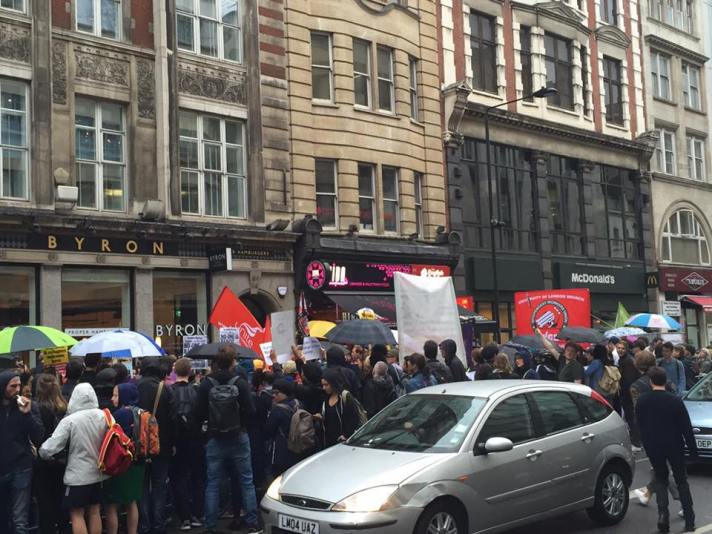
IWGB joins protest outside Byron in Holborn —

IWGB joins protest outside Byron in Holborn

byron3Cosas and IWGB activists showing solidarity with the deported workers at Byron restaurants and protesting against their unscrupulous practices!


Activistas de la campaña 3Cosas y del sindicato IWGB mostrando solidaridad con los trabajadores deportados de los restaurantes Byron y protestando en contra de sus practicas despiadadas!

There’s a report on the protest in VICE here.

Read full details of the case in the Guardian here.


UK joins Greece at bottom of wage growth league — July 27, 2016