IWGB notes with concern that the Conservative government’s plans to offer UK citizens an in/out referendum on EU membership in 2017 could lead to the UK’s exit from the European Union.
IWGB believes an exit would be detrimental to many IWGB members and their families, many of whom reside in the UK based on its membership of the EU.
IWGB further believes that the push for exit is being driven by the nationalist right who want to attack migrants as well as workers’ rights more generally, and would have negative consequences for workers and particularly migrants in the UK.
IWGB also notes the strength of anti-immigrant and anti-rights rhetoric which is being used by political figures and by the press to persuade the British public to vote for an EU exit. IWGB stands in strong opposition to these views.
With this in mind the IWGB recognises that the EU, like its constituent member states, is organised primarily in the interests of capital, as has been demonstrated by recent events in Greece. IWGB stands in solidarity with Greece and with other countries affected by the current political setup of the EU.
IWGB resolves:
To combine opposition to British exit from the EU with advocating a Europe reorganised to serve workers’ interests: a democratic Europe promoting workers’ rights and social provision, levelled up across the continent, and with genuine freedom of movement and equal rights for migrants.
For these reasons IWGB believes its members would be worse off in the event of an EU exit and IWGB therefore resolves:
to publicly state its opposition to an EU exit for the reasons outlined above
to call for support from other groups on the left who may currently support or be ambivalent to a UK exit from the EU
to publicly state its belief in the need for EU reform as an alternative to exit
to publicly state support for and solidarity with the people of Greece and other countries negatively affected by the EU’s economic policies
to identify and work with other groups that are campaigning to stay in the EU
to inform and educate members and the general public about the consequences for working people of an EU exit
to build networks of solidarity and support in the wider community.
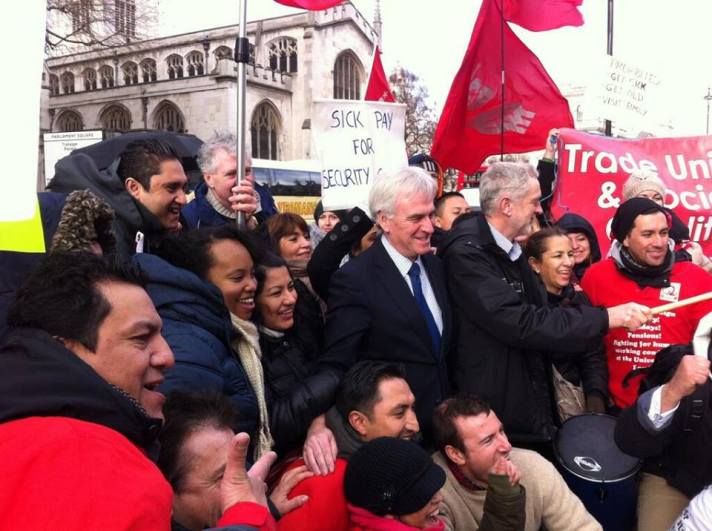
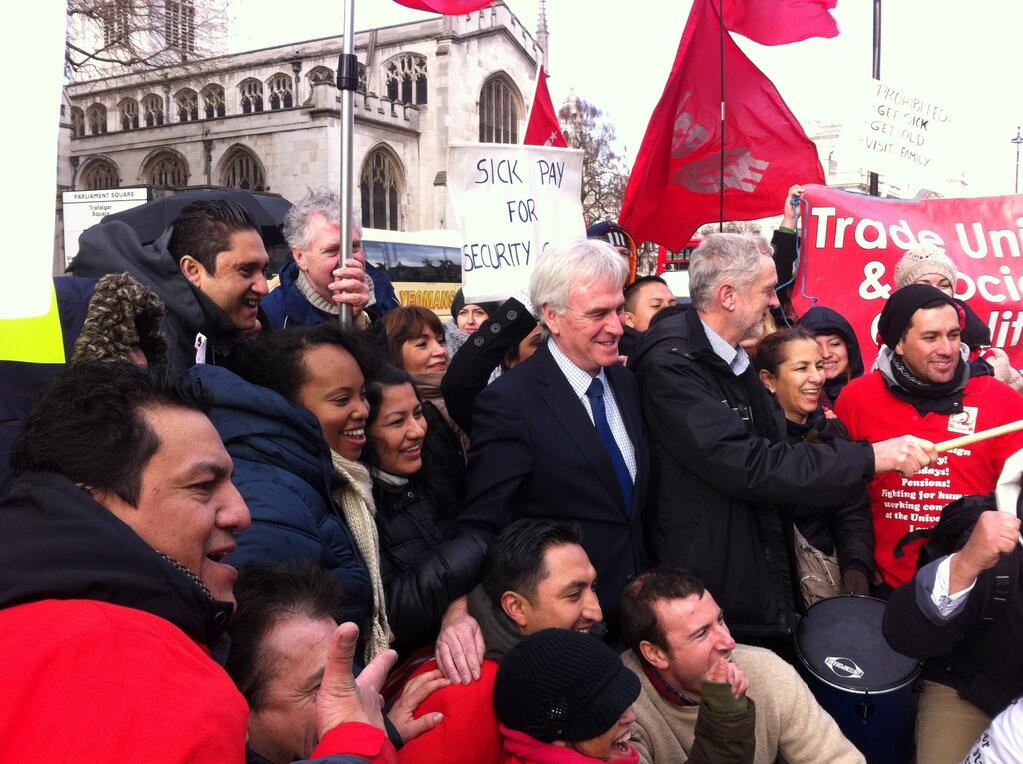
John McDonnell MP and Jeremy Corbyn MP with IWGB strikers at Westminster in January 2014.
This appeal is on behalf of the University of London branch of the Independent Workers’ Union of Great Britain (IWGB), an independent trade union representing the poorest workers in London.
Our success has always come from the support of a network of friends, families and volunteers. As part of plans to take our campaigning to the next level we are initiating the IWGB Community, and we would like you to join!
The IWGB organizes the UK’s most hyper-exploited workers, most of whom are women and migrants. These are the people that clean the toilets of the city, sweep its floors and carry out the portering. They travel on the early-morning buses or trains, when most of London is still in bed, and spend their days doing shifts for two or three different employers. To most people they are one thing: invisible.
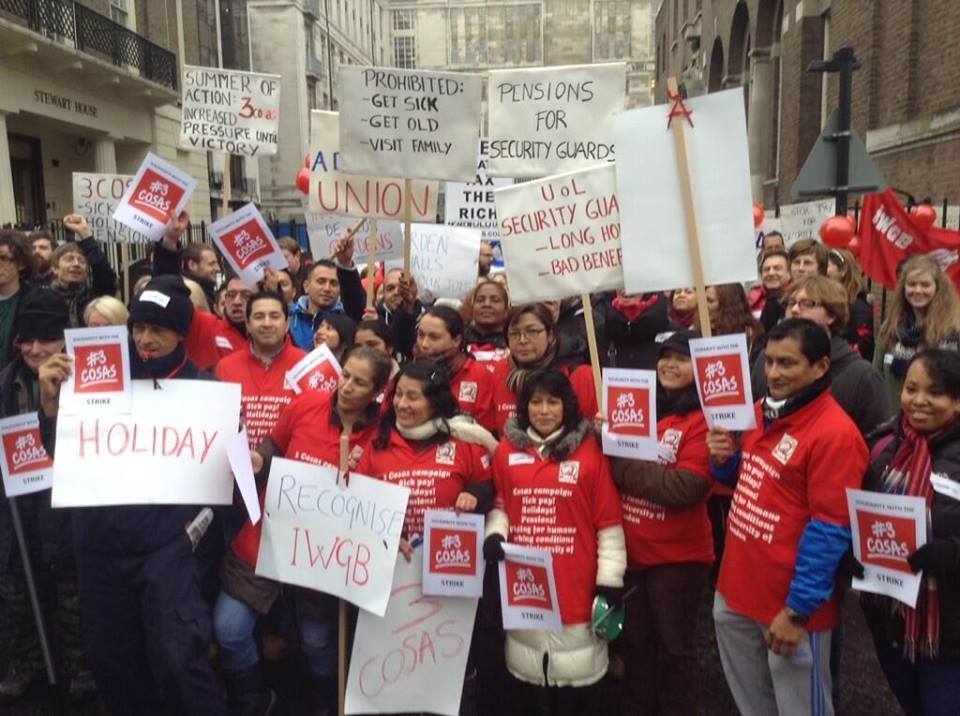
IWGB 3 Cosas strike at Senate House, November 2013.
Over the past 12 months alone our campaigns have led to cleaners and other low-paid workers winning improved sick pay, holidays and pensions and achieving the London Living Wage (now £9.15). Just recently we have secured these improvements for workers at the London School of Hygiene and Tropical Medicine; and we have also won the London Living Wage at the Royal College of Music and the Royal College of Art.
On top of this, we provide free language classes; organize social events, provide free employment law advice in our workers advice centre, support members in disciplinaries, grievances and at employment tribunals.
More important than the campaign victories, the democratic, worker-led initiatives have given workers respect and dignity. They are beginning to be treated like human-beings.
With next to no resources we have achieved impressive and life-changing results. We now need financial support to take our struggle to the next stage.We are asking you to become a member of our community, the University of London IWGB Community.
The IWGB Battle Bus – day 2 of the January 2014 strike!
As a member of the University of London IWGB Community you will receive a regular newsletter about the activities of the union, you will be invited both to our parties and our protests, and, most importantly, you will be key to the development and success of the union at a critical time. We ask that you pay a small monthly sum to help us achieve our aims.
How will your contribution be spent?
To help with the funding of the IWGB Legal Department. We have won funding for the formation of a Legal Department, however we will need more in order to pay for a legal department coordinator.
To pay for campaign organizers who will help run the campaigns that our members depend upon.
To pay for the rent of our small office in which we hold employment rights talks’ and our members meet.
To support strike action taken by low-paid members.
We hope that you are able to help our union grow and support some of London’s most vulnerable workers achieve dignity and respect.
Cofely Section Director Enda Nally puts a brave face on things…
We’ve finally heard back from Kim Frost, UoL HR Director, regarding the future of the University’s hard and soft services contract. The current arrangement, with Cofely GDF-Suez, is due to expire in November – and while last year Cofely were talking boldly of a new 10-year deal, things seem to have cooled somewhat since then.
Cofely Section Director Enda Nally has recently been pleading with the IWGB not to copy in senior University of London management to instances of their contractors’ incompetence, and this desperation may be explained by Mr Frost’s email to us earlier this week, which states:
‘I am now able to tell you that the strategic review and planning for the future provision of Facilities Management services to the University is expected to be completed in September and we will then begin procurement of the new services. This means that the existing Cofely contract will need to be extended for a few months in the interim while that process is underway’.
Not exactly a ringing endorsement!
The options are various – to stick with Cofely, to bring in another company, or to split the services between different companies (essentially a return to the pre-2010 arrangement).
The most sensible solution, of course, would be to end the double-level of management, lack of accountability and two-tier workforce and bring our Cofely colleagues in-house. The IWGB will be calling for this option to be fully costed and presented to the Board of Trustees in order that they can make a choice based on the best interests of the whole University, rather than on narrow ideological grounds.
Whatever happens, all current staff will be protected and transfer under TUPE legislation BUT please do get in touch with any concerns – uol@iwgb.org.uk.
A noted union fan shows his approval of the IWGB’s latest win
IWGB has learned this morning that it has won its case against the University of London in the Central Arbitration Committee (CAC). This is a fantastic result!
The case surrounded our complaint that the University had breached the Information and Consolation of Employees Regulations (ICE) when it attempted to collude with UNISON and UCU to avoid dealing directly with IWGB members and other staff. (You can read more about the background to the complaint here.)
The CAC Panel agreed. In reaching its decision, the Panel entirely rejected the University’s argument that its behaviour was not only legal but also consistent with good practice:
“It was the view of the Panel that the Employer had fallen short of good industrial relations practice both in terms of its arrangements for appointing representations [sic] and the subsequent ballot. It was an extremely short time scale from the announcement of the ballot to its closure and it lacked confidentiality as the HR Department, in monitoring that there was no repeat voting, had access to how an individual employee voted.
[…] the Panel is accordingly not persuaded that the Employer has complied with the requirements of regulation 14(2). […] It was unacceptable to expect employees to vote yes or no to four candidates that resulted from the arrangements agreed between the Employer and the two recognised unions without the Employer putting in place arrangements which allowed for alternative candidates to be put forward.”
The result of this decision is that the University must scrap the ICE arrangements it made with UNISON/UCU and start again, opening up the process to all employees – as the Regulations require. The deadline for this to be done is 30 November 2015.
UoL IWGB Branch Secretary Catherine Morrissey, who submitted the complaint, commented:
“We invoked the ICE Regs in November last year because we know that the cosy relationship between UNISON/UCU and University management is not working in the interests of staff. The panel’s decision today, and comments they made during the hearing, confirm that.
This is a huge victory for IWGB and for working people in general. Had the University succeeded in its arguments, the ICE Regulations would have been completely undermined. This decision shows that employers can’t simply do what suits them. We’re delighted that the panel found in our favour and will be looking to put forward IWGB candidates for election in November.”
This decision is so hot off the press it hasn’t even reached the CAC’s own website yet, so IWGB members are the first to know!
You can read the full decision here – the document describes the background to the complaint and the arguments made by both sides. The Panel’s considerations and decision are on pp.25–30.
UoL’s barrister has previously indicated that the University is likely to appeal. If it does, we look forward to meeting them again in an Employment Tribunal!
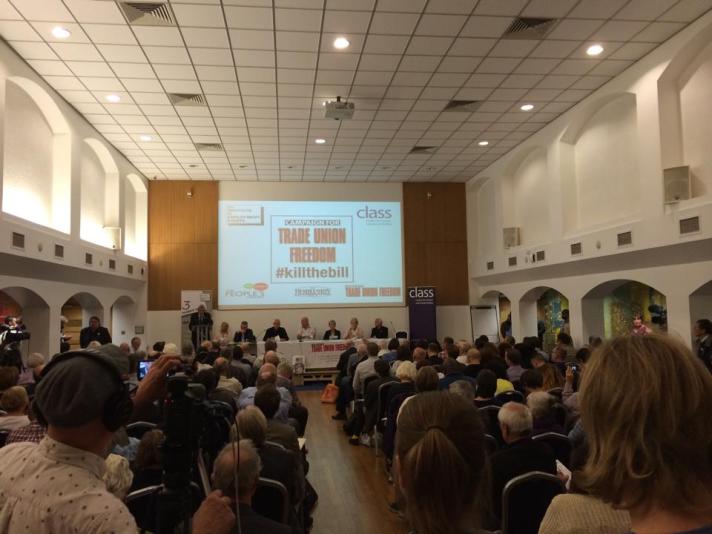
We know how to have a good time in the IWGB – there have been two meetings this week concerned with the planned Tory trade union legislation, and we were at both of them.
One was a meeting of neighbourhood unions to discuss what we might do at a local level to combat this legislation. Everyone agreed that since the government are planning to push this through before the end of the year, active opposition to it has to start urgently. There was a lot of discussion about overall strategy, but the key point for now is that they’re going to do targeted protests outside MPs’ constituency offices.
It was decided that the first one should be at 12.00 on 8th August (that’s this Saturday) at Iain Duncan Smith’s office, which is in Chingford. (64A Station Road, Chingford, London, E4 7BE.) The IWGB will be there – so please come along if you can! If you are free email uol@iwgb.org.uk and we can arrange to meet up.
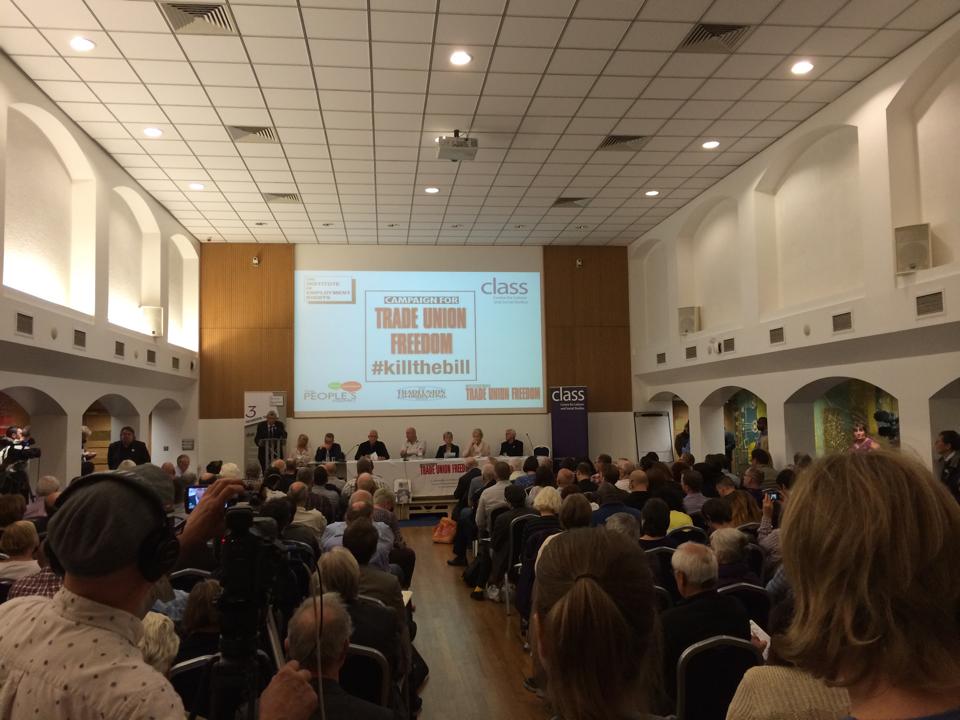
Someone in the far distance addresses the Right to Strike meeting last Wednesday
The second was a national meeting (full report here) featuring speeches from Len McCluskey, Mark Serwotka and Dave Prentis among others. Fearing that it might never end, we decided to keep our mouth shut…
But, you might be asking, what is all the fuss about?
There’s a lot in the new bill, but the crucial changes are:
a legal strike will require a 50% turnout and some areas of the public sector also 40% support among all those eligible to vote
attacks on facility time – reducing paid time off for union reps
further restrictions on picketing – limiting the number of pickets, and requiring them to give additional details to the police
increasing the notice period for strikes – this will increase to 14 days, giving employers more time to prepare and to bring in replacement labour
agency workers allowed to replace strikers – this is currently banned across the EU
It’s already unbelievably hard to strike effectively in the UK. There is no problem in terms of the number of days lost to strikes. No-one goes on strike except as a last resort, as no-one wants to lose pay.
Yet these changes aim to make it harder still – with the simple aim of making it harder for ordinary workers to win decent pay rises, or to stop redundancies, or to protest unfair dismissals or discrimination.
All of us will suffer if we don’t stop this bill – so please help us fight it!
We just wanted to provide as much of an update as we could on CoSector developments. As you will see from the email exchange below, non-CoSector staff were effectively barred from Thursday’s meeting, but we circulated a set of questions to all affected staff in the hope of getting them raised.
Initial reports suggest that the picture still remains vague. Two pieces of further information were that:
The UoL would be the sole shareholder in CoSector, but there might be sub-companies set up later which were jointly owned with externals where there expertise was needed to develop specific products or services.
Apart from the new CoSector management team, for the moment new staff being recruited would still join UoL, but that the situation going forward would be reviewed when the business plan is being approved (it’s thought this will be December or January).
Please do get in touch with more info (uol@iwgb.org.uk) – we’ll be discussing with members and various others what next steps to take.
Below is the email we send out on Thursaday am, with a Kafkaesque interchange with CoSector HR beneath it:
Sorry to bother you again – as I’m sure you know, there’s a staff meeting regarding CoSector taking place at 10 this morning.
I and other University colleagues were planning to attend – we’re concerned about these developments, and we think they will affect all of us (and as the CoSector slot was largely cut from the 16 July ASM, we haven’t had a chance to ask questions).
However, as you will see from the email exchange below, we have been strongly discouraged from doing so!
There were a bunch of questions that we were hoping to raise, and I thought it might useful to send these round. You may already know the answers but if not it would be great if some of these could be asked.
Do let me know how it goes
Cheers
Danny
1. The ‘Building a new tomorrow’ document has plans which are predicated on expanding turnover from £15m to £30m in the next 5 years, and generating a 10% profit. What evidence is there that these projections are realistic?
2. One of the main justifications for these plans is that it will be possible to attract investment. How will the new company attract investment, and in what form? Where will investment come from if the UoL retains 100% ownership of shares?
3. UoL staff are apparently to be seconded to CoSector. How long will ‘secondments’ be for? Is it possible that staff could eventually be forced across to CS employment?
4. UoL presumably wants CoSector to succeed, therefore it cannot be UoL’s intention to return staff to their UoL posts. Given that, can they explain why staff are being ‘seconded’, not TUPEd?
5. What is the exit strategy if the CoSector project goes wrong? (Both for staff’s jobs, and for the University more generally as the principal owner/investor)
6. If CS were to go wrong, and UoL staff were to return to UoL, what would happen to CS staff?
7. Who would pay the redundancy payouts if the company fails – UoL or CoSector?
8. What pension schemes are being considered for new hires in CoSector?
9. Much of the feedback by staff in earlier consultations centred around their desire to work for the University, rather than for a private company, and also stressed that the fact that these services were being provided by a University department was a selling point for prospective clients. How can these findings be reconciled with the Co-Sector proposals?
10. Has the University of London taken legal advice to ensure that its covenant of use of Senate House will not be infringed by the establishment of the proposed company? What about in future, should more shares be transferred to private ownership?
11. Has it been ascertained that CoSector fits with the JANET eligibility criteria?
12. Is CoSector eligible to purchase educational software licences? If not, have the costs of new licences been calculated, and factored into financial projections?
13. Many staff are concerned that their current relationships with the colleges could be damaged by the establishment of CoSector, potentially leading to a loss of business? Has this risk been factored in?
14. CoSector already has its own human resources department, rather than being able to use the UoL HR department. What other duplications of this sort are likely to occur? Have these costs been factored in?
From: Matthew Thorne
Sent: 29 July 2015 15:15
To: Danny Millum
Cc: Anthony Kemp
Subject: Re: CoSector meeting tomorrow
Thanks Danny
Kind regards
Matt
________________________________________
From: Danny Millum
Sent: 29 July 2015 15:08
To: Matthew Thorne
Cc: Anthony Kemp
Subject: RE: CoSector meeting tomorrow
Dear Matthew
Sorry – I’m not trying to be pedantic, and I know you are only trying to do your job.
I’m still not sure you’ve quite answered my last question – but I can take a hint, and I’ve no wish to cause awkwardness for other members of staff by gate-crashing.
Let’s continue this discussion in another forum soon.
Best wishes
Danny
From: Matthew Thorne
Sent: 29 July 2015 14:27
To: Danny Millum <Danny.Millum@sas.ac.uk>
Cc: Anthony Kemp <Anthony.Kemp@london.ac.uk>
Subject: Re: CoSector meeting tomorrow
Dear Danny,
The CoSector ASM is for those staff that directly related to CoSector i.e. Housing, ULCC and The Careers Group and you are therefore not required to attend the meeting.
As previously mentioned further information about CoSector and the opportunity to raise further questions by the UoL staff will take place in due course.
Kind regards
Matt
________________________________________
From: Danny Millum
Sent: 29 July 2015 13:57
To: Matthew Thorne
Cc: Anthony Kemp
Subject: RE: CoSector meeting tomorrow
Dear Matt
Many thanks for getting back to me. I’m afraid that the next ASM is not even scheduled yet, and is likely not to take place until November.
Last September I was assured by Chris Cobb that there would not be a new private company, but rather simply a department. Between then and now all manner of decisions have been made, and I would imagine that a similar thing will happen between now and this November.
The implications of CoSector – on our pension schemes going forward, on potential ‘CoSector-esque’ developments for other departments, on relations within the University Of London, on the UoL’s relationship with the colleges etc – are extremely significant, and will affect us all.
As I’m sure you know, consultation over new proposals is a two-way process – staff need to be informed of, but also wish to contribute to and have an impact on, these developments. As such any opportunity to answer questions from any source ought to be beneficial.
Taking the above into account, can I just clarify that I am NOT permitted to attend tomorrow’s meeting?
Best wishes
Danny
From: Matthew Thorne
Sent: 29 July 2015 12:33
To: Danny Millum <Danny.Millum@sas.ac.uk>; Anthony Kemp <Anthony.Kemp@london.ac.uk>
Subject: Re: CoSector meeting tomorrow
Dear Danny
The ASM tomorrow is for CoSector related staff only rather than the wider UoL. There will be information about CoSector coming out as things develop which will be shared with all UoL staff and further opportunity to raise questions in the University all staff meetings going forward.
Kind regards
Matt
________________________________________
From: Danny Millum
Sent: 29 July 2015 11:56
To: Anthony Kemp
Cc: Matthew Thorne
Subject: CoSector meeting tomorrow
Dear Anthony
Sorry to bother you – I’ve just seen the message on the intranet re tomorrow’s CoSector meeting.
I and other colleagues from the wider University had been planning to attend the meeting – we’d hoped to hear more about CoSector at the ASM on the 16th, and had the impression that tomorrow would be an opportunity for all of us to ask questions, as these developments will have long-term consequences for everyone at the UoL.
Could I confirm with you that while all UoL staff are not required to attend, they may do so if they wish?
There’s a nice blog post here describing a session on migrant union organising part-run by IWGB Vice-President Henry Chango Lopez – read the full piece here.
To coincide with the introduction of the shiny new Intranet, the University took the opportunity to remind us all of the massive increase in consolidated London Weighting we would be getting on 1st August. This of course is the implementation of the agreement that was reached on behalf of all staff by Unison and UCU.
Whilst any increase in pay is cause for celebration, and is down to the hard work of IWGB members among others, it remains to be an unsatisfactory deal and there will be a push for an increase in the future.








 Independent Workers Union of Great Britain - Universities of London Branch