IWGB’s University of London branch secretary responds to vice-chancellor’s email  — October 29, 2018

IWGB’s University of London branch secretary responds to vice-chancellor’s email 

Dear Peter

I am writing briefly in response to the email below, the tone of which I am afraid I find disappointing.

While I completely agree that professionalism, respect and mutual trust and indeed laudable principles on which to base an institution’s culture, I don’t see how that can be squared with the reality of the University of London.

Currently, predominantly BME outsourced workers at the University suffer much worse terms and conditions than their mostly white directly employed counterparts. This is blatant discrimination and incompatible with the principles you outline.

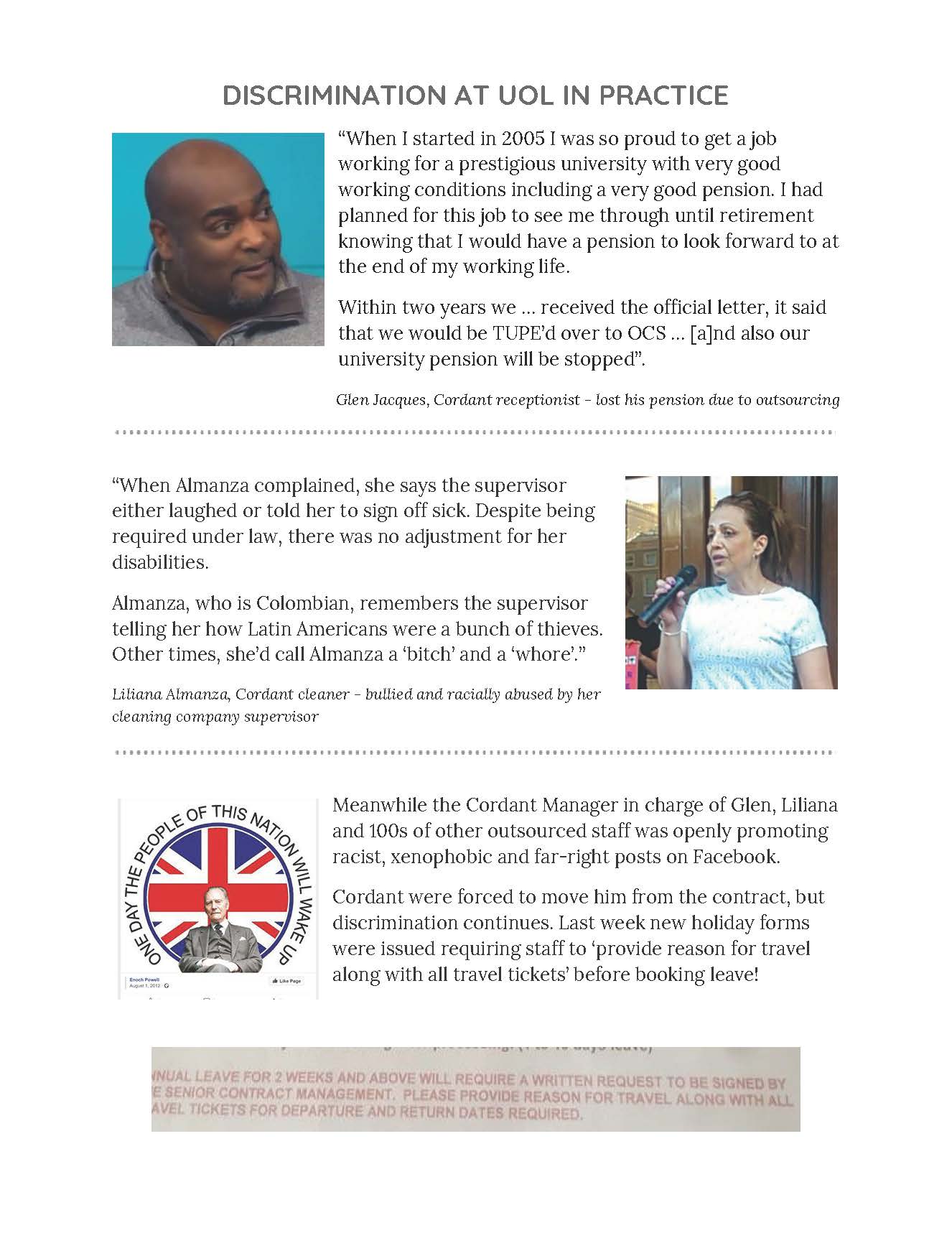
In addition, the main outsourcing company Cordant have been allowed to employ first a manager that was an open supporter of the far right, and now another manager who has been accused by no fewer than 3 women of blatantly racist, sexist and homophobic behaviour and yet remains in post. These women continue to work in fear on a daily basis, a fact difficult to square with any declaration that no member of staff should work ‘in an environment where they feel uncomfortable’.

Finally, while it’s definitely a positive development that you have met with the cleaners, it is worth bearing in mind that they have just voted 100% yes for strike action following the failure of the University to engage with them.

It is these predominantly middle-aged Latina cleaners, along with your own security officers, who will be forming the bedrock of the 30 October demonstration. When UCU struck earlier this year for 14 days the University continued as usual with no additional security – yet when low-paid migrant workers take action this is cause for a massive lockdown and pre-emptive yet vague accusations of intimidation. This can only be seen as further double standards.

As stated in numerous emails, the IWGB as the chosen union of these workers remains open for negotiation. All of our offers have been ignored. Until the University engages in dialogue to end its discriminatory employment practices there will continue to be strikes and demonstrations, and we believe it’s clear the responsibility for any disruption clearly lies with the side that refuses to negotiate.

Best wishes

Danny

Danny Millum
Branch Secretary
University of London IWGB


From: Fiona Bernardone On Behalf Of Vice Chancellor
Sent: 26 October 2018 10:11
To: Central-University <central-university@london.ac.uk>
Subject: Message from the Vice-Chancellor

Dear Colleagues,

I have now met with most of the heads of member institutions and I have been impressed by their support for the University, and their wish to work closely with us. They all see membership of the University as a benefit to their institution. This is important when considering the University of London Bill which is currently passing through Parliament. The Bill establishes member institutions as universities in their own right. It was debated in the House of Commons last week and successfully passed through its second reading and now progresses on to the Bills Committee. Each Head sees the Bill as a means of consolidation within the federal university.

Evidence for this came from a recent visit by Chris Cobb and I to Paris. We were invited by Professor Ed Byrne, President of KCL and Deputy VC UoL, to attend the signing of a preliminary agreement between KCL and the Founding Institutions of the University of Paris for a strategic partnership. Ed was generous in his speech in emphasising UoL’s presence at the ceremony and the opportunities from closer working between the two federal universities. You will be aware of the University of London in Paris which I visited for the first time in the afternoon. It is an impressive building superbly located in the centre of the city. Our exploration with Member Institutions about how we may utilise this “asset in Europe” post Brexit has been met with considerable interest and positive proposals.

As you will have read, the Board of Trustees have firmly supported our plan for Facilities Management Services (intranet post here). I am conscious that this is a matter that has generated strong feelings, some of which have been expressed in communications directed at me and my executive team in a tone that I have found personally disappointing.

I am mindful of the planned demonstration on 30th October and of the feelings that some of you have expressed in relation to the impact of previous demonstrations at the University.  In this regard I would wish to echo the message expressed toward the end of the recent intranet post on this matter, that is, that I do not expect any member of staff to work in an environment where they feel uncomfortable.

My background as a doctor is one of professionalism, respect and mutual trust. I have previously worked closely elsewhere with colleagues and recognised representatives to foster a culture based on these principles. I will carry on with this approach here at UoL. I am continuing to visit the University’s departments and meet staff to enable as many as possible to connect with me directly. I have come in early to Senate House on a number of occasions to meet the cleaners and porters. I am constantly impressed by everyone’s very evident loyalty and commitment to the community of the University, whatever their background and would like to thank you all for the welcome you have given me.


Peter Kopelman
Vice-Chancellor


University of London launches race equality group — October 17, 2018

University of London launches race equality group

The University of London (UoL) is introducing its first race equality group “in recognition of the under-representation of black and minority ethnic staff in senior levels”. Membership is open to everyone at UoL and participants will be encouraged to share their experiences and insights to help the university improve its “working practices and promote a positive and inclusive workplace culture”.

The launch, which takes place on 24 October in Chancellor’s Hall, 1.30–3pm, includes a presentation by Jannett Morgan, associate director for Advance HE’s Diversifying Academic Leadership programme. She will discuss the empowerment and promotion of talented people from under-represented groups. See details here.

IWGB’s University of London branch appoints its first BME officer — October 12, 2018
‘In-house’ fundraiser gives £2,000 boost to IWGB strike fund — September 18, 2018

‘In-house’ fundraiser gives £2,000 boost to IWGB strike fund

Thanks so much to everyone who came to the University of London ‘back in-house’ fundraiser party on 15 September, and to those who helped raise the money in a range of creative ways. These included raffle prizes donations and the organising of a well-run bingo session.

Some 200 people descended on SOAS for the event. We had an amazing time and managed to raise more than £2,000 which will help us continue the fight for justice and equality and support the next strike by outsourced workers at Senate House.

Translation

¡Muchísimas gracias a todos los que vinieron a la fiesta de recaudación de fondos para la campaña de la rama Universidad de Londres anoche, y tambien a todos quienes nos apoyaron y ayudaron a recaudar el dinero de diferentes maneras!

Definitivamente la pasamos genial y logramos recaudar más de £2000 para la próxima huelga y para seguir luchando por justicia y igualdad!

 HASTA LA VICTORIA SIEMPRE!

One university should mean one workforce: it is time to end discrimination at UoL — August 15, 2018

One university should mean one workforce: it is time to end discrimination at UoL

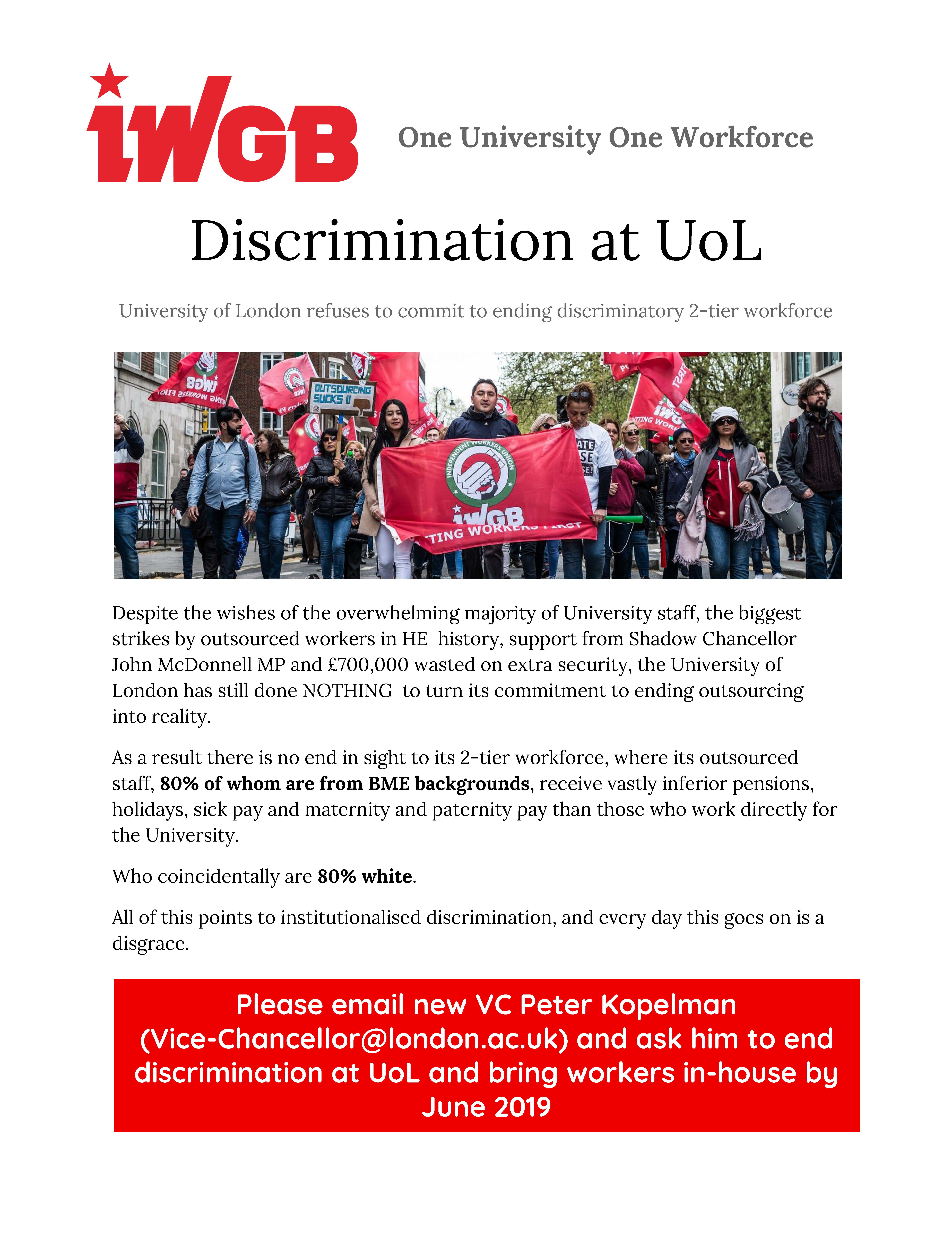
Despite the wishes of the majority of its staff, the biggest strikes by outsourced workers in higher education history, support from high-profile politicians, and £700,000 wasted on extra security, the University of London (UoL) refuses to commit to ending its discriminatory two-tier workforce.

Not even the acres of negative press nor the heartfelt pleas from outsourced staff, the majority of who are from BME backgrounds, have managed to make a chink in the armour of the university’s senior management team.

Incidentally, 80 per cent of the institution’s directly employed staff are white. And guess what? Unlike their outsourced BME colleagues, they have enviable pension arrangements and holiday entitlements, are entitled to sick pay and good maternity and paternity pay. Moreover, the university’s ‘dignity at work’ policy ensures they are treated with respect.

All of this point to institutionalised discrimination, and it is a disgrace.

Please email the university’s new vice-chancellor, Peter Kopelman (vice-chancellor@london.ac.uk) and ask him to end discrimination at UoL and bring workers in-house by June 2019.


University of London’s outsourcing manager under fire for racist Facebook posts — July 10, 2018

University of London’s outsourcing manager under fire for racist Facebook posts

IWGB’s general secretary demand immediate action over racist and far-right posts by Cordant manager who oversees two of the University of London’s five outsourcing contracts

Dear Chris Cobb,

I am writing to you, in my capacity of General Secretary of the Independent Workers’ Union of Great Britain (IWGB), to express my grave dismay at the fact that the person you have chosen to oversee your outsourced contracts is openly xenophobic and racist.

The person in question is a Cordant manager who oversees two of your five outsourcing contracts, in particular with respect to cleaners, porters, security guards, receptionists, and postroom staff. As you are well aware, the overwhelming majority of these workers are migrants.

The matter has come to my attention as his Facebook page, which is accessible to the public and has been seen by various of the outsourced workers he oversees, is replete with anti-immigrant, xenophobic, racist, and race-baiting posts.

I suggest you give it a look yourself, but to see just a small taste on what is on offer, the below suffices: an homage to Enoch Powell, a joke about how immigrants in the UK are benefits scroungers, and a joke about how Polish people are cleaners. For good measure he also wants fascists to have free reign to propagate their hate (see post about Tommy Robinson).

Now for some time we have been making the case that outsourcing, at least the way you do it, is inherently discriminatory. You have a predominantly BAME and migrant workforce which work on far inferior pay, terms and conditions, and treatment compared to their predominantly white British directly employed colleagues. And our members certainly feel as though they are bearing the brunt of the discriminatory policy.  But these recent revelations take the matter to a whole new level.

For now, in addition to working under inferior terms and conditions, the workers are being supervised by someone who thinks they shouldn’t even be here in the first place. Given some of the hostile interactions some of the workers have had with Lee Smith, including on one occasion Lee Smith aggressively pushing and shoving one of our members, needless to say, some of our members are deeply unsettled.

Of course, there are also serious legal issues which you need to consider, such as the University’s Public Sector Equality Duty pursuant to the Equality Act 2010.

Now your usual tactic is to place the blame for all things outsourcing on the contractors themselves. Not this time. You and only you chose Cordant for your contracts. No one else made that decision except the University of London. This is your responsibility. I want to know what you’re going to do about it, and I want to know now.

Kind regards,

Dr Jason Moyer-Lee
General Secretary
IWGB


Birkbeck Justice for Workers Campaign Update #2 —

Birkbeck Justice for Workers Campaign Update #2

Below, is an extract from a letter from Birkbeck Justice for Workers, which provides an update on its campaign to bring Birkbeck, University of London’s cleaning, catering and security staff back in house. They also share a letter in solidarity received from the South Africa’s Outsourcing Must Fall movement.

Dear all,

Our campaign is gathering pace. We have over 450 signatures on our petition – we’d love to get that to 500, so please keep sharing with your friends and colleagues. Birkbeck UNISON are having positive negotiations with management and we know the weight of support for our campaign is strengthening our hand. We have also received a heart-warming message of solidarity from the Outsourcing Must Fall movement in South Africa – you can read that below.

The message of solidarity mentions fighting unions. We’d like to thank the University of London IWGB for joining us at our demonstration last month.

Best wishes

Birkbeck Justice for Workers


Solidarity from #OutsourcingMustFall Campaign, South Africa

We write to you in solidarity with your struggle for the insourcing of workers at Birkbeck College. Our struggle against outsourcing received national prominence during the student protest against fee increases in 2015 when insourcing of workers was included as part of #FeesMustFall movement’s demands. The solidarity from students raised the profile of our struggle against poor working conditions and wages we had endured since our universities introduced outsourcing of what it called, ‘non-core functions’ in the late 1990s.

Although outsourcing is commended as ‘cost effective’, ‘efficient’, ‘productive and strategic’, it has been shown through a cost accounting analysis based on the experience of the University of the Witwatersrand in South Africa, that it results in increased ‘transaction costs’. These include cost creep from an increase in complaints and worker unrest, the loss of coordination efficiencies and of tacit skills and organisational memory (Adler et al., 2000, in Dumba, 2014).  The combination of these elements have shown the opposite of organisational efficiencies claimed to justify outsourcing.

Notwithstanding the victories scored to be insourced at some of the institutions in South Africa, there is still a long road ahead against outsourcing in our country. Not only are many higher education institutions still using workers from outsourced companies, the #OMF  has had to extend its campaign to include the whole of the public sector where cleaning, security, catering and landscaping services have been outsourced at local, provincial and national government level including parastatals.

We have combined different tactics of protests such as pickets, occupations and strikes to make our voices heard. We have also approached political parties to pass motions against outsourcing in the Legislature but we have yet to see results from this approach.

While we have worked with a union, and many members of #OMF have subsequently joined this union, we have had to fight on two fronts, of the union and #OMF campaign. The latter has proven to be much more flexible to respond to the immediate concerns of workers. We are also of the view that our campaign has the potential to revive and rebuild fighting unions in the process of struggling to ensure outsourcing does fall.

We wish you all the success with your struggle against outsourcing at Birkbeck College.

Yours in solidarity

#OMF Co-ordinating Committee Convenor

Executive Mukhwevho


IWGB applauded for standing up to the ‘gig economy giants’ — July 1, 2018

IWGB applauded for standing up to the ‘gig economy giants’

IWGB’s fight against organisations such as the University of London, which continues to trample over the employment rights of its outsourced workers, features on the politics page of the Guardian.

The article, “The tiny union beating the gig economy giants”, describes IWGB’s grassroots fightback that is helping to win basic rights for couriers, cleaners and other workers on zero-hours contracts.

It highlights a range of the union’s successful actions including last month’s Deliveroo case in which 50 couriers won a six-figure payout because they had been denied rights including the legal minimum wage and paid holiday. More important, the article pays particular attention to IWGB’s ongoing ‘back in house campaign’ at the University of London.

Written by Yvonne Roberts, it quotes from Glen Jacques’ letter in which the receptionist warns: “Every pyramid is only as strong as its foundation, and if the foundation is not maintained to a high standard, the pyramid will, in time, collapse.” And it includes profiles of three of the workers who run the union – Mags Dewhurst, part-time bicycle courier and IWGB vice-president; Sarah Anderson, chair of the union’s first foster care workers’ branch; and our president, Henry Chango Lopez.

Read the full Guardian article here.

IWGB questions proposed closure of Lunchbox café and subsequent redundancies — June 26, 2018

IWGB questions proposed closure of Lunchbox café and subsequent redundancies

Less than two years after staff working at the Lunchbox café in Student Central were TUPE’s to Aramark from University of London employment, plans are afoot to close the outlet. This would mean the loss of a vital shared space for students in Bloomsbury and potential redundancies.

There is no doubt that with proper investment this could be a profitable concern.  IWGB is appealing to the university to reverse this decision and recognise its wider responsibility for Bloomsbury’s student and academic community, and has today contacted Vivienne Shinner, Aramark’s director of operations (see below), to call for clarification and question the hasty nature of the formal consultation process, which is taking place without adherence to due process.

Dear Viv,

I have been informed by affected staff that there are plans to close the Lunchbox café at Student Central with a number of potential redundancies.

This information was communicated to staff at a meeting on Wednesday 20 June, at which they were also informed that the formal consultation process had begun.

As with previous Aramark restructures, it is clear that due process is not being followed here.

  1. Aramark has immediately entered into formal consultation over redundancy with no attempt being made over preceding months to improve the situation or involve staff.
  2. Insufficient information has been provided for this to constitute a meaningful consultation – all that staff have been told is that the outlet has been suffering ‘difficult trading conditions’ and has made a loss of £12.6k over the last 10 months. Without more detail as to the financial situation (previous profit levels, turnover, investment or lack thereof) it is impossible for staff to participate properly in this process.
  3. No consideration whatsoever has been given to the role that the café plays as part of the wider University community, and the impact the loss of this facility and this space will have on the student experience more widely, as well as the other outlets based in the building.
  4. This comes only 2 years after the restructure which saw staff TUPE from the University of London to Aramark. It is a damning indictment of the lack of resource that has been put into the café that Aramark are now looking to close a previously thriving café.
  5. You state in your letter that this is merely a consequence of ‘difficult trading circumstances’. However, in the meeting you said that the decision had in fact been made by the University of London – which of these is in fact the case?
  6. Coincidentally, this comes at a time when Aramark and the University have been forced by the IWGB campaign to end zero-hour contracts at the UoL – it would appear extremely convenient that Aramark have chosen this moment to try and save money by making staff redundant.

Could you please provide full detail of the financial position of the café and the decision-making process / alternatives considered prior to this point?

Could you also confirm who on the University of London side is responsible for this decision?

Can you confirm that in ANY redundancy package staff will receive the enhanced redundancy terms accorded to University of London staff?

Best wishes,

Danny