Response to Senate House UNISON’s claims over outsourced workers — March 26, 2014

Response to Senate House UNISON’s claims over outsourced workers

Senate_House_UnisonDear Dave,

You have recently written a blog post on behalf of UNISON Senate House Branch, entitled “Terms and Conditions: Success at Last!”  In this post you announce (4 months late) the fact that Cofely workers now have up to 6 months sick pay and 25 days holiday.  You then attribute this victory to UNISON activists, negotiations and campaigning.  This post is so ridiculous I seriously considered whether it was even worth responding to, however given that some uninformed individuals might read it, I guess it is important to set some facts straight.  Given that nearly every sentence is either enormously misleading or just a blatant lie, I would ask you in advance to bear with me on the tedious nature of the task at hand.

You begin the post by saying “negotiations took months of meetings”.  That may be true, however what you leave out is the fact that the negotiations were conducted in secret and without the consultation or consent of the outsourced workers.  But most importantly, the negotiations were being used by UNISON officials to undermine the outsourced workers’ 3 Cosas Campaign.  Indeed a Guardian article which came out yesterday (http://www.theguardian.com/education/2014/mar/24/cost-private-contracts-universities-documents-services-workers) revealed that UNISON had told the University of London that they were keen to “counter” the campaign and even suggested that if the University were to offer up just one additional day’s annual leave that that could “suffice” to shut the cleaners up.

You go on to say that the campaign was the product of combined efforts of Senate House and London Region UNISON activists.  That’s true, until of course, all the Senate House UNISON activists left UNISON in disgust in March, 2013 after UNISON invalidated an election on technicalities in order to prevent pro- 3 Cosas Campaign candidates from winning.  When we all left we created a new branch of the Independent Workers Union of Great Britain (IWGB) where we have been for nearly a year.  We are now the biggest union at the University of London Central Administration, and represent a majority of Cofely employees.  There are only a handful of outsourced workers who are still UNISON members and these are dominated by managers and supervisors.  And sorry to be nit-picky on the details, but the announcement on terms and conditions was made on the afternoon of the second day of a strike by IWGB outsourced workers.

You then go on to say “leaflets were sent, campaign funds were spent, protests were held”.  This is all true, but you do leave out a few points.  UNISON paid for absolutely nothing.  Not one p.  In a branch committee meeting in November of 2012 we presented a budget for the campaign of just over £2,200.  We had enough votes on committee to pass the budget but Simon Meredith, Vice-Chair of the branch, with the support of Tony Mabbott, a UNISON London Region official, refused to allow a vote.  Various committee members called for a vote but the vote was blocked and the “leaders” stormed out of the room.  Not only did UNISON not pay for leaflets, but the UNISON London Region official tried to stitch up the previous Communications Officer (who was a key player in the London Living Wage and 3 Cosas Campaigns) by telling the University of London that the printing bill he had racked up for the union was his personal responsibility and he therefore owed UoL a lot of money.  This is despite the fact that all his printing had been democratically approved at committee meetings- but UNISON and democracy have a difficult relationship.  And with regard to the protests, yes protests were held but the Senate House Branch “leadership” was glaring in its absence.  Furthermore, Maggi Ferncombe, the UNISON London Region manager, sent out public letters distancing UNISON from the protests.  University and Cofely management then put these up on notice boards and used them to discredit the campaign.

You say that there were some hiccups with the new contracts and that these were brought to management’s attention through UNISON reps.  It is true that there were some problems and the IWGB brought these to the attention of management.  Of course there is one UNISON rep who likely brought some of these issues up.  That would be Sharon Bracey, the UNISON workplace rep for Cofely who is also the Cleaning Services Manager, in charge of roughly 140 cleaners and porters.  She initiates disciplinary procedures against cleaners, puts people on 0 hours contracts, etc.  And yes, she is the best person UNISON could find to be a workplace rep.  I’m sorry to point out the blatantly obvious, but when workers raise contract concerns with her they are not doing so because she is a UNISON rep, but rather because she is their boss.

Your closing lines, where you congratulate the cleaners on their hard work and claim credit for the victory are so disdainfully hypocritical that it defies common sense to think you can write something like that and not be challenged on it.  In sum, it is probably worthwhile for the UNISON Senate House branch to do some reflection on why it has lost nearly all its low paid members, all of its activists, and a large contingent of direct employees.  What’s left of UNISON at Senate House is now run by a collection of managers, pathological liars, and unelected autocratic bureaucrats masquerading as a union.  As far as I can tell the plan for building this organisation appears to be based on selling subsidized car insurance, broken promises, and a re-writing of history that would make Stalin proud.  Good luck!

-Jason Moyer-Lee

 

Guardian revelations on University of London outsourcing and UNISON collusion with management — March 25, 2014

Guardian revelations on University of London outsourcing and UNISON collusion with management

Cleaner from 3Cosas campaignOn 28 February this year, students protested outside Senate House in the University of London. A small group somehow got into the office of the vice-chancellor, Adrian Smith. While there, they took a cache of documents. I have seen two, and they that reveal a dark underside to one of the most contentious aspects of higher education.

Read Aditya Chakrabortty’s full article here.

UoL directly-employed workers’ drop-ins — March 21, 2014

UoL directly-employed workers’ drop-ins

hthompsonHannah Thompson is our new University of London direct employees rep, and if there are any issues you’d like to raise face-to-face with the union, or if you are not yet a member of IWGB but would like more information, you are welcome to come to our weekly drop-in sessions. Hannah and other officers will be in the Institute of Education bar every Tuesday lunch, 12:30-1:30.

Student criticises University of London for £800 fine after Senate House chalk protest —

Student criticises University of London for £800 fine after Senate House chalk protest

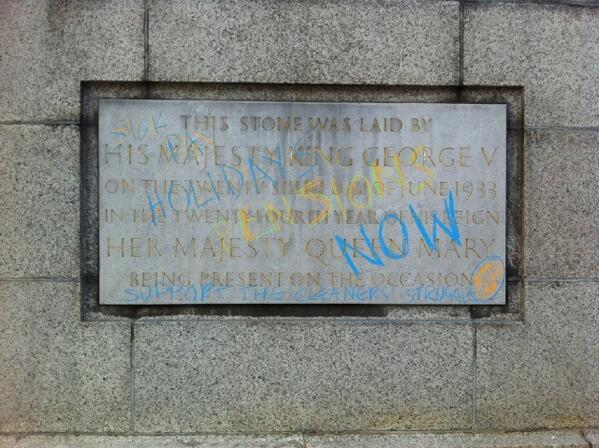
Kons2A student today hit out at the University of London after she was prosecuted for scrawling chalk on a building during a demonstration over staff  pay.

Konstancja Duff, 25, was arrested, ordered to pay an £810 fine and given a three-month conditional discharge after writing slogans in coloured chalk during a protest for the rights of cleaning staff.

Read full story here.

We believe in strikes – motion of support from Birkbeck UNISON — March 17, 2014

We believe in strikes – motion of support from Birkbeck UNISON

Birkbeck_CollegeThe following statement was passed by Birkbeck UNISON branch committee after our recent strikes – a great gesture of solidarity!

This branch notes;

1)      The ongoing dispute of outsourced workers at the University of London to achieve union recognition, full parity of terms and conditions with directly employed staff, and no job losses, organised through the 3 cosas campaign.

2)      The success of the recent strike action taken by these workers through their union, the IWGB, in winning some of their demands on terms and conditions.

3)      The threat to discipline workers for attendance at picket lines.

This branch believes;

1)      That a victory for any group of workers in struggle should be celebrated, and that success for this campaign in particular will be very beneficial to many other groups of outsourced workers at other Bloomsbury colleges and beyond, many of whom are UNISON members and some of whom are engaged in similar disputes

2)      That UNISON membersshould stand in solidarity with this dispute and refuse to accept management attempts to intimidate workers out of taking lawful industrial action.

This branch resolves;

1)      To send solidarity greetings to the 3 cosas campaign.

2)      To publicise details of the campaign to our members, including details of any future industrial action or demonstrations and a request for financial support.

Letters from 3 Cosas campaigners asking for IWGB recognition — March 15, 2014

Letters from 3 Cosas campaigners asking for IWGB recognition

martalunaThe main priority of the 3 Cosas workers right now is to achieve union recognition for their union, the IWGB, with the outsourcing company Cofely. This is particularly important as there are potential redundancies at the Garden Halls this summer and Cofely refuses to negotiate with the IWGB as they don’t recognise the union. This is despite the fact that the majority of Cofely employees are IWGB members.

Cofely instead chooses to recognise UNISON, which barely has any members, and where the Cleaning Services Manager is the rep! Over 50 IWGB members have written letters to Cofely management asking for recognition. Over the coming days we will be publishing these letters on our Facebook page, beginning with these great letters, from a Guatemalan cleaner named Marta Luna (https://www.facebook.com/3coca/posts/616898071732432), an Ecuadorian cleaner named Ruth Cecilia Tapia Lopez (https://www.facebook.com/3coca/posts/618481784907394) and Olga, a cleaner from Colombia (https://www.facebook.com/3coca/posts/619073781514861).

University of London IWGB responds to Jon Rogers — March 13, 2014

University of London IWGB responds to Jon Rogers

IWU-GB Logo_edited-7On Monday, 10 March, 2014 I attended a gathering of trade union activists and spoke alongside a BECTU rep from Ritzy Cinema.  Henry Chango Lopez, an outsourced worker at the University of London and the chair of our IWGB branch was meant to speak but unfortunately he fell ill and had to stay home from both work and trade union events.  Luckily, and unlike virtually all outsourced cleaners and porters who are UNISON members in London, Henry received his full salary for the day as he is entitled to three months sick pay this year.  The meeting was attended by a number of UNISON rank and file activists including the well respected member of the UNISON national executive committee Jon Rogers.  In my talk I gave a history of the activism of outsourced workers at the University of London, including the appalling treatment they received by UNISON (for a more extensive account of which see: http://www.lrb.co.uk/blog/2013/04/09/harry-stopes/miembros-no-numeros/, http://www.workersliberty.org/unisonpolice, http://lucaneve.photoshelter.com/gallery/27-03-2013-Senate-House-Cleaners-Protest-outside-UNISON/G0000mNpg7RXV_IM/C0000GPpTqAGd2Gg, http://bloomsburyfightback.wordpress.com/2013/04/03/unison-vs-the-workers/, http://www.workersliberty.org/story/2013/04/10/unison-officials-sabotage-democracy, http://www.workersliberty.org/story/2013/07/11/were-university-london-outsourced-workers-right-leave-unison, http://www.lrb.co.uk/blog/2013/12/03/harry-stopes/not-a-recognised-union/, and https://iwgb-universityoflondon.org/wp-content/uploads/2013/12/bbw-uol-unison-letter.pdf).

After the talk the session was opened up to questions and comments.  In one round of questions, Jon Rogers said that whilst he agreed with cross-union solidarity and recognised that I would probably disagree with him, he thought that we were wrong to leave UNISON and that the only way forward was necessarily transforming UNISON.  I had a response but before the moderator came back to us Jon had already left.  Rather then wait around for my answer he went home and wrote a blog post about the evening where he again condemned our decision and even characterised our approach as “wrongheaded”.  You can read his post here: http://jonrogers1963.blogspot.co.uk/2014/03/solidarity-in-struggle-against-low-pay.html.

Putting aside for the moment the disheartening tendency of UNISON Left/former-Left activists to condemn our decision to leave UNISON with much more enthusiasm and gusto than their public condemnations of UNISON’s behaviour, I have now read Jon’s blog post a couple times in an effort to identify the arguments he presents for why we made a bad choice in leaving.  Of course, last year at the moment we decided to leave, our decision was met with disapproval by nearly all prominent UNISON activists.  We were told that we would end up with a workforce split between two unions, that the direct employees wouldn’t join our union, that we wouldn’t be able to provide effective legal support or strike pay, that we wouldn’t have an office, and most importantly, that we wouldn’t win our demands for sick pay, holidays, and pensions.  After less than a year into the IWGB, nearly all the outsourced workers who were formerly members of UNISON have joined (as well as a growing contingent of catering workers who had never been unionised), we have a large group of direct employee members, we are the largest union on campus, we have taken one of the employers to an employment tribunal, we have compensated five days of strike action for all participating workers at full salary, we have an office, and the outsourced workers have won up to 6 months sick pay and 33 days holiday.  These terms and conditions are virtually unheard of for outsourced cleaners, porters, and caterers in London.  Given that it is quite hard to argue with concrete results, Jon’s arguments appear to be more ideologically driven.  In essence, he says that neither red nor red and black unionism is the way forward, that for the movement to progress UNISON has to be transformed, and that those who stay in UNISON and fight are not fools.  The ironic thing is that I strongly agree with each of these points.

In terms of the different colours and corresponding ideologies with which Jon attempts to identify the IWGB it is important to point out that the IWGB has no official political ideology and the members, key activists, and elected officials represent a plethora of political orientations.  The University of London branch for most of us is not red, or red and black, but rather democratic, member-led, activist, militant, and with an enormous amount of political and financial autonomy.  I would assume that Jon would agree that all of these characteristics are necessary for transforming our movement.

I do agree on the necessity of transforming UNISON, however where I disagree with Jon on this point is two-fold.  Firstly, I don’t think that fighting within UNISON is the only way forward.  Indeed, I would argue that part of the way forward for our movement is thinking and acting a bit more creatively and removing the ideological straight-jackets that we too often willingly put on ourselves.  Of course, having the full support of the IWGB union has been essential to the success of the 3 Cosas Campaign, but in the scheme of things it is just one piece in the puzzle.  Also crucial has been the support of the University of London (student) Union, collaboration from Labour Start on an on line campaign, excellent videos produced by Reel News, hyperactivity on social media, a number of noisy protests, a two day strike, and lots of press coverage.  The results we have achieved, combined with the fact that the overwhelming majority of our members are satisfied with their union- as evidenced by nearly 50 handwritten letters from workers to their bosses recently asking for recognition of their union- shows that it is absolutely not essential to remain in the big unions in order to improve working conditions, especially for low paid workers.  However, and having said that, we are the first to recognise that every disaffected UNISON member breaking off from UNISON to form an independent branch of a small radical union is not a realistic way forward.  Indeed we have never advocated this as a way forward and on the multitude of occasions when cleaners in the Bloomsbury area have come to us asking to join the IWGB, we have- every single time- told them they would be better served by remaining in their UNISON branches (most of which are not nearly as bad as the Senate House branch was).  The second point is that we believe that leaving UNISON has helped to transform that union.  Despite being disgustingly uninterested in the well-being of their low paid members, the UNISON London Region officials are quite keen on maintaining good publicity, high profile recognition agreements, and membership.  So unless they want to see a repeat of the Senate House saga elsewhere, we hope that the example of what can happen when they spit in the faces of cleaners will encourage them to act differently with their remaining branches in the future.

Finally, we have never suggested that people who stay in UNISON are fools.  Indeed, and as I have tried to make clear throughout, we recognise that UNISON does work for some low paid workers.  There is no better example of this than the UNISON SOAS branch.  Like our branch, the SOAS branch is democratic, member-led, and militant.  I also happen to believe that they are on the verge of a major victory on cleaners’ terms and conditions.  My union branch has lent full support to the SOAS Justice for Cleaners campaign.  Just recently a number of IWGB members spent hours on the SOAS cleaners’ picket line, and our branch (which isn’t exactly overflowing with money) made a £100 donation to the SOAS cleaners’ strike fund.  It is worth pointing out that, unlike some local union branches who have wanted to donate to our strike fund, our decision didn’t need to be approved by a corrupt, autocratic union bureaucrat.  Our union is proud to publicly support the SOAS cleaners’ struggle, and their union affiliation doesn’t change this.

In closing, it is worth emphasizing that I have a great deal of respect for some of the UNISON activists who have spent many more years than I have fighting both bosses and bureaucrats.  In many cases their struggles have borne results- both in terms of concrete improvements for members’ terms and conditions and in terms of establishing relatively autonomous and member-led branches, once again with SOAS UNISON being the prime example.  Yet when it comes to the decision of the workers at the University of London to leave UNISON and join the IWGB, these UNISON activists are dead wrong.

Jason Moyer-Lee

Please donate to the Chalk Fund – message from the student prosecuted by the UoL — March 12, 2014

Please donate to the Chalk Fund – message from the student prosecuted by the UoL

Sick-Pay-Holidays¡Compañeros!

As you may have heard, I was recently prosecuted by the managers of the University of London for chalking on the foundation stone at Senate House in support of the outsourced workers’ 3 cosas campaign for sick pay, holidays, and pensions.

I was convicted of Criminal Damage by Judge Nina Tempia, whose other claim to fame is having spoken out in the media on the need to deny bail to people arrested during and after the riots. In the same trial I was acquitted of assaulting two police officers after video footage proved that their statements were works of fiction.

I have been ordered to pay £810 in damages to the managers of the University of London, and £200 in court costs. Any help towards paying these would be very much appreciated. You can give money to the Chalk Fund here:

http://tinyurl.com/ksm9u8n

I’m not the only person being dragged through the courts for challenging the university management. Another person is facing spurious allegations of assaulting a security supervisor on a 3 cosas picket line, the truth being that he was the one assaulted, as witnessed by several people including myself.  In the aftermath of the violent eviction by TSG of the Senate House occupation in December, several people have also been charged with obstructing Highways and Officers and suchlike; it remains to be seen whether charges will arise from the mass arrests at the Cops Off Campus demo the following day, which saw arrestees banned from the university, from protesting, and in one case even from being in a group of four or more people, as part of their bail conditions.

Any money raised beyond the £1010 needed for my fine will be put towards the legal costs of other people arrested for protesting against the university.

Please forward this email to anyone else you know who might be interested.

Many thanks for your solidarity. Hasta la victoria siempre!

Kosh x

IWGB letter to Vice-Chancellor and Collegiate Council over Garden Halls — March 10, 2014

IWGB letter to Vice-Chancellor and Collegiate Council over Garden Halls

garden hallsThe University of London IWGB Branch Chair, Henry Chango Lopez, has written to the Vice Chancellor and the University of London Collegiate Council with an urgent request for information on plans for the Garden Halls, and the Garden Halls’ workers:

Dear Professor Smith and Collegiate Council Members

I am writing on behalf of workers and members of the IWGB currently employed at the University’s ‘Garden Halls’ by Cofely and Aramark.

Since the announcement last year that the University had received planning permission to redevelop the Cartwright Gardens site, which would involve the demolition of all three halls, workers have been understandably extremely concerned for their future employment.

The IWGB has made a series of requests for clarification as to the timetable governing this process, but has thus far received no concrete information.

In addition, we have made a number of proposals to Cofely with the aim of preventing / reducing potential redundancies, but again the employer has refused to sit down with us and discuss these seriously.

As new posts at the Halls of Residence are now being filled by employees on contracts which end on July 1, the assumption among our members is that they will all be made redundant on this date, should opportunities elsewhere on the contract not arise.

This is less than 4 months away, and the uncertainty and stress this is creating is untenable. We would therefore ask the University:

• To confirm what the plans for the Halls are
• To reassure us that there will be no compulsory redundancies
• To agree to engage fully in talks with workers and the IWGB, the union which represents the vast majority of them

If you could get back to me as soon as possible regarding this that would be much appreciated.

Henry Chango Lopez

Branch Chair

IWGB University of London