Improved pay offer for 2014-15 — April 22, 2014

Improved pay offer for 2014-15

pound-sign-blackHigher education employers have made a “full and final” pay offer of 2%, with a minimum pay point equal to the living wage, following pay talks with the unions.
The details of the offer are:

Pay rates for all staff covered by the higher education national agreement would be increased from 1 August 2014 by 2%.

Point 1 of the pay spine would also be increased by a further £30. This would bring point 1 to the current rate of the living wage (£7.65) in those higher education institutions that have a 35-hour working week, which equates to an increase of 2.2%.

London weighting – Post 92 higher education institutions that pay London weighting in line with the national agreement are recommended to increase these by 2%.

Pre 92 higher education institutions are not subject to national negotiations on London weighting.

The final offer is based on the following understandings:

  • that it would settle the pay negotiations for 2014/15;
  • that it would draw a line under the 2013/14 negotiating round and dispute.
Justice for the Garden Halls’ workers —

Justice for the Garden Halls’ workers

garden hallsThe University of London has announced the closure of three of its intercollegiate Halls of Residence, with over 50 redundancies threatened, effective from 30 June 2014

Many of those facing redundancy will be workers who have been at the forefront of the 3 Cosas Campaign which has successfully fought for improved terms and conditions for outsourced workers at the UoL

Cleaners, porters, and catering and security staff (many of whom have worked at the University for years, and are among its lowest-paid staff) are among the affected workers

The majority of these workers are IWGB members, yet the University and its contractors Cofely and Aramark are refusing to deal directly with our union

The IWGB is demanding:

  • a guarantee of no compulsory redundancies
  • full and meaningful consultation
  • a fair and transparent selection process for posts elsewhere in the UoL
  • maintenance of terms and conditions for any workers transferred to contracts outside the UoL

These workers are among the most vulnerable at the University, and have been a national example through their successful campaigns for the living wage and 3 Cosas.

Contact us at uol@iwgb.org.uk or on 07771783094 to find out how you can help – or if you are affected yourself come to our meeting on Friday afternoon in the union office at ULU, 2nd floor.

AGM this Saturday – all members welcome! — April 21, 2014

AGM this Saturday – all members welcome!

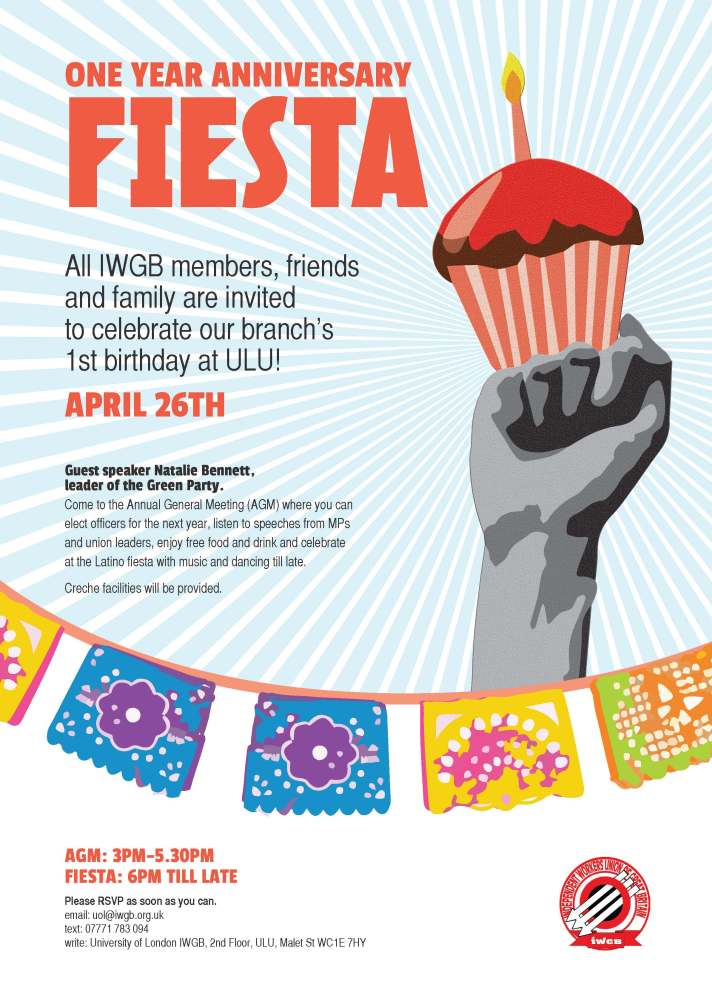
agm_posters_Page_1The University of London IWGB branch Annual General Meeting will be held this Saturday at 3pm on the 3rd floor of ULU (Malet St, London WC1E 7HY)

At the AGM there will be:

  • elections for branch officer positions for the next year
  • guest speakers including Green Party leader Natalie Bennett
  • free food and drink
  • a Latino fiesta with music and dancing till late.

If you could get in touch to confirm your attendance that would be great – call 07771783094, or email uol@iwgb.org.uk.

We will also be electing our national officers, and nominations for General Secretary, President, Vice-President, and Treasurer will be accepted up to and including the day of the AGM.

If you wish to nominate or be nominated for any of the positions, please just email uol@iwgb.org.uk for more details.

See you there!


Officer post nominations are in — April 9, 2014

Officer post nominations are in

voteThe nomination period for officer posts for the University of London IWGB branch has now closed.

The following nominations have now been received:

  • Chair: Henry Chango Lopez
  • Vice-Chair: Sonia Chura
  • Secretary: Catherine Morrissey
  • Treasurer (Position 1): Yvette Bailey
  • Treasurer (Position 2): Alison Hunter
  • Education Officer: Helle Abelvik-Lawson
  • Recruitment Officer: Hannah Thompson

Although there are no contested positions, the prospective officers still need to be approved by the branch.

There will be a secret ballot at the AGM on the 26 April, where everyone will get a ballot paper and a chance to vote YES or NO for each of the candidates.

If you cannot attend the AGM, please ask your rep, or email uol@iwgb.org.uk, or call 07783719479, and you can collect a ballot paper, complete it, and return it. It will then be opened with the others at the AGM.

Hope that makes sense! Get in touch as well if you have any other questions…

Fiesta y reunion anual general (AGM), sábado 26 de abril — April 2, 2014

Fiesta y reunion anual general (AGM), sábado 26 de abril

agm_posters_Page_2Todos los miembros del IWGB, sus amigos, y familias estan invitados a celebrar el primer aniversario de nuestra rama en ULU (Malet St, London WC1E 7HY)!

Invitada especial Natalie Bennett, el líder del partido verde.

Vengan a la reunion anual general (AGM) del sindicato donde pueden elegir los oficiales para el proximo ano, escuchar discursos de miembros del parlamento y líderes sindicales, disfrutar comida y bebida gratis y celebrar en la fiesta con musica y baile hasta tarde.
Habre guardería para los ninos.

AGM: 3PM-5.30PM
FIESTA: 6PM TILL LATE

AGM and Fiesta – Saturday 26 April 2014 —

AGM and Fiesta – Saturday 26 April 2014

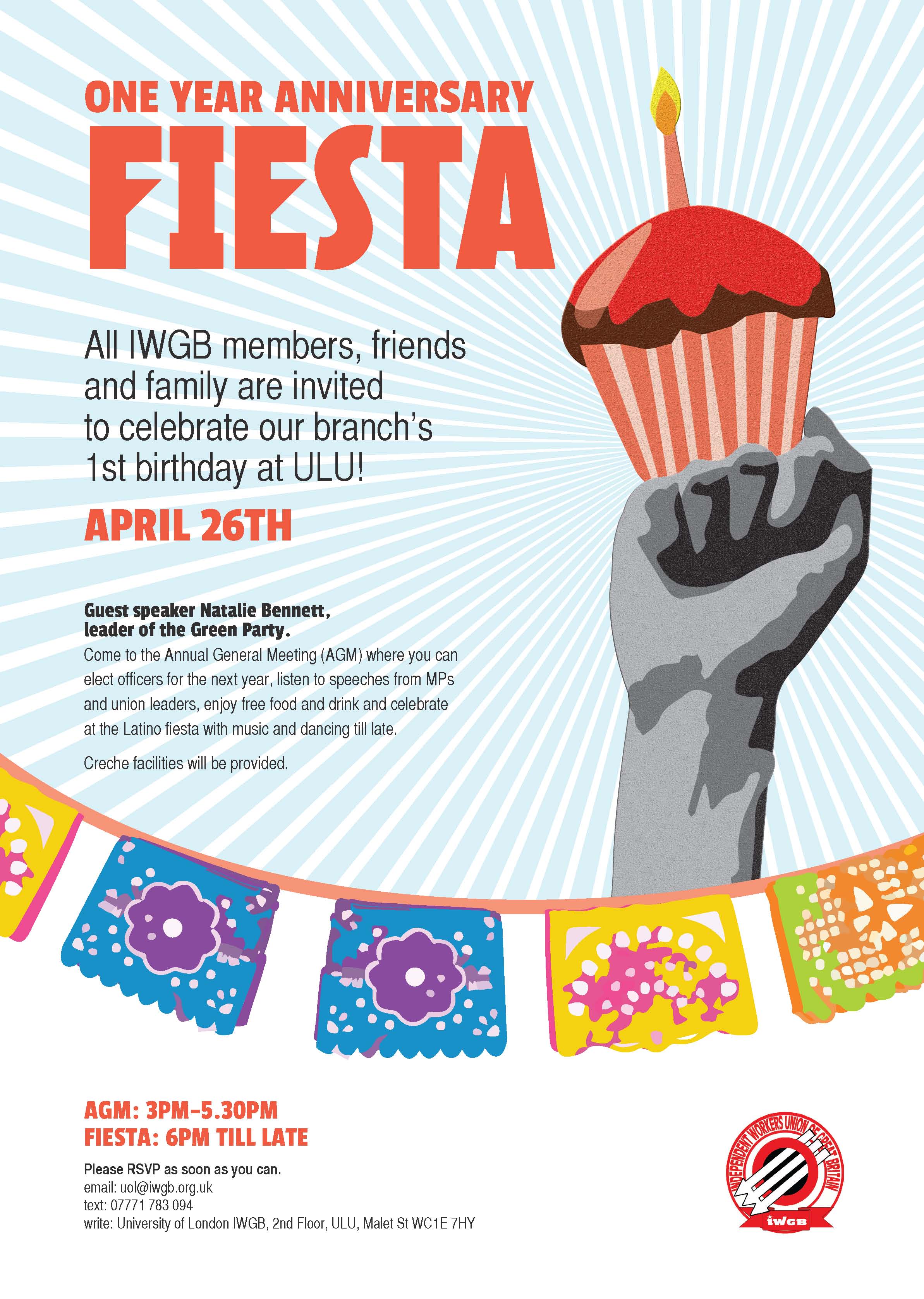
agm_posters_Page_1All IWGB members, friends and family are invited to celebrate our branch’s 1st birthday at ULU on Saturday 26 April!

Come to the Annual General Meeting (AGM) where you can elect officers for the next year, listen to speeches from MPs and union leaders, enjoy free food and drink and celebrate at the Latino fiesta with music and dancing till late.

All members will receive invitations soon.

Creche facilities will be provided.

AGM: 3PM-5.30PM
FIESTA: 6PM TILL LATE

Summer volunteer position at the IWGB — April 1, 2014

Summer volunteer position at the IWGB

volunteerThe IWGB  is  looking for an enthusiastic person who is committed to improving working conditions at the University of London to fill our volunteer position for 2-3 days a week for the summer from 15th of May – 31st of July.

Ideally you will have

  • been an active member of a union or have knowledge of the trade union movement
  • previous exposure to case work would be desirable
  • some knowledge of employment law
  • knowledge of MS Office
  • we have a large Latin American membership so Spanish would be a plus!
  • any graphic design knowledge will be a bonus and we ask that you bring your own laptop

Hopefully the successful applicant will get a lot out of this role – both in terms of helping work with a grassroots, campaigning union and in the skills, confidence and contacts we’d hope to help you develop.

See here for full details and how to apply.

Letter re future of Garden Halls from Daniel Cooper, ULU Vice-President — March 27, 2014

Letter re future of Garden Halls from Daniel Cooper, ULU Vice-President

cooperDear University of London,

As Vice President of the University of London Union (ULU), I am writing to you to express our concerns about future job losses owing to this summer’s upcoming refurbishment at the Garden Halls of residence.

Since the refurbishments were announced in 2013, workers at the Garden Halls have been living in a state of uncertainty about their futures. This uncertainty has been compounded by the fact that the University of London has refused to enter into negotiations with the trade union which represents the vast majority of Garden Halls staff, the Independent Workers of Great Britain (IWGB).

Since then, we have seen five days of industrial action across two periods (in November 2013 and January 2014), in which workers’ grievances over the Garden Halls jobs figured centrally. We stress that these strikes where wholly avoidable, and happened due to the University’s continuing failure to get around the negotiating table. In so far as any of our members experienced disruption, it is understood by students that it is solely due to the intransigence of the University and of Cofely GDF-Suez.

The workers have made two reasonable demands, which we ask you to consider and respond to. Firstly, that Garden Halls workers be re-allocated within the University of London as vacancies arise; secondly, that this is operated on the basis of a seniority system.

We see no reason why uncertainty should continue any longer, nor why the University does not negotiate with the IWGB – the only trade union in the Garden Halls which a genuine claim to represent the staff there.

ULU will continue to speak to Garden Halls students about the situation and we would appreciate an update and clarification from the University of London.

Regards,

Daniel Cooper

Vice President of the University of London Union (ULU)

Response to Cofely letter to IWGB members on recognition —

Response to Cofely letter to IWGB members on recognition

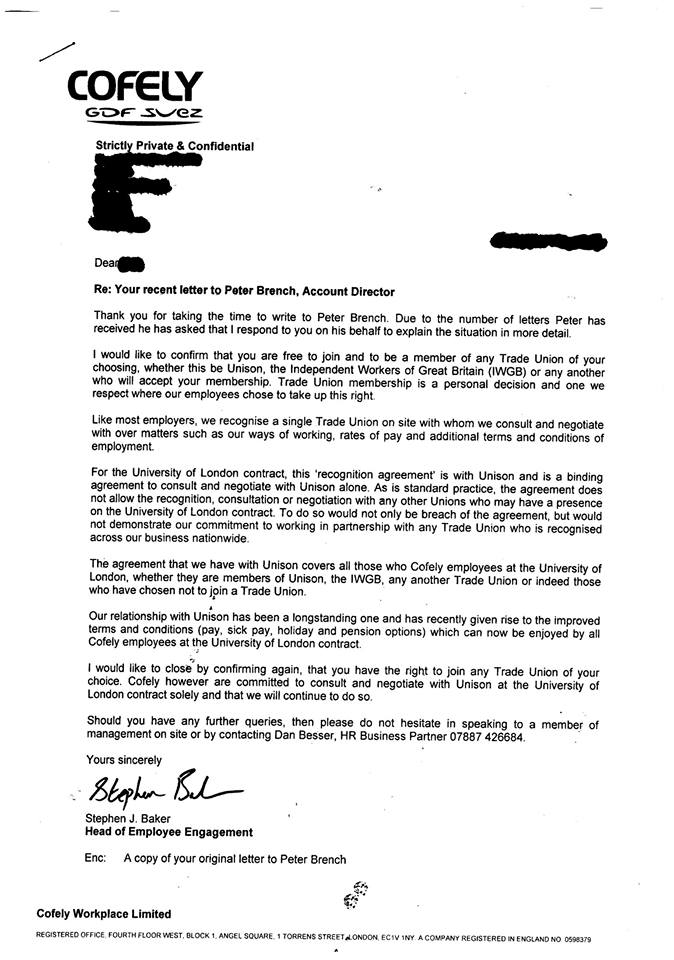
downloadDear Mr. Baker,

You have recently responded to letters written by your employees requesting that Cofely recognise the Independent Workers’ Union of Great Britain (IWGB) on the University of London contract (https://iwgb-universityoflondon.org/wp-content/uploads/2014/03/letter.jpg).  The IWGB represents the majority of workers on the University of London contract.  In your letter you explain why Cofely will continue to recognise UNISON, the main reason being that the current recognition supposedly does not allow you to recognise or engage with any other union.  Having read your letter a couple times, I can’t help but wonder if you have even read the UNISON Recognition Agreement?  On the off chance you haven’t, or perhaps if you have gotten it confused with a different recognition agreement, you can read it here: https://docs.google.com/file/d/0B5bXblPVqizeUy1lVjkyWTdUZjQ/edit.

In the fourth paragraph of your letter you say that this Recognition Agreement is “binding” and that it doesn’t allow “recognition, consultation or negotiation with any other Unions who may have a presence on the University of London contract.”  Unfortunately you are wrong on both accounts.  I would draw your attention to section 4.1 of the Recognition Agreement which says: “The Company and the Union accept that the terms of this agreement are binding in honour upon them but do not constitute a legally enforceable agreement.”  In the currently legalistic world of industrial relations, “binding in honour” is about as uncommitted as an agreement can be, perhaps one step up from a “pinky-swear”.  Indeed when we all used to be in UNISON and attempted to try and use that Recognition Agreement for the benefit of workers, facilities time or other requests were often denied because it was a voluntary recognition agreement or there were other considerations.  In other words: it wasn’t legally binding.

In terms of the claim that you cannot engage with another union, the Recognition Agreement does not mention- anywhere- other unions.  This claim simply is not true.  However it is quite telling of your industrial strategy: to hide behind the UNISON Recognition Agreement in order to provide an excuse to the public and workers for why you don’t recognise the union that clearly has the membership, support, and trust of the majority of the workforce.  The fact that UNISON is willing (even eager?) to provide this cover for you says quite a bit about where this union’s priorities lie.  Your company has already made clear to us- in those negotiations you are supposedly not allowed to have- the real reason for not wanting to recognise the IWGB: you don’t like that our union engages in formal procedures such as grievances, employment tribunals, and strikes, and that we cite employment law in our emails.  I realise that based on your experience with UNISON at Senate House you may have formed the impression that unions exist in order to rubber-stamp management plans or to collude with management on how to undermine workers’ campaigns (for more on this read the recent Guardian article which tells how UNISON suggested to University of London management that offering one additional day’s leave might be enough to undermine the 3 Cosas Campaign: http://www.theguardian.com/education/2014/mar/24/cost-private-contracts-universities-documents-services-workers).  However, in the IWGB we believe that unions are there to defend the rights of members and to actively campaign on improving wages, terms, and conditions.

In the sixth paragraph of your letter you say that the relationship with UNISON is long-standing and attribute to this relationship the recent improvement in workers’ sick pay, holiday, and pension entitlements.  Putting aside for the moment the fact that the Recognition Agreement is less than three years old, it is interesting to note that you have taken a page out of UNISON’s strategy book with regard to re-writing history.  I hate to be the bearer of bad news, but that tactic has been tried and tested and it hasn’t worked yet.  Indeed, the letter from BBW after the strike in November, 2013, which attributed the victory on terms and conditions to UNISON, played a large part in motivating workers to strike again at the end of January, this time for three days.  The main reason for that strike was union recognition, the need for which was driven home by the constant and blatant collaboration between the company and the currently recognised union.  It is also worth pointing out that the people you are writing to all used to be members of UNISON.  Their 3 Cosas Campaign was unsupported by UNISON.  Their votes were cancelled by UNISON.  They decided to leave UNISON.  They have participated in IWGB protests, strikes, and/or campaign meetings.  Improved terms and conditions were announced on the second day of their IWGB strike action.  And the current UNISON workplace rep is their boss’s boss, who they never voted for.  So they might not be the easiest people to convince that the company’s partnership with UNISON is what gave rise to their improved conditions.

In closing, it is perhaps worth drawing your attention to section 11.1 of the Recognition Agreement which states: “It is agreed that there will be an annual review of this agreement by both parties to ensure it remains relevant and effective.”  Of course, this agreement has been quite effective from the perspective of both Cofely management and UNISON.  It helps Cofely management avoid engagement with their own workforce and the corresponding reps.  And it allows UNISON to claim one of the biggest victories for outsourced workers in the higher education sector in recent years.  However, given that the majority of the workforce is in the IWGB, nearly all of the IWGB members have chosen to leave UNISON, there are only a handful of UNISON members left and these are dominated by supervisors and managers, the UNISON workplace rep is the Cleaning Services Manager, and the recent revelation that UNISON was colluding with UoL management to undermine the 3 Cosas Campaign, I must say that from the perspective of the workers, it is difficult to imagine an agreement that could be less “relevant and effective”.

The final clause of the Recognition Agreement states: “This is a joint Recognition Agreement.  Either The Company or the Union may terminate this agreement by giving no less than six months’ notice in writing to the other party.”  I’m not sure how much longer UNISON and Cofely will continue to repeat the same tactics and lies, but at some point I am sure you will come to see how counter-productive they are.  In the mean time our members and your workforce will continue to campaign until you recognise the union which actually represents them.

Kind regards,

Jason Moyer-Lee