Email from Kim Frost regarding ICE arrangements — January 27, 2016

Email from Kim Frost regarding ICE arrangements

We hope you’ve seen the email below from Kim Frost, which has confirmed that the University have finally given up their court battle against us!
We’ll obviously be checking the small print to make sure they haven’t tried to trick us again and control this process more than they should. But on the whole this is good news – it now means that we are going to get to choose our negotiating reps for the first part of the process of setting up the new forum.
We’ve been fighting hard for this in order to ensure all staff are properly represented, and to force the University to consult as widely as possible on vital issues and decisions affecting all staff.

Now we need your help!

Please could you take five minutes to:

  1. Let us know if you think what Kim is proposing is fair (e.g. two grade 6s and three grade 7s). Is there a better way of setting ‘constituencies’?
  2. Let us know if you would be up for standing for one of these positions – we need to have as many IWGB candidates as possible!
  3. Let us know if you can help out by campaigning and speaking to people once the process begins.

Any questions, let us know, and thanks as ever for your support!

Here is the email (our favourite bit is in italics):

Informing and Consulting our Staff

You may remember that around this time last year the University held a vote to ask employees to agree the appointment of employees nominated by our recognised trade unions to represent all staff in negotiating with the University over arrangements for consulting and informing staff under the Information and Consultation of Employees Regulations 2004. These regulations give employees the right, for example, to be informed about their employer’s economic situation and to be informed and consulted about issues which might affect job security.

Our current arrangements to carry out information and consultation are contained in our agreements with our recognised trade unions, UCU and Unison. However as these agreements do not extend to the relatively small number of staff in Level 10, they do not cover the whole of the University’s workforce. This meant that when, in November 2014, the University received a request from over 10% of our employees to establish information and consultation arrangements specifically under the Regulations, the University was required, notwithstanding its established arrangements with the recognised trade unions, to make arrangements for employees to appoint or elect negotiating representatives with a view to agreeing how the University would inform and consult its workforce specifically under the Regulations.

Consequently we asked staff to vote in a ballot in February 2015 on whether they wished those employees nominated by the recognised trade unions to act as their negotiating representatives for these purposes. A majority of those voting approved their appointment.

However, a member of staff made a successful complaint to the Central Arbitration Committee (CAC) that the process we followed did not satisfy the requirements of the Regulations. This decision was upheld on 15 January by the Employment Appeal Tribunal (EAT).

I would wish to make clear that the University’s understanding, supported by external legal advice, was that the process we followed in February 2015 did meet the requirements of the Regulations. However, there was no previous case law on this aspect of the Regulations to guide our understanding. The CAC and EAT decisions have clarified these legal requirements.

Starting the Process

In light of these decisions, the University intends to start a new process through which staff will elect their negotiating representatives. These representatives will then seek to agree, with the University, the procedure under which the University will informing and consult its employees under the Regulations. This notification is therefore given for the purposes of the Information and Consultation of Employees Regulations 2004, and is issued on 26 January 2016.

Appointing Representatives to agree arrangements for informing and consulting staff
For the purposes of the election, there will be two constituencies. The first constituency will comprise all staff in Levels 1 to 6. The second constituency comprises all staff in Levels 7 and above.

Staff in Levels 1-6 will be asked to elect two representatives. Staff in Levels 7 and above will be asked to elect three representatives. The two negotiating representatives elected from the Level 1-6 constituency will represent all Level 1-6 staff. The three negotiating representatives elected from the Level 7 and above constituency will represent all staff in Level 7 and above.

Using these two constituencies will in our view ensure that each group is adequately represented in the negotiations. The number of representatives to be elected by each constituency also reflects the relative numbers of staff in each group.

Any member of staff may stand as a candidate for election to represent employees in their constituency as a negotiating representative. Candidates employed in Levels 1-6 will therefore be standing for election to represent all Level 1-6 staff. Candidates employed in Level 7 and above will be standing for election to represent all staff in Levels 7 and above.

We will be inviting staff who wish to stand for election to notify us of that by a specified deadline.

A ballot will then be held over a two week period and will be run by the Electoral Reform Society.

What will the Negotiating Representatives be asked to do?

The elected negotiating representatives will be asked to negotiate an agreement (covering all staff) with the University which will set out the issues on which the University will inform and consult its employees and how this information and consultation will be carried out.
If an agreement can be reached with all negotiating representatives, that will be the procedure which will apply going forward.

If agreement can only be reached with a majority of the negotiating representatives, the University would conduct a further ballot in which staff would be asked to vote on whether or not to adopt the agreement reached with the majority of the negotiating representatives.

Do the Representatives have a wider continuing role?

No. Their only role at this stage is to represent employees in their constituency in negotiations with the University on the content of an information and consultation agreement. Their role as negotiating representatives ceases once agreement is reached or if negotiations are unsuccessful.

Following the conclusion of these negotiations, information and consultation representatives will need to be elected or appointed and it is these representatives who would represent you going forward, receiving information from, and being consulted by, the University on your behalf. How these representatives would be elected or appointed, and their term of office, is something that will be decided in the negotiations with the negotiating representatives.

What topics are covered by Information and Consultation?

It is for the University and the negotiating representatives to agree how the University will inform and consult its staff and on what topics. However, these information and consultation arrangements typically cover issues such as the University’s activities and economic situation, the structure and development of employment within the University, as well as decisions likely to lead to substantial changes in work organisation such as large scale redundancies (unless these are being consulted on under separate legal consultation obligations).

Does this cover Negotiation with the University on Pay and Conditions?

No. The Regulations only cover information and consultation, rather than negotiation. They do not cover negotiation on pay and conditions. These will remain covered by national and local agreements with our recognised trade unions UCU and Unison.

What Is the Timescale?

By the end of January we will issue an invitation to staff to nominate themselves as candidates for election as negotiating representatives for their constituency. We expect to hold the election in March.
K B FROST

Victory! University of London appeal thrown out by the EAT! — January 19, 2016

Victory! University of London appeal thrown out by the EAT!

We’re delighted to announce that last Friday the University of London lost its case against us at the Employment Appeal Tribunal (see more details and background here)

This means that they have to re-run the process whereby staff get to choose the people who will represent them in negotiations with management about what the future information and consultation of employees (us!) will consist of.

This is also a massive victory for the IWGB, who were represented by two lawyers, in contrast to the UoL’s £10k per day QC!

As soon as we know more details of how the re-run process will work we’ll be in touch, but in the meantime do let us know if you have any questions – uol@iwgb.org.uk.


UoL v IWGB employment appeal tribunal next week! — January 6, 2016

UoL v IWGB employment appeal tribunal next week!

Next Friday, 15 January, IWGB meets UoL in court (again!) to argue that UoL broke the law last year when it set up an employee consultation forum featuring only members of the UNISON and UCU committees.

With bags of students’ money to burn, UoL management has decided to appeal to the EAT (Employment Appeal Tribunal) against the resounding victory IWGB won on this case at the Central Arbitration Committee hearing last summer. By re-engaging their previous QC David Reade, UoL looks set to bring the total spend on this pointless action up to at least £20,000. It seems there’s no expense spared when it comes to avoiding meaningful engagement with staff!

Following the appalling stitch-up between UoL and its favourite unions over London Weighting, IWGB used the Information and Consultation of Employees Regulations (ICE) to force UoL to set up a forum to consult directly with staff – but UoL attempted to circumvent the law by designing the forum in such a way that it would simply be tacked on to their existing (and exclusive) recognition agreement with the dynamic duo.

IWGB Secretary Catherine Morrissey is the named party in the case and will be attending the Tribunal supported by IWGB President Dr Jason Moyer-Lee, ably represented by a QC and counsel from Cloisters Chambers. The hearing is open to the public so all IWGB members (and indeed any UoL staff) are very welcome!

We’ll keep you posted about any developments on the day and of course when we hear the outcome.

EAT hearing details:

Friday 15 January

10.30-16.30

Fleetbank House, Office Of Fair Trading, 2-6 Salisbury Square, London EC4Y 8JX

BREAKING NEWS – CAC rejects University of London call for delay in rep nominations — October 7, 2015

BREAKING NEWS – CAC rejects University of London call for delay in rep nominations

Morrissey vs Frost (not sure Hoffman was the right casting, but there you go...)
Morrissey vs Frost (not sure Hoffman was the right casting, but there you go…)

Ok – admittedly this process is getting pretty tortuous for us – and we started it (!) – but there’s been another twist in Morrissey vs Frost (aka the University of London desperately and expensively seeks to deny representation to its own employees for reasons no one can quite fathom)…

We received notification on Friday that the University’s request to have the date for appointing new reps via a fair process had been REFUSED by the Central Arbitration Committee!

This means that by law the appointment deadline is still 30 November – so pretty soon!

As ever, in the interest of full disclosure, you can read more – see the letter itself here, and the indefatigable Ms Morrissey’s latest missive to Kim Frost here.

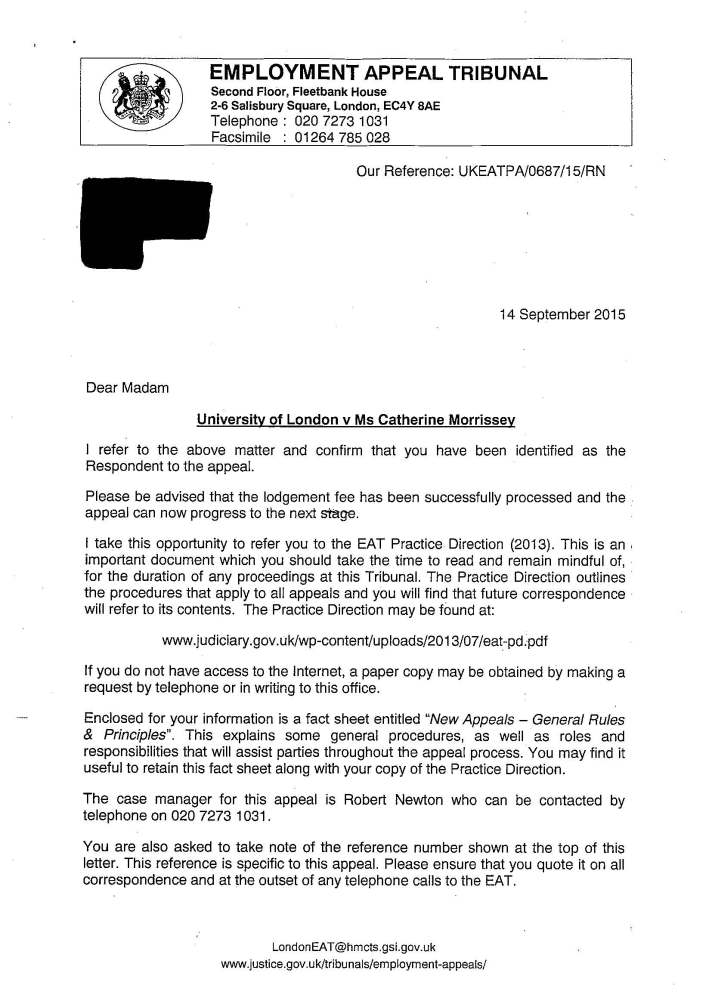
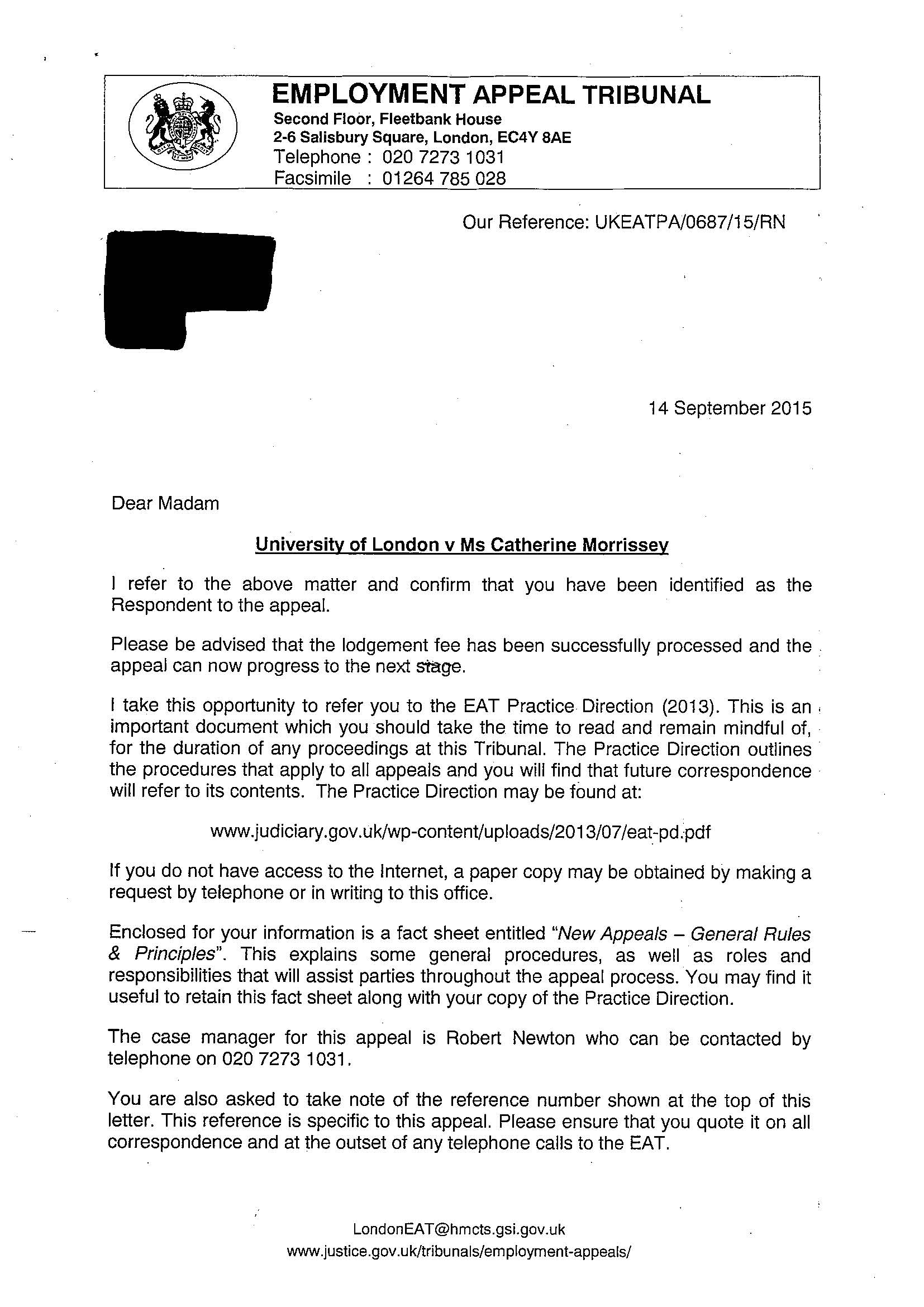
BREAKING NEWS! University of London to appeal CAC decision! — September 16, 2015

BREAKING NEWS! University of London to appeal CAC decision!

We recently wrote to Kim Frost asking him for an update on the University’s arrangements, as mandated by the CAC:

to arrange for the process of election or appointment of negotiating representatives, in accordance with regulation 14, to take place by 30 November 2015.

He didn’t respond directly BUT this morning we got our answer – a letter confirming that the UoL will be appealing the decision, and that this appeal will now be held before an Employment Tribunal.

This will obviously necessitate further expense – bear in mind that the barrister they commissioned for the original hearing is estimated to charge 8-10K PER DAY,and that they have just had to pay an additional fee to lodge the appeal.

This seems an extraordinary waste of public money – the University does not have a strong case, and all that they have been asked to do is to set up a fair consultation process with their employees, which you would think they would welcome.

The IWGB has filed an FOI request to discover how much has already been spent on this, and will of course be contesting the appeal vigorously.

We’ll let you know when we have a date!

employmenttribunalimage_Page_1

Victory! IWGB wins case against University — August 3, 2015

Victory! IWGB wins case against University

A noted union fan shows his approval of the IWGB's latest win
A noted union fan shows his approval of the IWGB’s latest win

IWGB has learned this morning that it has won its case against the University of London in the Central Arbitration Committee (CAC). This is a fantastic result!

The case surrounded our complaint that the University had breached the Information and Consolation of Employees Regulations (ICE) when it attempted to collude with UNISON and UCU to avoid dealing directly with IWGB members and other staff. (You can read more about the background to the complaint here.)

The CAC Panel agreed. In reaching its decision, the Panel entirely rejected the University’s argument that its behaviour was not only legal but also consistent with good practice:

“It was the view of the Panel that the Employer had fallen short of good industrial relations practice both in terms of its arrangements for appointing representations [sic] and the subsequent ballot. It was an extremely short time scale from the announcement of the ballot to its closure and it lacked confidentiality as the HR Department, in monitoring that there was no repeat voting, had access to how an individual employee voted.

[…] the Panel is accordingly not persuaded that the Employer has complied with the requirements of regulation 14(2). […] It was unacceptable to expect employees to vote yes or no to four candidates that resulted from the arrangements agreed between the Employer and the two recognised unions without the Employer putting in place arrangements which allowed for alternative candidates to be put forward.”

The result of this decision is that the University must scrap the ICE arrangements it made with UNISON/UCU and start again, opening up the process to all employees – as the Regulations require. The deadline for this to be done is 30 November 2015.

UoL IWGB Branch Secretary Catherine Morrissey, who submitted the complaint, commented:

“We invoked the ICE Regs in November last year because we know that the cosy relationship between UNISON/UCU and University management is not working in the interests of staff. The panel’s decision today, and comments they made during the hearing, confirm that.

This is a huge victory for IWGB and for working people in general. Had the University succeeded in its arguments, the ICE Regulations would have been completely undermined. This decision shows that employers can’t simply do what suits them. We’re delighted that the panel found in our favour and will be looking to put forward IWGB candidates for election in November.”

This decision is so hot off the press it hasn’t even reached the CAC’s own website yet, so IWGB members are the first to know!

You can read the full decision here – the document describes the background to the complaint and the arguments made by both sides. The Panel’s considerations and decision are on pp.25–30.

UoL’s barrister has previously indicated that the University is likely to appeal. If it does, we look forward to meeting them again in an Employment Tribunal!

Hasta la victoria!

CAC case update – IWGB optimistic of victory after hearing — July 9, 2015

CAC case update – IWGB optimistic of victory after hearing

We just wanted to give you a quick update after Tuesday’s CAC hearing of our complaint against the University of London over its handling of the recent ICE request.

The hearing went extremely well, thanks to the hard work of our legal team, both of whom were very generously donating their time and expertise to the IWGB pro bono.

This stands in contrast to the University of London’s legal eagle, who will have charged an estimated £8-10k for this day’s work! He did his best with a very weak hand, using the old lawyer’s trick of ‘forgetting’ to submit his statement in advance, and dredging up an obscure case to use as precedent – though sadly it turned out this applied to a different regulation than the one under discussion…

The verdict will be delivered before the end of the month, and although the panel seemed positive there are obviously no guarantees. The University have already indicated they are likely to appeal if things go against them, which will presumably incur another £10k or so of fees for David Reade. It seems incredible that they are prepared to spend all of this time and money essentially stopping UoL staff from having a free choice as to who represents them at a negotiating meeting – money that we are always told is not there when pay rises or London Weighting is discussed…

We’ll keep you posted!

University of London hires top silk for CAC case — July 2, 2015

University of London hires top silk for CAC case

1028The formal hearing of our complaint against the University of London over its handling of the recent ICE request will take place on Tuesday 7 July at the Wesley on Euston Street.

All members are welcome to come and cheer on proceedings – just drop us a line on uol@iwgb.org.uk and we can give you more details.

The UoL is pulling out all the stops – they have engaged QC David Reade (pictured), whose resume includes acting for British Airways in their injunction case against Unite, and for British Coal against the NUM. Why the University would rather spend a fortune on this redoubtable union-basher rather than sit down and talk with IWGB representatives is beyond us, and should they lose the case a fine of up to £75k could be added to the cost of their intransigence.

Anyway, we have our own crack legal team from Cloisters Chambers, who in true David and Goliath style have taken on the case pro bono – hasta la victoria siempre!

Update! CAC case proceeds to formal hearing as UoL refuse to negotiate — June 4, 2015

Update! CAC case proceeds to formal hearing as UoL refuse to negotiate

lon350Today’s informal hearing at the CAC lasted less than two hours as the University refused to budge from its position.

Mindful of the fact that (according to Kim Frost) ‘our established Trade Unions won’t share a table with IWGB’ and that ‘if the IWGB were involved in negotiating with us in any formal sense, it would wreck our relationship with the established Trade Unions’, UoL clearly feels it has no choice but to risk a penalty notice of up to £75,000 at the EAT, which would be the result of a decision in IWGB’s favour at the formal CAC hearing.

The hearing is likely to take place in July, and as it is open to the public all employees would be welcome to attend – details of how to do that will be published as soon as we have them.

Put on the spot by the Panel Chair, Professor Lynette Harris, the University’s Director of HR had little to say about why the University had made no efforts to consult with non-UNISON/UCU members about how to conduct the ballot to elect negotiating representatives. He did, however, give this interesting piece of information: that despite a formal complaint having been lodged about the way UoL conducted that ballot, they have continued to work with the reps who were ‘appointed’ by that process and are ‘close to a conclusion’ about how the ICE forum will work! So watch the UoL intranet for a post about what great things they have in store for the future … or at least that portion of the future between now and when the CAC orders UoL to go back to the drawing board and start again!

IWGB President Jason Moyer-Lee, who attended the hearing with UoL Branch Secretary Catherine Morrissey, said, “Despite the University’s recalcitrance, I feel more confident than ever that we have a strong case. I’m also very pleased to confirm that a barrister has agreed to take the case pro-bono for the IWGB”.

We look forward to meeting Kim and Migy again in July!